Z-Tests for a Population Mean
Scope Label
Core 9758. This branch covers one-tailed and two-tailed -tests for a single population mean. It is the main procedural branch for Hypothesis Testing.
Use it with Hypothesis Testing Logic and Decision Methods for the conceptual language.
When a -Test Is Used
The core -test applies when testing a claim about one population mean and the population standard deviation is known. The observations should form a random independent sample from the population model.
The sample statistic is .
Under , the test statistic is
For observed data, use
The denominator is the standard error of the sample mean. This links directly to Sampling Distribution of the Sample Mean.
Distributional Justification
The -test is justified in two common cases:
- if the population is normal, then is exactly normal;
- if the population has finite variance and the random independent sample is sufficiently large for its shape, then is approximately normal by the central limit theorem.
In both cases, under ,
exactly or approximately.
The familiar guideline is only a rule of thumb. Strong skewness, heavy tails or influential extremes may require a larger sample; there is no universal magic cutoff.
Standard Workflow
For a -test:
- Define clearly in context.
- State and .
- Identify the tail direction.
- State or compute the test statistic.
- Use either the critical-region method or the p-value method.
- Write a contextual conclusion.
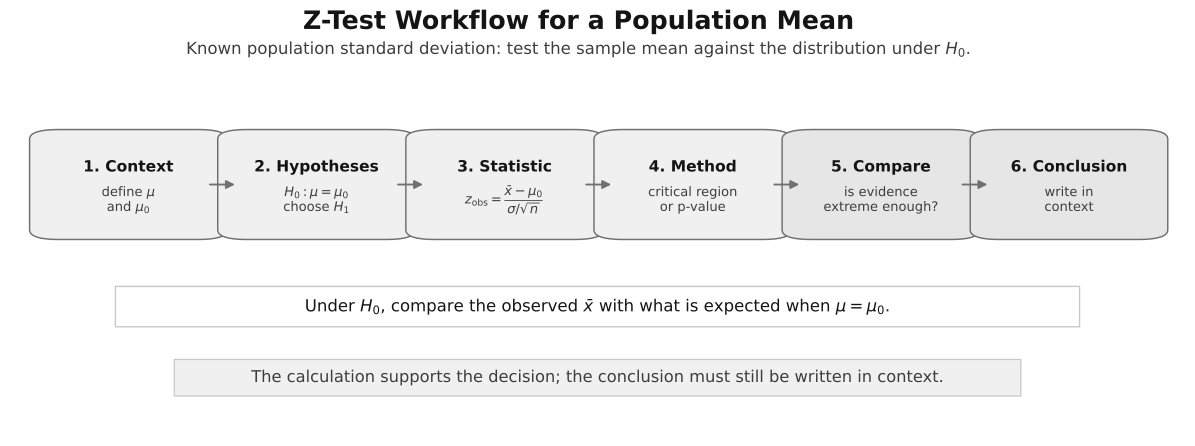 How to read this figure. First verify a random sample and known , then define and its tail. Standardise using the standard error , make one coherent decision, and conclude in context.
Two Routes to the Same Statistic
The formula for the statistic is the same in the two common justifications, but the reason it is valid is different.
| Situation | Distribution of | Comment |
|---|---|---|
| Population normal, known | exact normal | works for any |
| Population not necessarily normal, known, large | approximately normal | uses the central limit theorem |
In both cases, under ,
is standard normal exactly or approximately.
Do not use this core -test formula if the population standard deviation is not given and the question is not clearly using a large-sample approximation.
Critical-Region Method
The critical-region method compares the observed statistic with critical values.
For common -tests:
| Test | Alternative | Critical-region idea |
|---|---|---|
| Lower-tailed | reject for sufficiently negative | |
| Upper-tailed | reject for sufficiently positive | |
| Two-tailed | reject for sufficiently large $ |
The critical values come from the standard normal distribution.
p-Value Method
The p-value is computed under .
For :
- lower-tailed test: ;
- upper-tailed test: ;
- two-tailed test: , using symmetry of the standard normal distribution.
Reject if
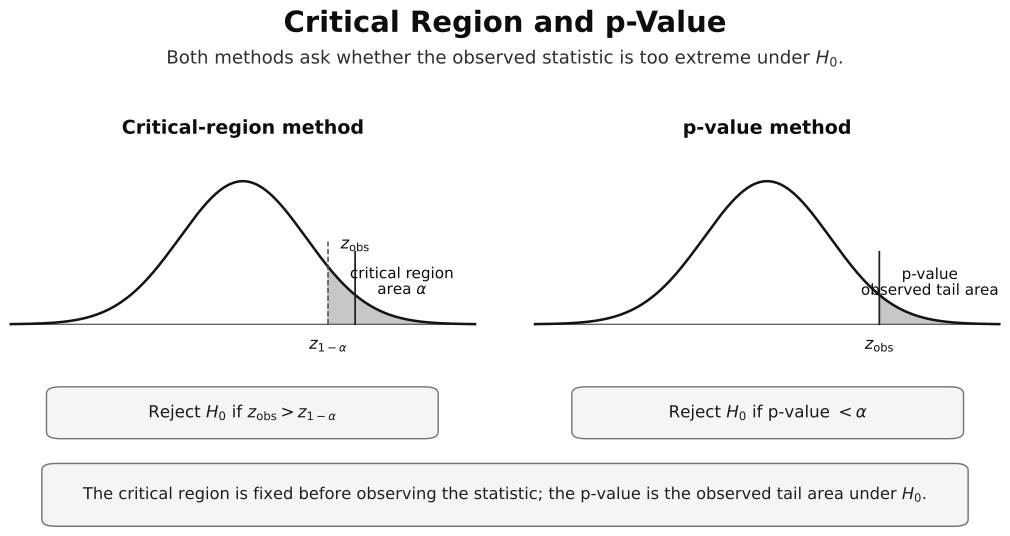 How to read this figure. Critical values and p-values are two encodings of the same tail comparison. Use the same , significance level and sampling model in either method.
Common standard-normal critical values are:
| Significance level | Lower tail | Upper tail | Two tails |
|---|---|---|---|
These are rounded critical values; use calculator precision when a boundary decision is sensitive to rounding.
Worked Example 0: Upper-Tailed Test
A random sample of readings is taken from a process with known population standard deviation . The historical mean is , while the investigator asks whether the mean has increased. The sample mean is .
and
For an upper-tailed test, and . Both methods reject . There is sufficient evidence at the level that the process mean has increased.
Worked Example 1: Lower-Tailed -Test
A manufacturer claims that the mean mass of a component is g. The population standard deviation is known to be g. A random sample of components has mean mass g.
Test at the level whether the mean mass has decreased.
Step 1: Define the parameter
Let be the true mean mass of the components.
Step 2: State the hypotheses
This is a lower-tailed test.
Step 3: Compute the statistic
Critical-region method
For a lower-tailed test, the critical value is approximately .
Since
the observed statistic lies in the critical region. Reject .
Conclusion: there is sufficient evidence at the level that the mean mass has decreased.
p-Value method
The p-value is
Since
reject .
The conclusion is the same.
Worked Example 2: Two-Tailed -Test
A machine is claimed to fill packets with mean mass g. Fill masses are assumed normally distributed, and the population standard deviation is known to be g. A random sample of packets has mean mass g.
Test at the level whether the machine is incorrectly calibrated.
Let be the true mean fill mass.
This is a two-tailed test because “incorrectly calibrated” means too low or too high.
The observed statistic is
For a two-tailed test, the critical values are approximately
Since
reject .
Conclusion: there is sufficient evidence at the level that the machine is incorrectly calibrated.
Equivalently,
which gives the same decision.
Worked Example 3: Insufficient Evidence
A company claims that a process has mean completion time minutes. The population standard deviation is minutes. A sample of jobs has mean time minutes.
Test at the level whether the mean completion time is less than minutes.
The observed statistic is
For a lower-tailed test, the critical value is approximately .
Since
the statistic is not in the critical region. Do not reject .
Conclusion: there is insufficient evidence at the level that the mean completion time is less than minutes.
Calculator Discipline
A graphing calculator can be used to:
- compute tail probabilities;
- compute p-values;
- find normal critical values.
However, the calculator does not decide:
- the correct ;
- the test direction;
- whether to use or ;
- how to write the conclusion.
Those decisions must come from the context and the sampling distribution.
When reading calculator output, identify:
- the test statistic, usually reported as ;
- the p-value;
- whether the tail choice entered into the calculator matches .
The calculator may give a number, but it does not know whether the question asks for an increase, decrease, or any change. That decision must be made before using the calculator.
Common Pitfalls
- Using instead of in the test statistic.
- Forgetting the denominator .
- Using a one-tailed critical value for a two-tailed test.
- Failing to state in context.
- Writing “accept ” when the correct conclusion is “do not reject ”.
- Reporting the decision without a contextual conclusion.
Revision Checklist
- Can you state when a -test for one mean is appropriate?
- Can you compute correctly?
- Can you choose the correct critical region from ?
- Can you calculate and interpret a p-value?
- Can you write a conclusion in context?