Hypothesis Testing Logic and Decision Methods
Scope Label
Core 9758. This branch develops the reasoning language behind one-tailed and two-tailed -tests for a single population mean.
Use it with the hub Hypothesis Testing and the procedural branch Z-Tests for a Population Mean.
A Test Measures Evidence Under
A hypothesis test starts by temporarily assuming the null hypothesis is true.
It then asks:
Under that assumption, how unusual is the sample result?
This is the reason the sampling distribution is built under . The test is not comparing two equally trusted claims. It is asking whether the sample gives enough evidence to reject the baseline claim.
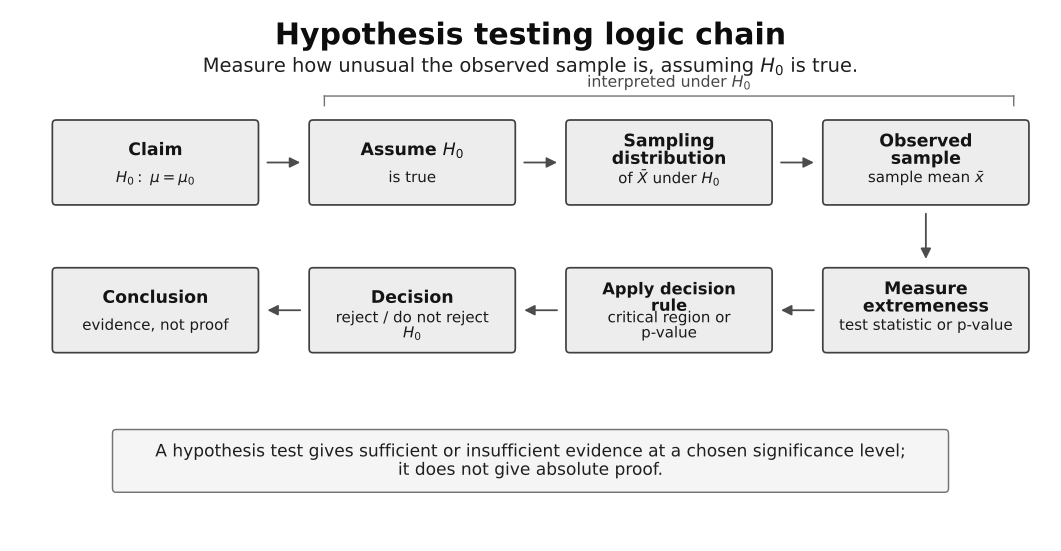 How to read this figure. The calculation is conditional on . It measures compatibility between the sample and the null model; it does not assign a probability to either hypothesis.
Statistical Hypotheses
A statistical hypothesis is a claim about a population parameter.
For a population mean, the null hypothesis is usually
The equality is essential because it fixes the reference distribution used for the test statistic.
The alternative hypothesis may be
Choose from the wording and purpose of the investigation, not from the sample mean after it is observed.
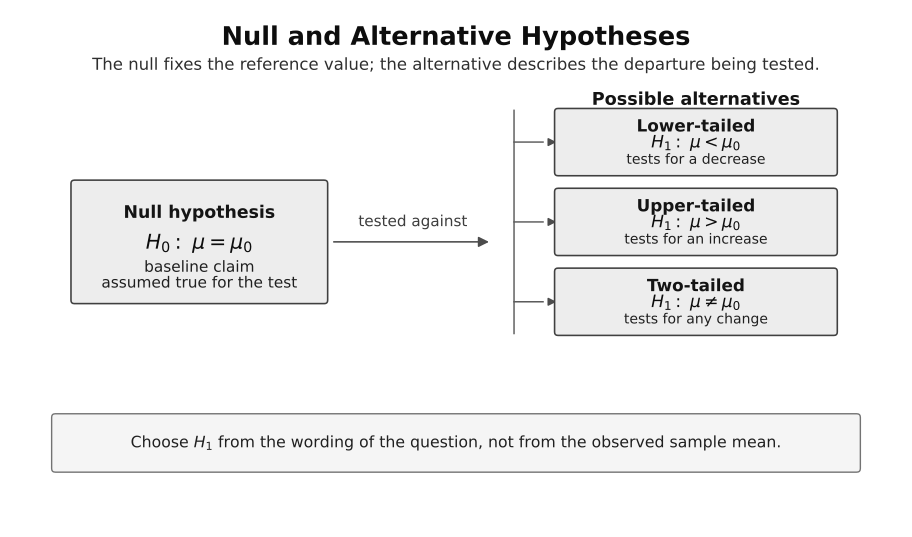 How to read this figure. The equality in fixes the reference distribution. The inequality or not-equal sign in fixes the direction in which evidence is counted.
Translating Wording into
Many testing errors happen before calculation begins.
| Wording | Meaning | Alternative |
|---|---|---|
| has increased | definite increase | |
| is greater than | definite increase | |
| has decreased | definite decrease | |
| is less than | definite decrease | |
| has changed | either direction | |
| is different | either direction | |
| is affected | either direction | |
| has overstated the mean | true mean is lower | |
| has understated the mean | true mean is higher |
For example, “the machine is not correctly calibrated” usually means the mean may be too high or too low, so the test is two-tailed.
When a verbal null claim is composite, such as “the mean is at least ”, a lower-tailed test uses the boundary value
The equality supplies the boundary distribution; it does not redefine “at least” as “equal”. Values of make an unusually small sample mean no easier to obtain, so calibration at controls the null-side error at the boundary.
Tail Direction
The form of determines where the rejection region lies.
Lower-tailed test
If
then unusually small test-statistic values support .
Upper-tailed test
If
then unusually large test-statistic values support .
Two-tailed test
If
then unusually extreme values in either direction support .
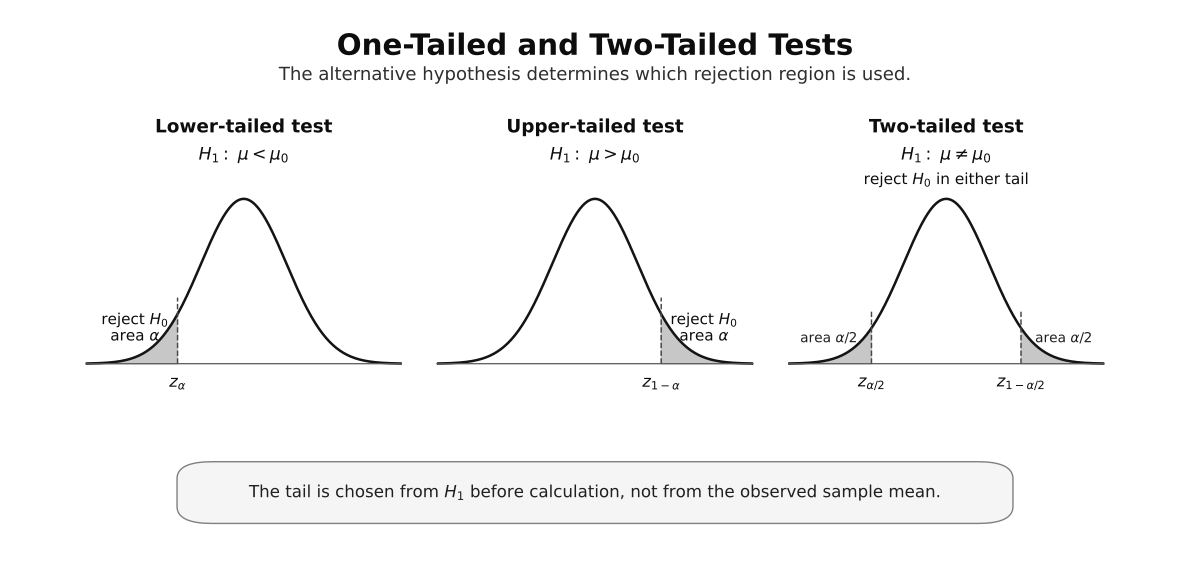 How to read this figure. All of lies in one tail for a directional claim; for a two-sided claim it is split equally across both tails.
Significance Level
The significance level is the chosen threshold for rejecting .
It controls how extreme a result must be before it counts as sufficient evidence against .
Typical levels are:
A smaller significance level demands stronger evidence before rejecting .
There is a more precise interpretation: is the probability of rejecting when is actually true. In words, it is the allowed risk of a false rejection.
So a significance level means:
This does not mean there is a probability that is true. The probability is calculated under the assumption that is true.
Critical-Region Method
The critical region is the set of test-statistic values that lead to rejection of .
The critical-region method is:
- decide the test direction from ;
- use to find the critical value or values;
- compute the observed test statistic;
- reject if the statistic lies in the critical region.
For a -test:
- an upper-tailed test uses the right tail;
- a lower-tailed test uses the left tail;
- a two-tailed test uses in each tail.
p-Value Method
The p-value is the probability, assuming is true, of obtaining a result at least as extreme as the observed result.
Decision rule:
A small p-value means the observed result would be unusual if were true. It does not mean that the p-value is the probability that is true.
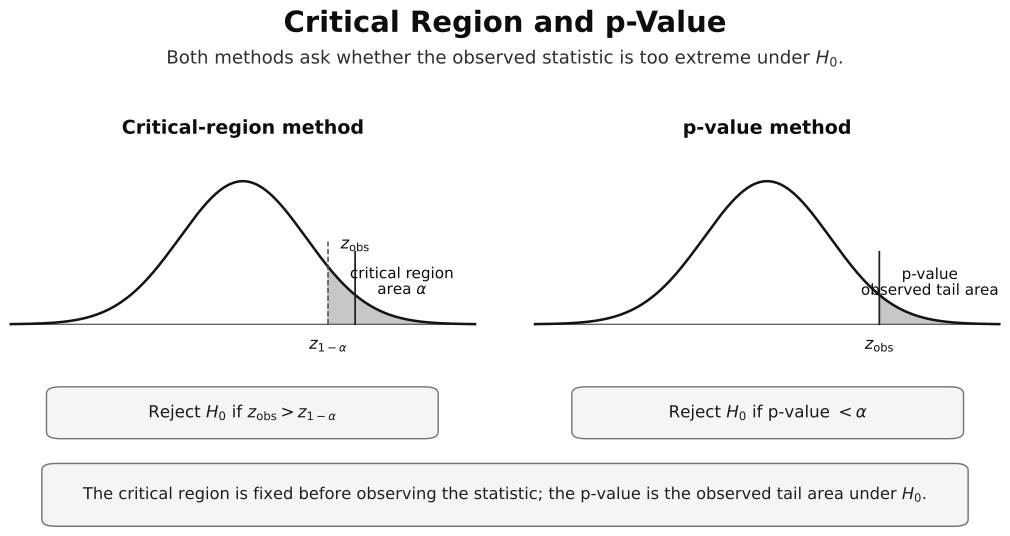 How to read this figure. The critical boundary is fixed by before the sample is interpreted. The p-value boundary is fixed by the observed statistic. Rejection occurs when the observed tail area is no larger than the allowed null-tail area.
Critical Region Versus p-Value
The two methods are equivalent when used correctly.
| Method | Question asked | Decision |
|---|---|---|
| Critical region | Did the statistic enter the rejection region? | Reject if yes |
| p-value | Is the observed result at least as extreme as allows? | Reject if p-value |
For and observed value ,
The last formula uses symmetry of the standard normal distribution.
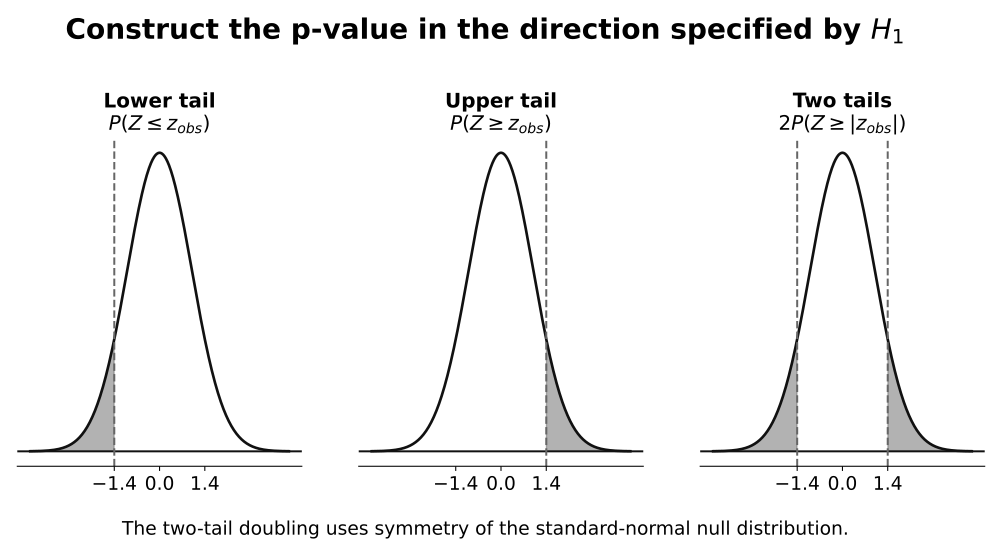
How to read this figure. Shade results at least as extreme as the observation in the direction specified by . A two-tailed standard-normal p-value includes the matching area in the opposite tail, so one tail is doubled.
Use whichever method the question asks for. If no method is specified, either is acceptable if the working is clear.
Mini-Examples: Wording Before Calculation
Overstated mean
Suppose a school claims that the mean score is at least , and the question asks whether the school has overstated the mean.
The suspected direction is lower than the claim, so write
Correctly calibrated
Suppose a machine is claimed to fill bottles with mean volume ml, and the question asks whether the machine is correctly calibrated.
Too low and too high both matter, so write
Do not change this to an upper-tailed test just because the observed sample mean happens to be above .
Writing Conclusions
A testing conclusion must be cautious and contextual.
If is rejected:
There is sufficient evidence at the level that …
If is not rejected:
There is insufficient evidence at the level that …
Avoid saying:
- “ is true”;
- “ is accepted”;
- “the alternative has been proved”.
A hypothesis test makes a decision at a chosen level of evidence. It does not deliver absolute proof.
Common Pitfalls
- Choosing the tail direction from the observed sample mean instead of the question wording.
- Forgetting that must contain equality.
- Splitting across two tails in a one-tailed test.
- Failing to split across two tails in a two-tailed test.
- Treating the p-value as the probability that is true.
- Writing a conclusion without context.
Revision Checklist
- Can you explain why the test statistic is considered under ?
- Can you translate wording into ?
- Can you decide whether a test is lower-tailed, upper-tailed, or two-tailed?
- Can you use both critical-region and p-value methods?
- Can you write a proper conclusion without overclaiming?