Sampling Distribution of the Sample Mean
Scope Label
Core 9758. This branch develops the distribution of the sample mean , including exact normal cases, the central limit theorem, and standardising with the standard error.
Use it with the hub Sampling and Estimation and the normal-distribution topic Special Continuous Random Variables.
From One Sample Mean to a Sampling Distribution
One observed sample gives one value of .
Before the sample is taken, however, many possible random samples could occur. Each sample may give a different sample mean. Therefore the sample mean has its own distribution.
The notation is:
- is one randomly chosen value from the population;
- is the random variable representing the mean of a random sample;
- is one observed value of after sampling.
This distinction is essential. A question about is about one item. A question about is about an average of items.
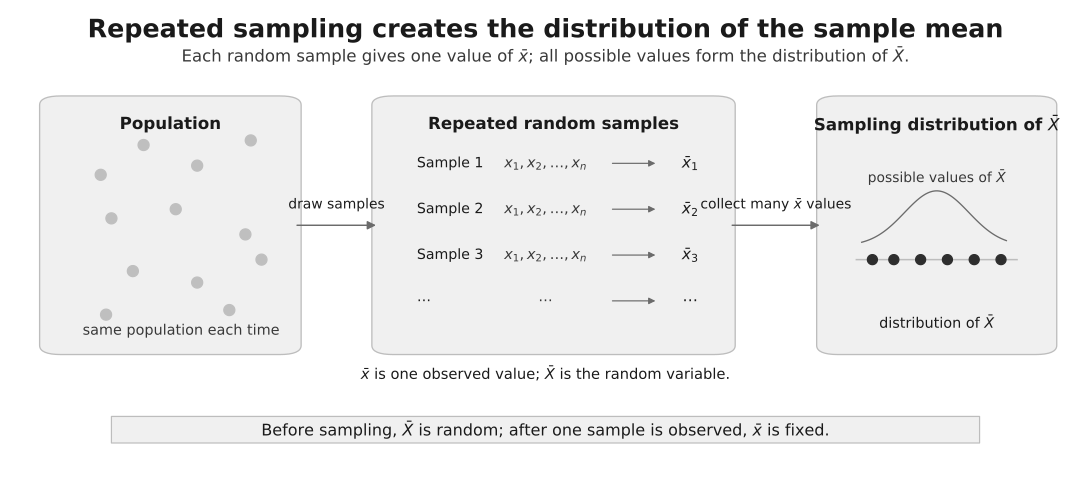 How to read this figure. Each iid random sample produces one realised mean . Their distribution is the sampling distribution of ; its shape is not automatically Normal.
Mean and Variance of
The standard H2 formulas below assume is a positive integer and the observations are independent and identically distributed with finite mean and variance. A survey design containing some randomisation is not automatically this iid probability model.
Enrichment context. For finite sampling without replacement, the exact variance can need a finite-population adjustment when the sampling fraction is not negligible. Core questions using the formula below normally signal the iid model, so do not add an extra correction unless explicitly required.
For a random sample of size from a population with mean and variance ,
and
Hence
This standard deviation is called the standard error of the sample mean.
Interpret the two results separately:
- says the sample mean is centred correctly;
- says sample means become less variable as increases.
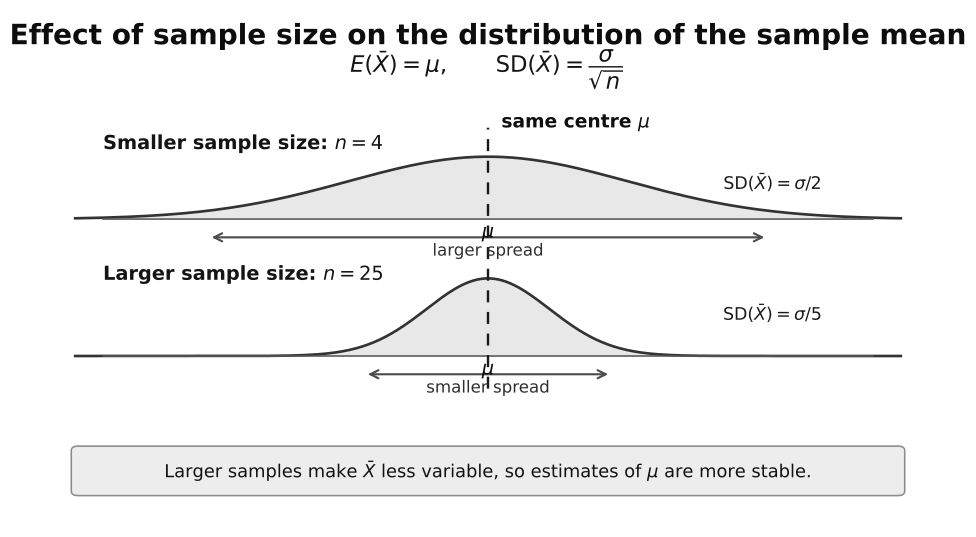 How to read this figure. For the displayed Normal-population case, remains exactly Normal, centred at , while its standard error shrinks as . The population spread of individual values remains .
Distribution of : The Exact Normal Case
If the population itself is normal, then the sample mean is exactly normal.
If
then for a random sample of size ,
This is exact for any sample size .
For example, if
and , then
The variance of is , so the standard deviation of is .
Distribution of : The Central Limit Theorem
If the population is not necessarily normal, the sample mean may still be approximately normal when the sample size is large.
If iid observations come from a population with finite mean and finite variance , then for large ,
This is the central limit theorem.
In H2 work, a common rule of thumb is
This is not a theorem guarantee or a sharp cutoff. Strong skewness or heavy tails may require a larger sample.
The important distinction is:
- itself may be skewed, discrete, or non-normal;
- may still be approximately normal when is large.
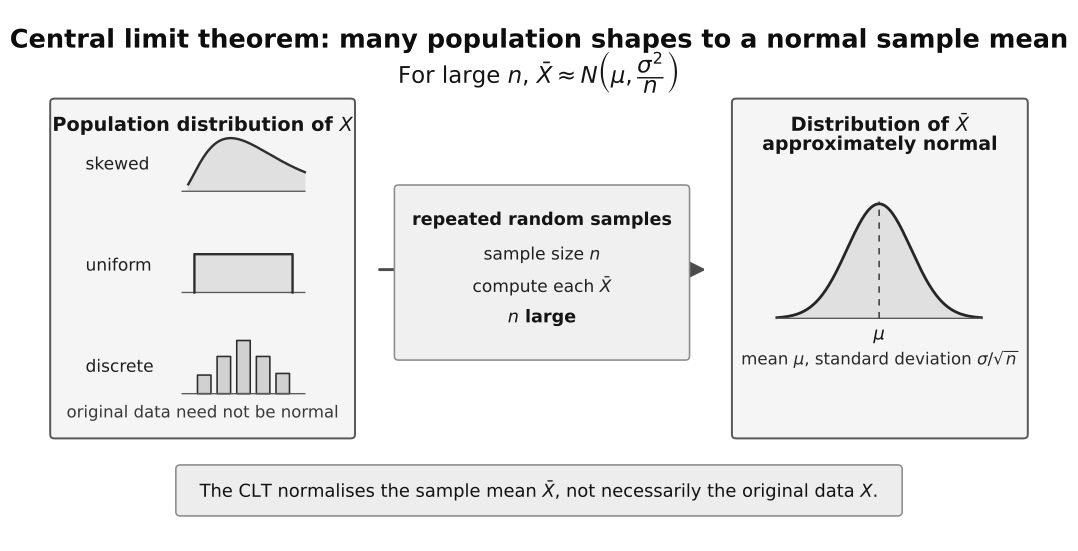 How to read this figure. The original population need not become Normal. Under iid finite-variance sampling, the sampling distribution of becomes approximately Normal for sufficiently large .
Choosing the Distribution of
Use this decision process:
- Is the population normal?
- If yes, use the exact result .
- If no, is large enough?
- If yes, use the approximation .
- If no, the usual normal model for is not justified from the given information.
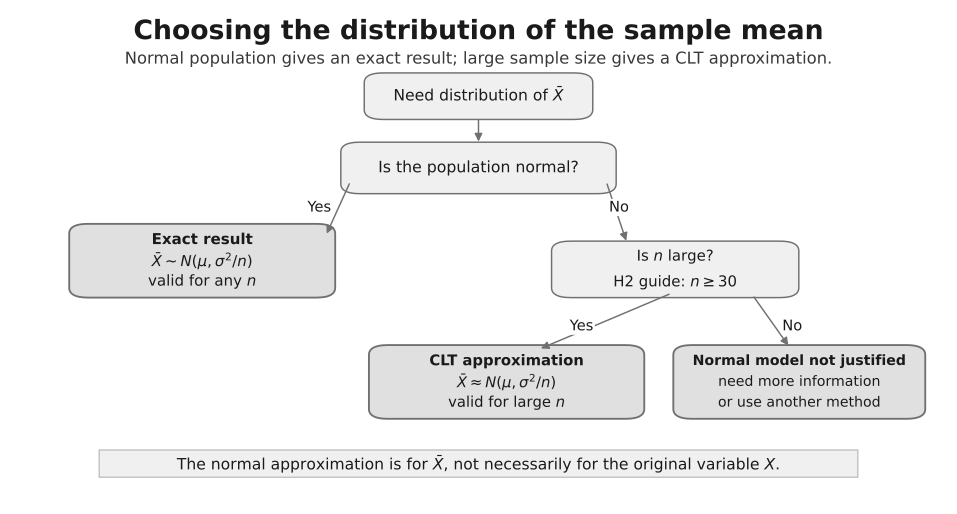 How to read this figure. A Normal population gives an exact result for any positive . Otherwise a large-sample CLT result is approximate, and the adequacy of the guide depends on population shape and tails.
Standardising
Once the distribution of is known or approximated, probability statements can be standardised.
For one observation,
For a sample mean,
The denominator is the standard error, not the population standard deviation. This is the most common procedural error in this branch.
For example, if the population standard deviation is and , then an individual observation has standard deviation , whereas the sample mean has standard error
The standard error describes the sample-to-sample fluctuation of . It is not the spread of individual observations and it is not a measurement mistake.
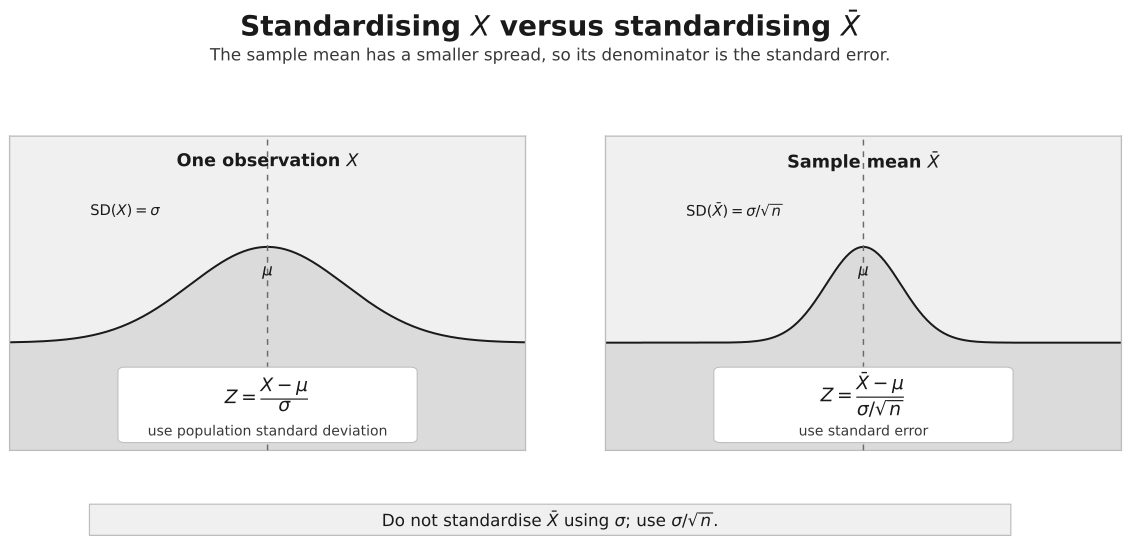 How to read this figure. An individual value uses spread ; an iid sample mean uses standard error . Apply the standardisation only after an exact Normal or justified CLT model is established.
Worked Example 1: Exact Normal Distribution of
The diameter of a metal rod is normally distributed with mean cm and standard deviation cm. A random sample of rods is selected.
Find
Let be the diameter of one rod. Then
Since the population is normal,
The standard deviation of is
Therefore
Hence
Worked Example 2: Central Limit Theorem
The time taken to fill one container is continuous and right-skewed, with mean and variance . Independent fill times are recorded for containers. Find approximately
The population is not stated to be normal, but the sample is large and the observations are independent with finite variance. By the central limit theorem,
Its standard error is
Therefore
Since
we get
No continuity correction is used because the underlying variable, and hence , is continuous. For a discrete lattice-valued mean, continuity correction requires separate care and is outside the intended model of this example.
Worked Example 3: Symmetric Interval for
Suppose has mean and standard deviation . A random sample of size is taken, and the central limit theorem is applicable.
Find
The sample mean has approximate distribution
The standard error is
Therefore
So
Worked Example 4: Finding the Least Sample Size
A measurement is normally distributed with mean and standard deviation . Find the least positive integer such that
Because the parent population is Normal,
exactly. A central probability of leaves total probability outside, or in each tail. Therefore let satisfy . The central probability is at least when
Hence
Keep the calculator quantile unrounded while solving. Using gives
Since must be a positive integer, the least possible value is
The final step is not ordinary rounding: choose the least integer that still satisfies the original probability requirement.
Link to Hypothesis Testing
Hypothesis testing uses this branch directly. A test for a population mean assumes a value of under , uses the distribution of under that assumption, and checks whether the observed is unusually extreme.
So the sampling distribution is not just another probability calculation. It is the foundation of inference about a population mean.
Common Pitfalls
- Treating and as the same object.
- Using instead of when standardising .
- Forgetting that the exact normal result requires the population to be normal.
- Applying the central limit theorem when is small and no normal population is given.
- Thinking the central limit theorem makes normal. It applies to .
- Assuming that a sample mean can never require continuity correction. If the underlying variable is discrete, is also lattice-valued; follow the model and syllabus context given.
Revision Checklist
- Can you explain why is random before sampling?
- Can you state and interpret ?
- Can you state and interpret ?
- Can you identify the standard error ?
- Can you decide whether the distribution of is exact normal or approximate normal?
- Can you standardise probability statements involving correctly?
- Can you rearrange a probability requirement and choose the least positive-integer sample size?
- Can you explain how this branch prepares for hypothesis testing?