Inverse Functions
Overview
An inverse reverses a mapping. The important H2 distinction is:
- every function has a reversed relation obtained by swapping the coordinates of its graph;
- only a one-one function has an inverse function.
Use this branch with Functions and Domains, Ranges, and One-One Functions.
Inverse Relation Versus Inverse Function
Suppose maps input to output .
The inverse relation reverses the ordered pairs in the graph of : if lies on the graph of , then lies on the inverse relation.
But this reversed relation is a function only if each output of came from exactly one input.
That is why one-one behaviour matters.
Example:
The output comes from both and . Reversing the graph would give both and , so the inverse relation sends one input to two outputs and is not a function.
If instead
then each output in comes from exactly one input. Hence exists.
Existence Condition
The inverse function exists if and only if is one-one on its stated domain.
Do not write only:
exists by the horizontal line test.
The more precise reasoning is:
- every horizontal line cuts the graph at most once;
- therefore is one-one;
- therefore the inverse relation is a function;
- hence exists.
The horizontal line test is evidence for one-one behaviour. The actual condition is one-one-ness.
Domain-Range Swap
If exists, then
This is not a formula to memorise separately. It follows from reversing the mapping:
- the original outputs become the new inputs;
- the original inputs become the new outputs.
Example:
Then
So
Graph Relationship
If exists, the graph of is the reflection of the graph of in the line .
The coordinate reason is:
So inverse functions swap input and output coordinates.
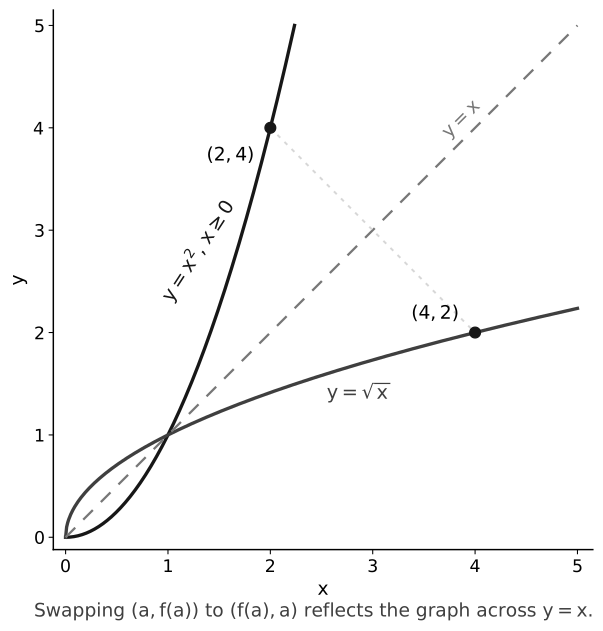 How to read this figure. The graph uses only on , so the original function is one-one. Each point becomes on the inverse; for example, becomes . The reflected curve is , whose domain is the original range . Equal scales on both axes are required for the line to be a genuine visual mirror.
When sketching inverse graphs:
- use equal scale on both axes;
- reflect endpoints accurately;
- swap domain and range;
- label the line if it is part of the argument.
Finding the Rule of an Inverse
Before finding , first establish that is one-one on its stated domain.
Then:
- write ;
- rearrange to make the subject;
- replace the old output variable by the new input variable;
- state the domain of the inverse using .
The familiar instruction “swap and ” is a shorthand for reversing ordered pairs. It does not by itself prove that the reversed relation is a function; one-one-ness must be established first.
Example:
This function is one-one because it is linear with non-zero gradient.
Write
Make the subject:
Therefore
Since ,
Branch Choice After Restricting Domain
The most common inverse-function error is choosing the wrong branch after solving a square.
Example:
First, the stated domain makes one-one.
Now find the inverse:
Then
So
But the original domain requires
so
Therefore choose the negative branch:
Hence
The branch is chosen from the original domain, not from preference.
Checking an inverse rule
After obtaining a candidate inverse, check both compositions on their correct domains:
and
This detects algebraic errors and incorrect branch choices. A formula that works only for some allowed inputs is not the inverse function on the stated domain.
Composition with an Inverse
If exists, then reversing after applying gives the original input:
Also,
These two identity functions may have different domains. Therefore, as functions,
and
need not be the same function unless their domains are the same.
This is an anchor-note emphasis: equality of functions requires checking domain, not just formula.
Example: let
Then
whereas
Both rules simplify to , but the two identity functions have different domains. They are therefore not equal as functions.
Intercepts and Endpoints Under Inversion
Reflection in swaps coordinate roles:
- an -intercept of becomes the -intercept of ;
- a -intercept of becomes the -intercept of ;
- an included endpoint remains included after its coordinates are swapped;
- an excluded endpoint remains excluded.
This lets you sketch many inverse graphs without first finding an algebraic inverse rule.
Reciprocal Warning
The notation means inverse function, not reciprocal.
In general,
For example, if , then
not
Common Pitfalls
- Finding an inverse rule before proving that the inverse function exists.
- Saying “by horizontal line test” without explaining one-one behaviour.
- Forgetting .
- Choosing the wrong square-root branch after restricting the domain.
- Sketching inverse graphs with unequal axis scales.
- Treating as a reciprocal.
- Assuming and are the same without checking domains.