Composite Functions
Overview
Composition means applying one function after another.
The main idea is not substitution alone. The outputs of the first function must be acceptable inputs for the second function.
Use this branch with the hub Functions.
Meaning and Order
The composite
means:
- start with ;
- apply first to get ;
- apply to that output.
So is read from right to left in terms of operation order.
Order matters. In general,
Example:
Let
Then
but
These are not the same function.
Existence Condition
For to exist on the whole domain of , every output of must lie inside the domain of :
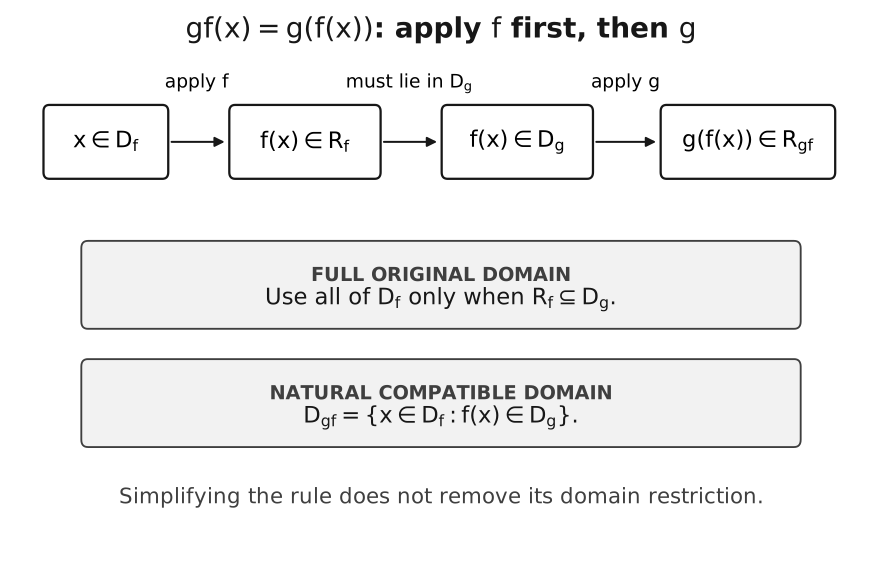 How to read this figure. Read the process from left to right but the notation from right to left: enters first and its output then enters . For to use every input in the original domain , every value in must belong to . If only some outputs are accepted, restrict the input set to those satisfying .
If
then does not exist as a function on the full original domain of .
If the question asks for a restricted composite, the repair is to restrict the domain of so that the surviving outputs of lie inside .
Natural Domain of a Composite
Even when is not true, the expression may still make sense for some inputs.
The natural domain is
This formula says:
- start only with legal inputs for ;
- keep only those inputs whose -outputs are legal inputs for .
This distinguishes two conventions that must not be mixed:
- Composite on the whole stated domain of : require , giving .
- Composite expression on its natural domain: retain only for which .
State which interpretation you are using when the question wording leaves room for doubt.
Example:
Let
Then
The composite is
but it is defined only when
So
Rule, Domain, and Range
To define a composite function properly:
- check the order;
- check the domain compatibility;
- find the rule by substitution;
- state the domain;
- determine the range using the actual domain.
The range step is often missed.
Example:
Let
Then
Its domain is determined by
so
On this domain,
and every non-negative value is attained, so
Notice that the square-root restriction is imposed on the inside output , not directly on until the inequality is solved. This inside-to-outside reasoning works for roots, logarithms, denominators and other restricted outer functions.
Range of a Composite
There are two useful range viewpoints.
Method 1: Pass ranges through the functions
First find . Then ask what does to the values in .
This is especially useful when is a simple interval.
Example:
If
then
If
then applying to gives
So
Method 2: Sketch or analyse the composite directly
Find
on its actual domain, then determine the range from the resulting function.
This is useful when the composite rule is simpler than reasoning through two separate graphs.
The same warning applies as before: do not determine range only from endpoints if the graph can turn inside the domain.
In set language, the range is the image of the actual composite domain:
Although always holds, equality need not hold because may receive only the subset of its possible inputs.
Restricting a Function So a Composite Exists
Sometimes a question asks for a restriction so that a composite exists.
The target condition is:
If this fails and a composite is still required, reduce the domain of so that the resulting restricted range fits inside .
Example:
Let
For to exist on the chosen domain of , we need
The largest possible real domain for this composite expression is
If the question requires an interval domain, we may choose either
or
The question wording decides the acceptable restriction.
When asked for a maximal domain, include every legal input, even when the answer is a union of intervals. An interval restriction such as is smaller than the maximal natural domain for .
Composition with an Inverse Function
If exists, then
and
These expressions look the same algebraically, but they may represent identity functions on different domains.
This reinforces the main theme of the topic:
- a function is not just a rule;
- a function includes its domain.
For example, if is defined by , then
while
The rules agree, but the functions do not because their domains differ.
Exam Workflow
For a requested composite :
- say explicitly that acts first;
- record , and if they are available;
- check for a full-domain composite, or solve for the natural domain;
- substitute to obtain ;
- simplify without losing restrictions;
- find the range from the actual composite domain.
A correct simplified rule with an incorrect domain is an incorrect function.
Common Pitfalls
- Reading as applying first. The function on the right acts first.
- Treating composition as substitution without checking domains.
- Assuming when only some outputs of are accepted by .
- Forgetting to state the domain of the composite.
- Finding the range of a composite from the formula while ignoring the restricted domain.
- Assuming .
- Assuming and are the same function without checking domains.