Domains, Ranges, and One-One Functions
Overview
This branch develops the language needed before inverse and composite functions make sense.
Use it with the hub Functions.
The core idea is:
- a relation may connect inputs and outputs in many ways;
- a function is a relation with exactly one output for every allowed input;
- domain and range describe the input and output behaviour of that mapping;
- one-one behaviour asks whether outputs identify inputs uniquely.
Set Notation
Domains and ranges are sets.
Useful notation:
- means .
- means .
- means all real such that .
- means all real numbers except .
- means union.
Common number sets:
- : real numbers;
- : positive real numbers;
- : negative real numbers;
- : non-negative real numbers.
Relations and Functions
A relation is an association between inputs and outputs.
It can be represented:
- numerically, using a table of values;
- graphically, using a curve;
- diagrammatically, using mapping arrows;
- algebraically, using an equation or rule.
A relation is a function if every allowed input has exactly one output.
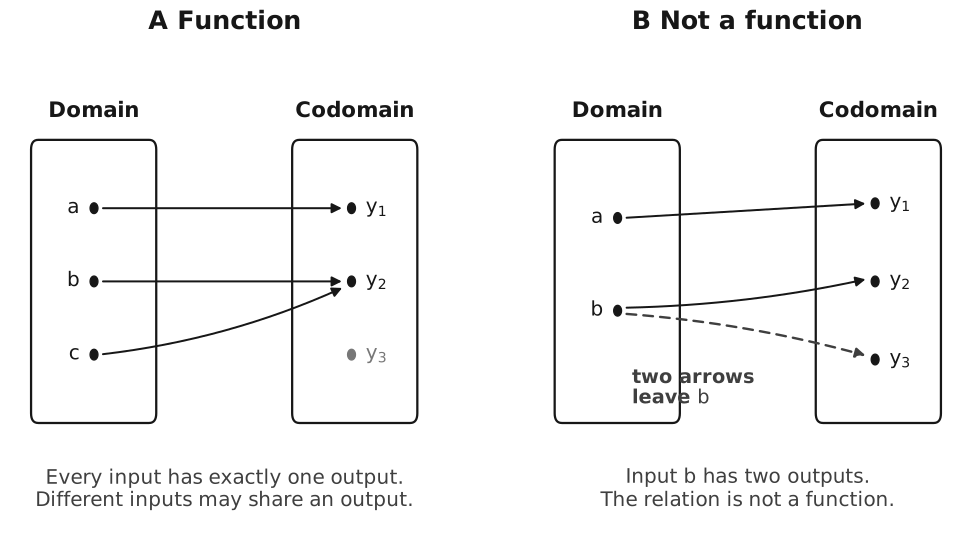 How to read this figure. Follow the outgoing arrows from each domain element. In panel A every input has exactly one output, even though and share ; this is a valid many-to-one function. In panel B, points to both and , so one input has two outputs and the relation is not a function.
Important distinctions:
- Two different inputs may share the same output and the relation can still be a function.
- One input with two different outputs means the relation is not a function.
- An input in the domain with no output also means the relation is not a function.
Rule, Domain, Codomain, and Range
A function can be written as
Here:
- is the domain , the set of allowed inputs;
- is the codomain, the declared target set;
- the rule tells how each is mapped;
- the range is the set of actual outputs.
The range is
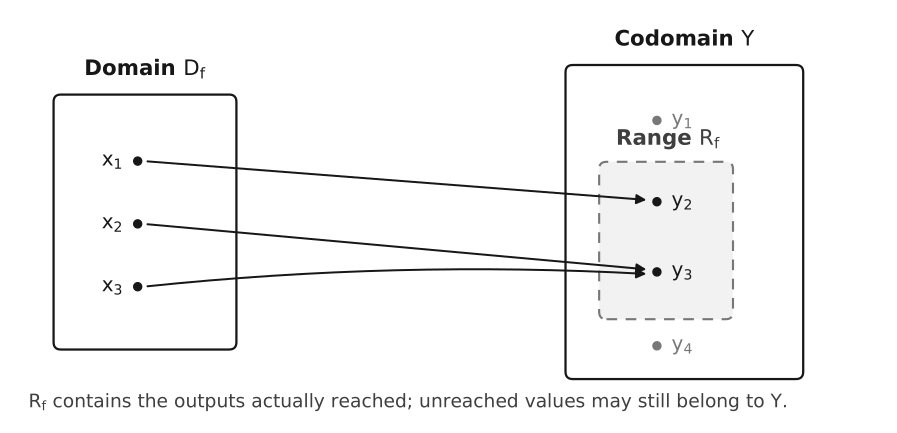 How to read this figure. The outer right-hand box is the declared codomain. The dashed region contains the values actually reached by arrows and is therefore the range. Unreached values such as and remain in the codomain, showing why codomain and range need not be equal.
For example,
has
The codomain is , but the range is only .
Equality of Functions
Two functions are equal only if they have the same:
- domain;
- codomain, when the codomain is part of the stated function;
- output for every input in the domain.
So a function is not determined by its formula alone.
For example,
and
are different functions because their domains are different.
This is not a technicality. It changes whether the function is one-one and whether an inverse function exists.
Maximal Domain
If no domain is given, the convention is to use the maximal real domain: all real values for which the rule makes sense and gives a real output.
Typical restrictions:
- denominator cannot be zero;
- an even root requires the expression inside to be non-negative;
- a logarithm requires the argument to be positive.
Examples:
has maximal domain
Also,
has maximal domain
Finding Range
The range is the set of possible outputs on the stated domain.
A safe strategy:
- identify the domain carefully;
- sketch or reason from the graph;
- check turning points and endpoint behaviour;
- consider asymptotic behaviour if relevant;
- write the output set in interval notation.
Endpoint checking alone is incomplete. A graph can turn inside the interval.
Example:
The minimum value is at , which lies inside the domain. The value is approached as but not attained.
Hence
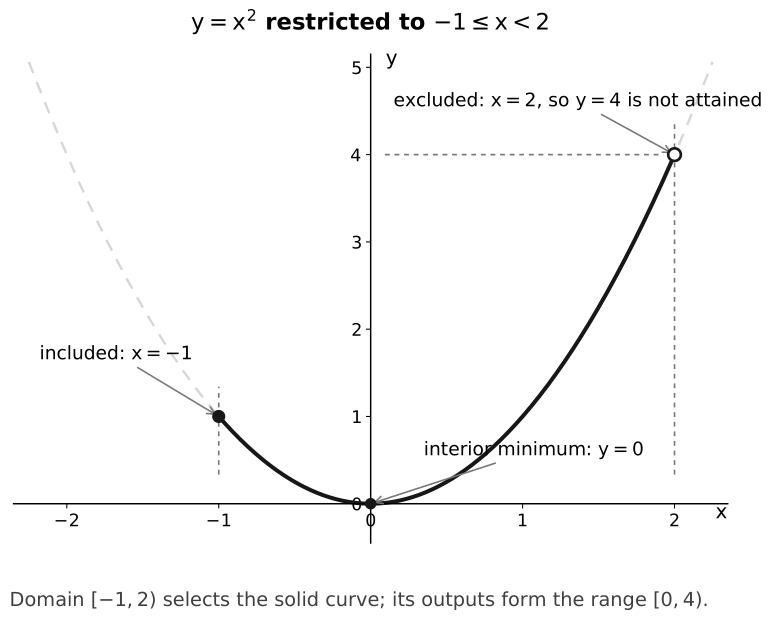 How to read this figure. The domain restriction selects only part of the parent parabola. The interior turning point gives the attained minimum . The open endpoint at makes only a limiting value, not an attained output. Hence .
A reliable range workflow
For a continuous curve on one or more domain intervals:
- mark included and excluded domain endpoints;
- locate stationary or turning points inside the domain;
- inspect asymptotes and end behaviour;
- decide whether each boundary output is attained or merely approached;
- combine the output intervals.
For example, an open endpoint in the domain does not automatically produce an open endpoint in the range: another allowed input may still produce the same output. Attainment must be checked from the whole domain.
Piecewise Functions
A piecewise function is one function whose rule changes on different parts of its domain.
Example:
The domain is
For range, treat each domain piece separately:
- if , then , so this piece gives ;
- if , then , so this piece gives .
Combining the pieces,
Vertical Line Test
The vertical line test checks whether a graph represents a function.
- If every vertical line cuts the graph at most once, the graph represents a function.
- If one vertical line cuts the graph more than once, the graph does not represent a function.
Reason: a vertical line fixes one input . More than one intersection means that one input has more than one output.
To show that a relation is not a function, it is enough to provide one counterexample, such as a vertical line that intersects the graph twice.
If a domain has been declared separately, also confirm that every in that domain has an image. “At most once” rules out multiple outputs; the definition additionally requires one output for every allowed input.
One-One Functions
A function is one-one, or injective, if no two distinct inputs have the same output.
Equivalent tests:
- algebraically, implies ;
- graphically, every horizontal line cuts the graph at most once;
- conceptually, each output identifies at most one input.
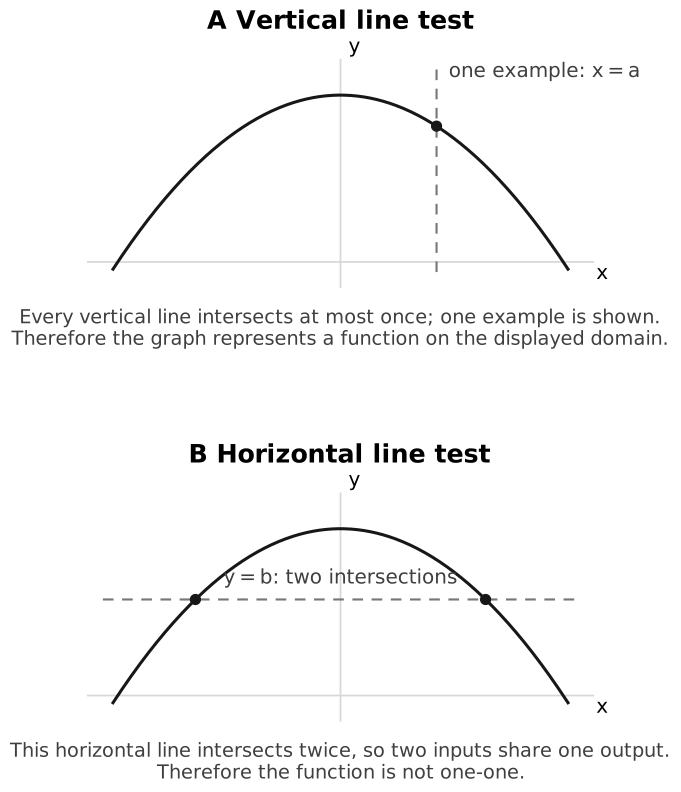 How to read this figure. The left panel uses a vertical line because fixing tests the number of outputs belonging to one input. The right panel uses a horizontal line because fixing tests how many inputs produce one output. The parabola passes the function test but fails the one-one test on the displayed domain.
Examples:
- on is not one-one because .
- on is one-one.
- on is one-one because its graph is crossed at most once by each horizontal line in its range.
Restricting the Domain
If a function is not one-one, it may be restricted to a smaller domain to make it one-one.
The restricted function keeps the same rule but uses a smaller input set.
Example:
on is not one-one. To make it one-one while preserving the range , use either
or
For
a largest one-sided domain that makes the function one-one is
or
The choice depends on the question.
“Maximal” means that the restricted domain cannot be enlarged while keeping the required one-one behaviour and, when requested, the same range. It does not always mean that the answer is unique. For on , both and are maximal one-sided restrictions with range .
Algebraic Test for One-One Behaviour
When a graph is inconvenient, start with two allowed inputs and assume
If this assumption necessarily leads to , then is one-one on the stated domain. If it permits distinct inputs, the function is not one-one.
For example, if , then
so is one-one on . For on , gives an immediate counterexample.
Common Pitfalls
- Thinking that a function must map different inputs to different outputs. That is one-one behaviour, not function behaviour.
- Forgetting that a function is defined by both rule and domain.
- Confusing codomain with range.
- Finding range from endpoint values only.
- Ignoring open endpoints when stating ranges.
- Treating a piecewise function as several unrelated functions.
- Using the horizontal line test before first checking that the relation is already a function.