Polar Form, de Moivre, and Roots
Enrichment — beyond 9758
This entire branch is optional enrichment. Polar/exponential form, de Moivre’s theorem, and general th roots are explicitly outside the 9758 syllabus. The core syllabus requires Cartesian algebra, modulus, argument, Argand representation, and specified Cartesian geometric transformations.
Overview
This branch develops polar and exponential form, where multiplication becomes scaling plus rotation. It is the main reference for de Moivre’s theorem, powers, roots, and the equal-spacing structure of roots in the Argand diagram.
Polar and Exponential Form
Complex numbers can be written in different forms depending on what we want to emphasise.
The Cartesian form
emphasises horizontal and vertical components in the Argand diagram.
Polar and exponential forms emphasise something different:
- the distance of the point from the origin;
- the direction of the point from the positive real axis.
These forms are especially useful for understanding multiplication, division, powers, and roots geometrically.
From coordinates to size and direction
For the principal representation, let
be a non-zero complex number.
In the Argand diagram, is represented by the point
Let
and
Here, is the distance from the origin to the point , and is the direction of the point measured from the positive real axis.
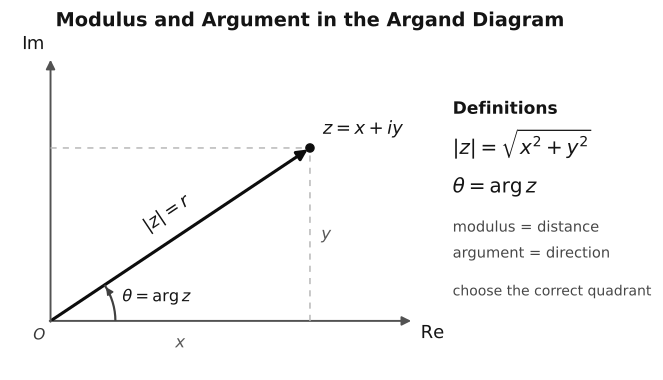 How to read the figure. The Cartesian coordinates and the pair locate the same point: is its distance from the origin and is its direction. Always determine the quadrant before choosing a principal argument.
From right-triangle geometry,
and
Substituting these into
gives
So
This is the polar form of a complex number.
Polar form
If has modulus and argument , then
In this form:
- gives the size or distance from the origin;
- gives the direction or argument.
So polar form separates a complex number into
For a non-zero complex number,
The principal value is unique in , but an arbitrary argument is not unique. If is any argument of , then
is also an argument of for any integer .
This wiki denotes the principal argument by , chosen in the range
When is written with an arbitrary argument, for some .
The number has modulus , but its argument is undefined. Therefore, polar form with a specified argument is normally used only for non-zero complex numbers.
Exponential form
Euler’s formula states that
Using this formula, the polar form
can be written more compactly as
This is the exponential form of a complex number.
Exponential form is not a completely separate idea. It is a compact way of writing polar form.
The expression
represents a direction in the Argand diagram, while the factor gives the distance from the origin.
So
means:
Example: writing in three forms
Consider
This is the Cartesian form.
To write it in polar form, first find the modulus:
Next, find the argument. The point lies in the first quadrant, so
Therefore,
This is the polar form.
Using Euler’s formula, we can also write
This is the exponential form.
So the same complex number can be written as
or
These are three different forms of the same number.
Converting from Cartesian form to polar or exponential form
To convert
to polar or exponential form:
- Find the modulus:
-
Find the argument using the correct quadrant.
-
Write either
or
The quadrant matters. The value of
alone may give the wrong argument if the point is not in the first quadrant.
Converting from polar or exponential form to Cartesian form
To convert
to Cartesian form, expand:
So the Cartesian form is
where
and
For exponential form,
first use Euler’s formula:
Then
and the same expansion gives the Cartesian form.
Why these forms matter
Different forms are useful for different purposes.
Cartesian form
is best when we need to identify real and imaginary parts, compare complex numbers, or perform basic algebra.
Polar form
is best when we want to think geometrically in terms of size and direction.
Exponential form
is usually the most efficient form for multiplication, division, powers, and roots.
For example,
This shows the geometric meaning of multiplication:
- multiply the moduli;
- add the arguments.
In words, multiplication scales distance from the origin and rotates direction.
This is why polar and exponential forms become powerful when studying geometric transformations, de Moivre’s theorem, and roots of complex numbers.
Multiplication, Division, and Geometric Effects
Polar and exponential forms make multiplication and division much easier to understand geometrically.
Suppose
and
where .
Then
Using the laws of indices,
Therefore,
So multiplication has a simple geometric meaning:
- the moduli are multiplied;
- the arguments are added.
In other words, multiplying by a complex number changes both the size and the direction.
Division
For division, require , equivalently .
Similarly,
Using the laws of indices,
So
Thus division has the geometric meaning:
- the moduli are divided;
- the arguments are subtracted.
This is why exponential form is usually the most efficient form for multiplication and division.
Multiplication by a positive real number
If , then multiplying a complex number by gives
Geometrically, this scales the distance from the origin by a factor of , but it does not change the direction.
So:
- if , the point moves farther from the origin;
- if , the point moves closer to the origin;
- the argument stays the same.
Thus multiplication by a positive real number is a scaling about the origin.
Multiplication by a unit complex number
A unit complex number has modulus .
For example,
has modulus .
If
then
The modulus is still , but the argument has changed from to .
Therefore, multiplying by
rotates the point anticlockwise by angle about the origin, without changing its distance from the origin.
If is negative, the rotation is clockwise.
Special case: multiplication by
The number can be written as
So multiplying by means multiplying by
If
then
Hence
The modulus is unchanged, while the argument increases by
Therefore, multiplication by rotates a point anticlockwise by
about the origin.
For example, if
then
Since
we get
So the point
is sent to
which is a anticlockwise rotation about the origin.
General geometric effect of multiplication
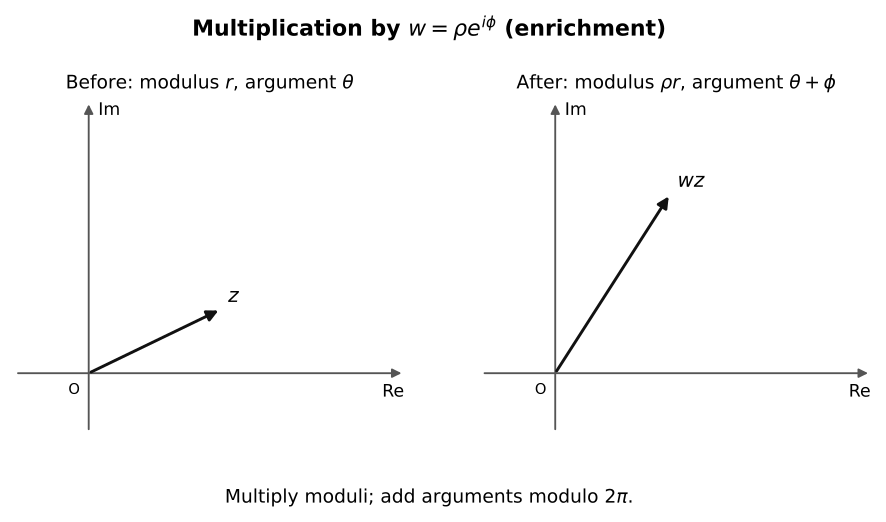 How to read the figure. Multiplying by scales the distance from the origin by and rotates the direction by . Argument addition is modulo ; the displayed angle must be normalised if a principal argument is requested.
Multiplication by a general complex number combines two effects.
If
then multiplying by gives
So
This means:
- the modulus of is scaled by the factor ;
- the argument of is increased by .
Therefore, multiplication by a complex number is a combination of scaling and rotation about the origin.
In summary:
- multiplying by a positive real number scales only;
- multiplying by a unit complex number rotates only;
- multiplying by a general non-zero complex number scales and rotates.
This is the main geometric power of polar and exponential forms: multiplication is no longer just algebraic expansion. It becomes a clear transformation in the Argand diagram.
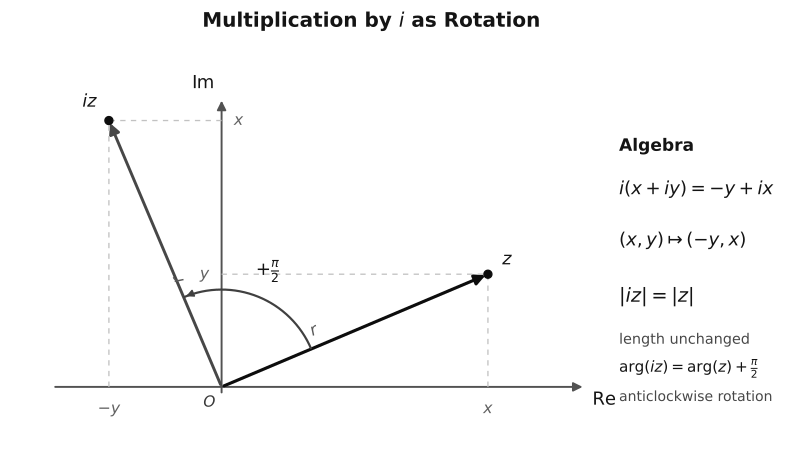 How to read the figure. Multiplication by maps to , preserves the modulus, and produces a anticlockwise rotation. Argument addition is understood modulo , followed by principal-range normalisation if required.
De Moivre’s Theorem and Powers
Polar and exponential forms make powers of complex numbers much easier to understand.
The key idea is:
Therefore, repeated multiplication should raise the modulus to a power and multiply the argument by the same power.
Why powers are simple in polar form
Suppose
Here:
- is the modulus of ;
- is an argument of .
If we multiply by itself repeatedly, the modulus is multiplied repeatedly, and the argument is added repeatedly.
So for a positive integer ,
The modulus becomes
and the argument becomes
Hence,
This is the general polar form of De Moivre’s theorem.
De Moivre’s theorem
In the special case where , we obtain
for positive integers .
Equivalently, using exponential form,
gives
So
This is often the most compact form of De Moivre’s theorem.
Conceptual meaning
De Moivre’s theorem says that powers act separately on size and direction:
- the modulus changes from to ;
- the argument changes from to .
So powers do not need repeated expansion. They can be handled by changing the modulus and the argument.
Example: finding a power
Find
First write in exponential form.
The modulus is
The argument is
So
Therefore,
Using De Moivre’s theorem,
Now
and
So
Since
we get
This example shows why exponential form is useful: a high power becomes a simple operation on the modulus and argument.
nth Roots of a Complex Number
Powers and roots are inverse operations.
If powers multiply arguments, then roots should divide arguments.
This is the main idea behind finding nth roots of a complex number.
Roots reverse powers
To solve
take with . We want all complex numbers whose th power is . The derivation below assumes ; if , the only distinct root is .
Suppose
where
If
then
For this to equal
we need
and the direction
to match the direction of .
So the modulus of each root should be
The argument should come from dividing an argument of by .
Why multiple roots appear
The important subtlety is that arguments are not unique.
If and
then the same complex number can also be written as
where is any integer.
Before taking roots, we must include these equivalent arguments:
Then, after dividing by , we get different possible arguments for the roots:
This is why has distinct roots when , not just one.
General formula for nth roots
If
then the roots of
are
The values
give all distinct roots.
Other choices of consecutive integer values of also give the same set of roots, possibly written with different arguments.
If , the equation has only the root .
Geometric meaning
The formula
has a clear geometric meaning.
All roots have the same modulus:
So all roots lie on the circle centered at the origin with radius
The arguments of neighbouring roots differ by
Therefore, the roots are equally spaced around the circle.
This equal spacing is not an extra rule to memorise. It comes from adding
to the argument of and then dividing by .
Workflow for finding nth roots
To solve
use the following steps:
- Write in exponential form:
- Include all equivalent arguments:
- Take the nth root of the modulus:
- Divide the argument by :
- Use consecutive integer values of , commonly
- Present the roots in exponential, polar, or Cartesian form as required.
Example: cube roots of unity
The cube roots of unity are the solutions of
Write
But because arguments are not unique,
So
Taking cube roots gives
Use
For ,
For ,
For ,
Therefore, the cube roots of unity are
In Cartesian form,
and
So the three cube roots of unity are
Geometrically, these three roots lie on the unit circle and are equally spaced by angle
They form the vertices of an equilateral triangle centered at the origin.
Key idea
For powers:
For roots:
The multiple roots appear because the same complex number has many equivalent arguments differing by multiples of
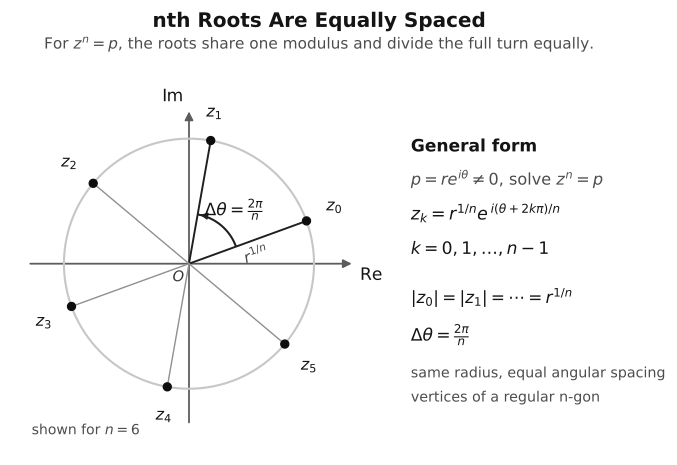 How to read the figure. For and integer , the distinct solutions of have common modulus and successive arguments separated by . If , the only distinct root is , with multiplicity .