Argand Diagram, Modulus, Argument, and Loci
Overview
This branch first develops the 9758-core geometry of Argand diagrams, modulus, argument, and transformations. Its later complex-loci section is retained as clearly labelled enrichment beyond the syllabus.
Syllabus boundary
Argand representation, modulus, argument, and the effects of conjugation, negation, addition, subtraction, and multiplication by are core. Complex loci are explicitly excluded from 9758 and begin only at the enrichment heading below.
The Argand Diagram
A complex number can be represented geometrically in a plane called the Argand diagram.
If
then is represented by the point
The horizontal axis is the real axis, and the vertical axis is the imaginary axis.
So:
- the real part gives the horizontal coordinate;
- the imaginary part gives the vertical coordinate.
Equivalently, can be represented by the position vector from the origin to the point .
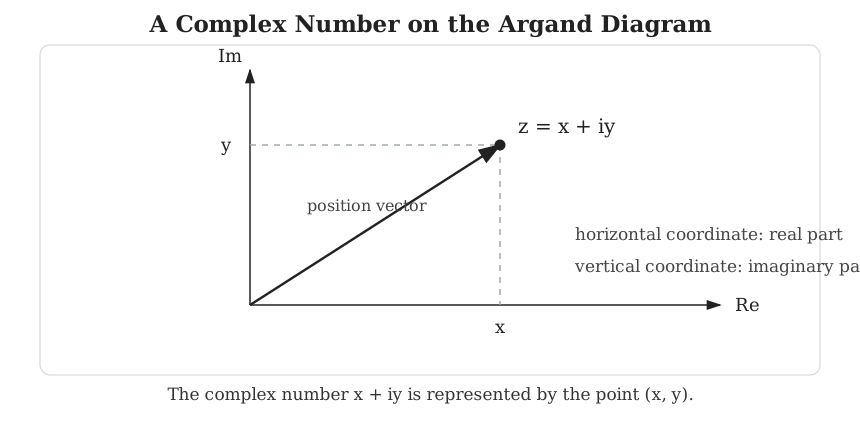 How to read the figure. Read the horizontal coordinate as and the vertical coordinate as . The arrow from the origin is the position vector of the same point, not a second object.
This representation gives complex numbers a geometric meaning.
For example, if
then is represented by the point
If
then is represented by the point
The Argand diagram also makes several important operations easier to understand.
Conjugation as reflection
If
then
In the Argand diagram, corresponds to the point , while corresponds to the point .
So conjugation reflects a point in the real axis.
Core transformations in the Argand diagram
Let and let the fixed complex number .
- Negation: maps to , a half-turn about the origin.
- Addition: translates every point by the vector .
- Subtraction: represents the displacement vector from the point to the point .
- Multiplication by : maps to , a anticlockwise rotation about the origin.
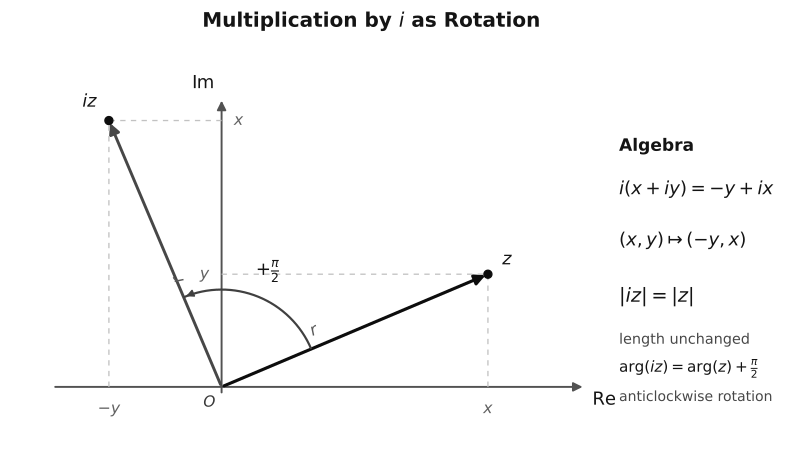 How to read the figure. Compare the coordinates before and after multiplication: . The equal radial lengths show that the modulus is unchanged; the directed arc shows the anticlockwise quarter-turn. If arguments are used, normalise the result to the chosen principal range.
Modulus as distance
The modulus measures the distance from the origin to the point representing .
If
then
So the modulus is not just an algebraic expression. It is a geometric distance.
Useful core identities are
They say that conjugation preserves distance from the origin, multiplication multiplies distances, and division divides distances.
Argument as direction
The argument measures the direction of from the positive real axis. In this wiki, denotes the principal argument in , while all arguments are for .
It is the angle made by the position vector of with the positive real axis.
So the argument is a geometric angle, not a length. It can be viewed as the general angle of the position vector representing .
Difference as distance between two points
One of the most important geometric interpretations is this:
is the distance between the points representing and in the Argand diagram.
This distance idea also explains the enrichment topic of complex loci. For example, outside the current 9758 core, a condition such as
means that the point representing is always a fixed distance from the fixed point representing .
Therefore, the locus is a circle with centre at and radius . This locus interpretation is retained later as enrichment, not as required Core 9758 content.
Why the Argand diagram matters
The Argand diagram is not just a way to draw complex numbers. It is the bridge between algebra and geometry.
It allows us to reinterpret:
- real part as horizontal position;
- imaginary part as vertical position;
- conjugation as reflection;
- modulus as distance;
- argument as direction;
- equations involving as geometric loci in enrichment work.
The main skill is to translate between the two languages:
This translation becomes especially important in the optional enrichment section on loci in the complex plane.
Modulus and Argument
The Argand diagram allows us to describe a complex number by two geometric quantities:
- its modulus, which tells us how far it is from the origin;
- its argument, which tells us its direction from the origin.
Together, modulus and argument give a geometric way to understand the position of a complex number.
Modulus: distance from the origin
Let
where .
The modulus of is defined by
Geometrically, is represented by the point
in the Argand diagram. Therefore, is the distance from the origin to the point .
This formula comes directly from Pythagoras:
For example, if
then
So
The modulus is always a non-negative real number:
Also,
only when
Argument: direction from the origin
The argument of a non-zero complex number is the angle made by the position vector of with the positive real axis. It is the general angle of the point representing in the Argand diagram.
It is denoted by
The angle is measured from the positive real axis:
- anticlockwise angles are positive;
- clockwise angles are negative.
For example, if a point lies in the first quadrant, its argument is positive and between
and
If a point lies in the fourth quadrant, its principal argument is negative and between
and
The argument of is undefined, because the origin has no direction from itself. So
is undefined.
Principal argument
The argument of a complex number is not unique.
For example, the angles
and
point in the same direction.
More generally, if is an argument of , then
is also an argument of for any integer .
This wiki defines to be the principal argument, which lies in the range
Thus
always denotes the principal value here. Other arguments must be written explicitly as .
Finding the argument from Cartesian form
Suppose
To find , do not blindly write
This can give the wrong quadrant.
A safer method is:
- locate the point in the Argand diagram;
- find the basic angle
- adjust the answer according to the quadrant.
Handle points on the axes directly rather than using :
The negative real axis uses , not , because the chosen range is . For , is undefined.
For example, if
then the point lies in the first quadrant. The basic angle is
Therefore,
If
then the point lies in the second quadrant. The basic angle is still
but the actual argument is
So
If
then the point lies in the fourth quadrant. The principal argument is
So
The quadrant is therefore essential when finding the argument.
Modulus versus argument
The modulus and argument answer different geometric questions.
The modulus answers:
The argument answers:
So for a complex number
the modulus gives its distance from the origin, while the argument gives its direction from the positive real axis.
Distance between two complex numbers
A very important interpretation is that
is the distance between the points representing and in the Argand diagram.
To see why, let
and
Then
So
This is exactly the distance between the points
and
Therefore,
should be read geometrically as the distance between two points in the Argand diagram.
Enrichment bridge to loci
Scope preview
The distance interpretation below prepares for complex loci, which are outside the current 9758 core. Learn it as enrichment unless your teacher explicitly assigns it.
This distance interpretation is one of the most important ideas for complex loci.
For example,
means the distance between the point representing and the fixed point representing .
Therefore, an equation such as
means:
Geometrically, this describes a circle with centre at and radius .
So many locus problems become much easier once modulus is interpreted as distance.
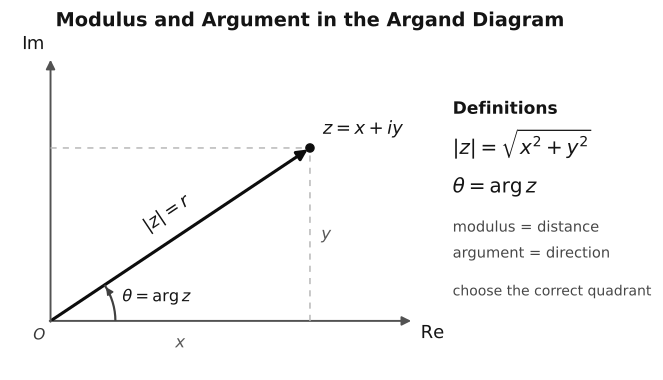 How to read the figure. The radial length is ; the directed angle from the positive real axis is the principal value . The dashed projections recover the Cartesian components and .
Enrichment — Loci in the Complex Plane (beyond 9758)
Scope
Complex loci are explicitly excluded from the 9758 syllabus. The material below is optional enrichment and must not be treated as required examination content.
What a locus means
In the Argand diagram, a complex number
is represented by a point.
When is allowed to vary, the point representing can move. A condition on restricts where this point is allowed to move.
The set of all possible positions of the point representing is called a locus.
For locus problems, it is useful to name the moving point:
- let be the point representing the variable complex number ;
- let be the point representing a fixed complex number ;
- let be the point representing a fixed complex number .
Then expressions involving can be translated into ordinary geometry.
The main translation
The key idea is that modulus means distance.
If represents and represents , then
means the distance from to .
So
Similarly,
Arguments also have a geometric meaning. The expression
means the direction of the line from to , measured from the positive real-axis direction.
Therefore:
- modulus statements become distance statements;
- equal-modulus statements become equal-distance statements;
- argument statements become direction or angle statements.
This translation is the foundation of complex loci.
Circle loci
Consider the condition
where is fixed and .
Let be the point representing , and let be the point representing .
Since
the condition says
So must always be a fixed distance from the fixed point .
Therefore,
represents a circle with centre and radius .
The assumption matters: if , the locus is the single point ; if , there is no solution because a distance cannot be negative.
If
then the centre is the point
For example,
represents a circle with centre
and radius
Inequality versions
The inequality signs describe regions.
The condition
means that is less than distance from . So it represents the interior of the circle, excluding the boundary.
The condition
represents the interior of the circle together with the boundary.
The condition
represents the exterior of the circle, excluding the boundary.
The condition
represents the exterior of the circle together with the boundary.
So:
- strict inequalities exclude the boundary;
- non-strict inequalities include the boundary.
Perpendicular bisector loci
Now consider the condition, with ,
Let represent , represent , and represent .
Since
and
the condition says
So is equidistant from the two fixed points and .
The set of all points equidistant from two fixed points is the perpendicular bisector of the line segment joining them.
Therefore,
represents the perpendicular bisector of the segment joining the points representing and .
If , both distances are identical for every . Therefore equality, , and hold throughout the complex plane, while the strict inequalities and have no solutions.
For example,
means that is equidistant from
and
So the locus is the perpendicular bisector of the line segment joining those two points.
Inequality versions
The condition
means that is closer to than to .
So the region is the side of the perpendicular bisector containing .
Similarly,
means that is closer to than to .
So the region is the side of the perpendicular bisector containing .
Again, strict inequalities exclude the boundary, while non-strict inequalities include it.
Argument loci
Now consider the condition
This is an open ray beginning at : the point is excluded because is undefined. When an argument inequality is used, interpret it in the stated principal range and check whether the interval crosses the branch cut at the negative real axis; a wrapped interval may need to be described as two angular sectors.
Let be the point representing , and let be the point representing .
The expression
represents the displacement from to .
Therefore,
means that the line from to makes angle with the positive real-axis direction.
So the locus is a half-line starting from and making angle with the positive real-axis direction.
However, the point itself is excluded, because at ,
and
is undefined.
For example,
represents a half-line starting from
making angle
with the positive real-axis direction, excluding the starting point.
Argument inequalities describe angular regions between rays. When sketching them, pay careful attention to whether the boundary rays are included or excluded.
Summary of standard locus patterns
| Complex condition | Geometric meaning | Locus |
|---|---|---|
| , | distance from is | circle with centre and radius |
| , | distance from is less than | interior; boundary excluded |
| , | distance from is at most | interior plus boundary |
| , | equal distance from and | perpendicular bisector of |
| , | closer to than to | open side of the bisector containing |
| , | direction from to is | open ray from , excluding |
Workflow for solving locus questions
For a locus question, avoid memorising templates blindly. Use the following workflow.
-
Identify the variable point representing .
-
Identify the fixed points, such as the points representing , , or .
-
Translate modulus expressions into distances.
For example,
means
- Translate argument expressions into directions or angles.
For example,
means the direction from to .
- Decide whether the condition gives a boundary or a region.
Usually:
- equality gives a curve, line, or ray;
- inequality gives a region.
- Decide whether the boundary is included.
Usually:
- and exclude the boundary;
- and include the boundary;
- for argument loci, the starting point is excluded because is undefined.
- Sketch or describe the locus clearly.
A good description should state the type of locus, its fixed point or centre, its radius or direction, and whether the boundary is included.
Inequalities and regions
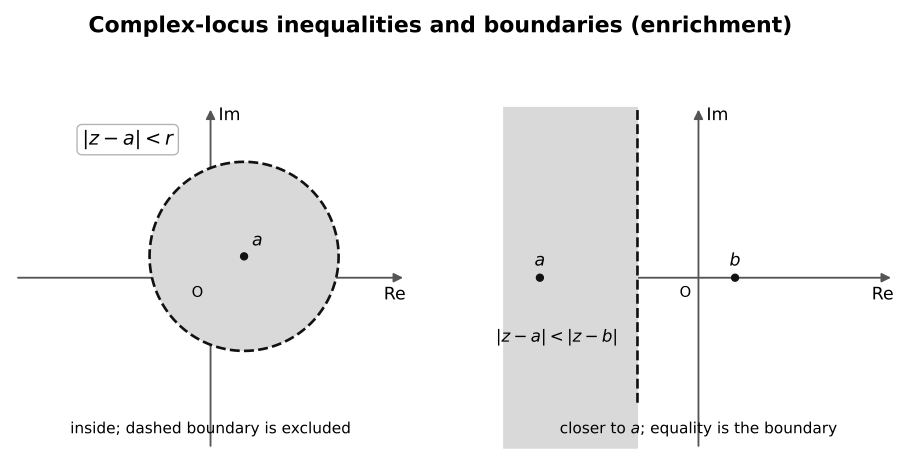 How to read the figure. Shading represents every point satisfying the inequality, not an area to calculate. In , the modulus is the distance from the moving point to the fixed centre , so the shaded set is the interior of the radius- circle. A strict sign such as excludes the boundary; replacing it by includes the same boundary. For equal-distance comparisons, the boundary is the perpendicular bisector of the two fixed points.
Many locus questions involve inequalities. The key point is that inequalities usually describe regions, not just curves.
For example,
means that is less than distance from the point .
So the locus is the interior of the circle centred at with radius , excluding the boundary.
Similarly,
means that is closer to than to .
So the locus is one side of the perpendicular bisector of .
To decide which side to shade, use the meaning of the inequality rather than algebra alone.
Optimization on loci
Some questions ask for the greatest or least value of an expression such as
subject to a locus condition.
The expression
means the distance from the moving point to the fixed point representing .
So these are geometric optimization problems.
The usual strategy is:
- convert the condition on into a geometric locus;
- interpret the expression to be optimized as a distance or angle;
- use the diagram to find the greatest or least possible value.
For example, suppose lies on a circle with centre and radius , and we want the greatest or least value of
Let be the point representing .
Then
So the question asks for the greatest or least possible distance from to a point on the circle.
These extreme distances occur along the line joining to the centre .
If
then the greatest possible value is
For a point moving on the full circle of centre and radius , the least possible value is exactly
Thus the exact maximum and minimum are and . These results need not apply unchanged to a disc, arc, or locus restricted by another condition.
This geometric approach is often much simpler than converting everything into Cartesian equations.
Main idea
The main skill in complex loci is translation:
Once the condition has been translated, the problem usually becomes ordinary plane geometry.
The most important translations are:
and