Complex Number Algebra and Roots
Overview
This branch develops the algebraic side of complex numbers: Cartesian form, equality, arithmetic, conjugates, division, square roots, and roots of real-coefficient polynomials. It supports the main hub by keeping the manipulation skills and conjugate-root reasoning in one reusable place.
Foundations
Why introduce ?
In the real number system, some equations have no solution. For example,
has no real solution, because the square of any real number is always non-negative.
To extend the number system, we introduce a new number called the imaginary unit, denoted by , defined by
With this definition, the equation
can now be solved:
so
Thus, introducing allows us to work with numbers beyond the real number system.
Square roots of negative numbers
Define by
with the convention that has positive imaginary part. With the principal-square-root convention, we write
More generally, if , then
For example,
and
Be careful with the difference between a square-root expression and solving a quadratic equation.
For example,
but the equation
has two solutions:
So square roots of complex numbers often need attention to signs.
Do not extend the real rule blindly to negative or complex numbers. For example,
whereas the principal value of is .
Cartesian form
A complex number is a number of the form
where
This is called the Cartesian form of a complex number.
The number is called the real part of , and the number is called the imaginary part of :
A very common mistake is to think that the imaginary part is . It is not.
If
then
and
The imaginary part is the coefficient of , not the whole term containing .
Real, imaginary, and complex numbers
For
the values of and determine the type of number.
If , then
so is a real number.
If and , then
so is a purely imaginary number.
If both and are non-zero, then has both a real part and an imaginary part.
The number is a special case. It can be written as
In the Argand diagram, it lies at the intersection of the real axis and the imaginary axis.
Algebraic and geometric meanings
A complex number should be understood in two connected ways.
Algebraically,
is an expression made from a real part and an imaginary part.
Geometrically,
can be represented by the point
in the Argand diagram.
In this diagram:
- the horizontal coordinate represents the real part;
- the vertical coordinate represents the imaginary part.
So
corresponds to the point
This dual viewpoint is the core of the topic. Many algebraic statements about complex numbers become geometric statements about points in a plane.
Equality of complex numbers
Two complex numbers are equal if and only if their real parts are equal and their imaginary parts are equal.
So if
then
and
This is the standard method for solving simple equations involving complex numbers in Cartesian form.
For example, suppose
Comparing real parts gives
so
Comparing imaginary parts gives
so
Therefore,
The reason this works is that equality of complex numbers means equality of both coordinates in the Argand diagram.
A key restriction: no natural ordering
Real numbers can be ordered on a number line. For example, it is meaningful to say
because lies to the right of on the real number line.
Complex numbers are different. They are represented in a plane, not on a single line. Therefore, there is no natural meaning of “greater than” or “less than” for non-real complex numbers.
For example,
is not a meaningful statement.
Although lies above in the Argand diagram, being higher in the plane does not mean being greater. In this topic, complex numbers should not be compared using inequality signs unless the comparison is about a real-valued quantity such as modulus.
For example,
is meaningful, because both sides are real numbers.
Arithmetic in Cartesian Form
The basic principle
When working in Cartesian form,
treat like an algebraic symbol, but always remember the defining rule
Most calculations follow the same basic workflow:
- expand or simplify using ordinary algebra;
- replace by ;
- collect the real and imaginary parts;
- write the final answer in Cartesian form .
This discipline is especially important in multiplication, division, and square-root problems.
Addition and subtraction
To add or subtract complex numbers, combine real parts with real parts, and imaginary parts with imaginary parts.
If
and
then
and
For example,
So
This is similar to adding or subtracting coordinates component by component:
Multiplication
To multiply complex numbers, expand as in ordinary algebra, then use
For example,
Since
we have
Therefore,
In general,
can be expanded as
Using
this becomes
So
The formula is useful, but in most calculations it is safer to remember the method: expand normally, replace by , and collect terms.
Division
Division is slightly different because the denominator may contain .
For example, in
the denominator is not real. To write the answer in Cartesian form, we multiply the numerator and denominator by the conjugate of the denominator.
The conjugate of
is
The reason this works is that
which is real.
So
The denominator becomes
The numerator is
Since
we get
Therefore,
This process is often called realising the denominator, meaning that the denominator is changed into a real number.
Square roots in Cartesian form
To find the square roots of a complex number in Cartesian form, suppose one square root is
where and are real.
For example, to find the square roots of
let satisfy
Then
Expanding the left-hand side gives
Since
we have
Now compare real and imaginary parts:
and
So
Solving these equations gives
or
Therefore, the square roots of
are
and
This pair is not accidental. If
then
as well.
So every non-zero complex number has exactly two distinct square roots, and they are opposites. The number has only one distinct square root. The principal square root is chosen as the root with positive real part, or, if its real part is zero, with non-negative imaginary part. Therefore under this convention, while the equation has both solutions .
Common working discipline
When doing arithmetic in Cartesian form, keep the following habits:
- collect the final answer as ;
- remember that , not ;
- do not leave a complex number in the denominator;
- compare real and imaginary parts only after both sides are written clearly in Cartesian form;
- for with , the two distinct roots are exactly and ; for , there is one distinct root.
Complex Conjugates
Definition
If
where , then the complex conjugate of is
Here, denotes the conjugate of . Some books use the notation instead.
Conjugation changes only the sign of the imaginary part:
- the real part stays the same;
- the imaginary part changes sign.
For example, if
then
Geometric meaning
In the Argand diagram,
is represented by the point
Its conjugate
is represented by the point
So conjugation reflects the point across the real axis.
This means that and have the same horizontal coordinate, but opposite vertical coordinates.
The key identity
The most important identity involving conjugates is
To see why, start from
and
Then
Expanding gives
The middle terms cancel, so
Since
we get
This is always a real and non-negative number.
For example, if
then
So
This identity is the reason conjugates are so useful: they can turn a complex product into a real number.
Extracting real and imaginary parts
Conjugates can also be used to isolate the real and imaginary parts of a complex number.
If
and
then
Therefore,
Adding a complex number to its conjugate removes the imaginary part.
Similarly,
Therefore,
Subtracting the conjugate removes the real part and leaves the imaginary component.
Conjugates and division
Conjugates are especially useful for division in Cartesian form.
For example, suppose we want to simplify
We multiply the numerator and denominator by the conjugate of the denominator:
So
Using the key identity,
Therefore,
provided that
The denominator is now real. This is why conjugates make division possible in Cartesian form.
Useful algebraic properties
Conjugation behaves naturally with the usual algebraic operations.
For any complex numbers , , and ,
and
If
then
These properties are useful because they allow conjugates to be handled algebraically without expanding every expression from first principles.
Why conjugates matter
Conjugates matter because they connect algebra and geometry.
Algebraically, they help us:
- turn products such as into real numbers;
- divide complex numbers in Cartesian form;
- extract real and imaginary parts.
Geometrically, they represent reflection in the real axis.
Later, conjugates also explain an important symmetry of polynomial roots: if a polynomial has real coefficients, then its non-real complex roots occur in conjugate pairs.
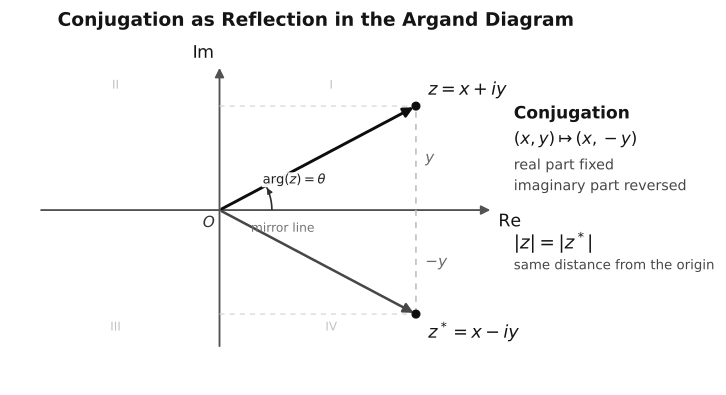 How to read the figure. Conjugation changes to , reflecting the point in the real axis while preserving its modulus. The two arguments have opposite signs except at the principal-argument boundary on the negative real axis.
Complex Roots of Equations
Why complex roots matter
Some polynomial equations have no real roots.
For example,
gives
There is no real number whose square is . But in the complex number system,
so the equation has two complex roots:
This is one reason complex numbers are useful: they allow polynomial equations to have roots even when real numbers are not enough.
Core example: a quadratic with a negative discriminant
Solve
Here , , and , so
Using the quadratic formula,
Check by substitution:
The conjugate root also satisfies the equation because all coefficients are real. Both answers are in Cartesian form.
Enrichment — Fundamental Theorem of Algebra
Scope
The general theorem is useful context but is not itself a required 9758 result. Use it here to understand root-counting, not as a substitute for the syllabus methods below.
The Fundamental Theorem of Algebra says that every polynomial of degree with complex coefficients has exactly roots in , counting repeated roots.
This means:
- a quadratic has complex roots, counting repeated roots;
- a cubic has complex roots, counting repeated roots;
- a polynomial of degree has complex roots, counting repeated roots.
The phrase “counting repeated roots” is important.
For example,
has only one distinct root,
but this root is repeated twice. So it counts as two roots.
Similarly, a quadratic always has two roots in when repeated roots are counted, even if it has no real roots.
For example,
has roots
Conjugate Root Theorem
The Conjugate Root Theorem says that if a polynomial has real coefficients, then any non-real root must occur together with its conjugate.
So if
is a root, where and , then
is also a root.
The condition that the polynomial has real coefficients is essential. The theorem does not necessarily apply if the polynomial has non-real coefficients.
Here is the algebraic reason. If
has real coefficients, then conjugating gives
If , then . Hence is also a root.
For example, if a polynomial with real coefficients has root
then it must also have root
Why conjugate pairs give real factors
Suppose a polynomial with real coefficients has the non-real root
Then it must also have the conjugate root
The corresponding two linear factors are
and
Their product is
Rewrite each factor as
and
Then
Using the difference of squares,
Since
we have
Therefore,
So
This is a quadratic factor with real coefficients.
This identity is very useful because it allows a conjugate pair of complex roots to be converted into a real quadratic factor.
Example: forming a real quadratic factor
Suppose a polynomial with real coefficients has root
By the Conjugate Root Theorem, it also has root
The corresponding quadratic factor is
Simplify each factor:
and
So
This is a product of conjugates, so
Therefore,
So the conjugate pair
corresponds to the real quadratic factor
Solving polynomials with a given complex root
When a polynomial with real coefficients is given and one non-real root is known, use the conjugate root theorem as a problem-solving tool.
A reliable workflow is:
- Write down the conjugate of the given non-real root.
- Form the quadratic factor from the conjugate pair.
- Divide the polynomial by this quadratic factor, or compare coefficients.
- Solve the remaining factor.
- Check that the total number of roots matches the degree of the polynomial.
For example, consider
which has real coefficients and the root
It must also have root
The conjugate pair gives the real quadratic factor
Polynomial division gives
Therefore the complete root set is
Check: the factorisation expands back to , the conjugate pair has sum and product , and all three roots have been counted once.
Conceptual interpretation
The Conjugate Root Theorem expresses a symmetry.
A polynomial with real coefficients does not distinguish between the imaginary direction above the real axis and the imaginary direction below the real axis.
In the Argand diagram, the roots
and
are reflections of each other in the real axis.
That is why non-real roots of real-coefficient polynomials occur in conjugate pairs.