Vector Lines, Planes, and 3D Geometry
Overview
This branch develops the Vector II layer of the topic. The main shift is from vectors as movements to vectors as a language for describing geometric objects in three dimensions.
The central idea is:
a line or plane is a set of points generated by directions or selected by constraints.
Lines in 3D
A line in 3D is determined by one point and one direction.
If is the position vector of a fixed point on the line and is a direction vector, then
Here is the position vector of a general point on the line.
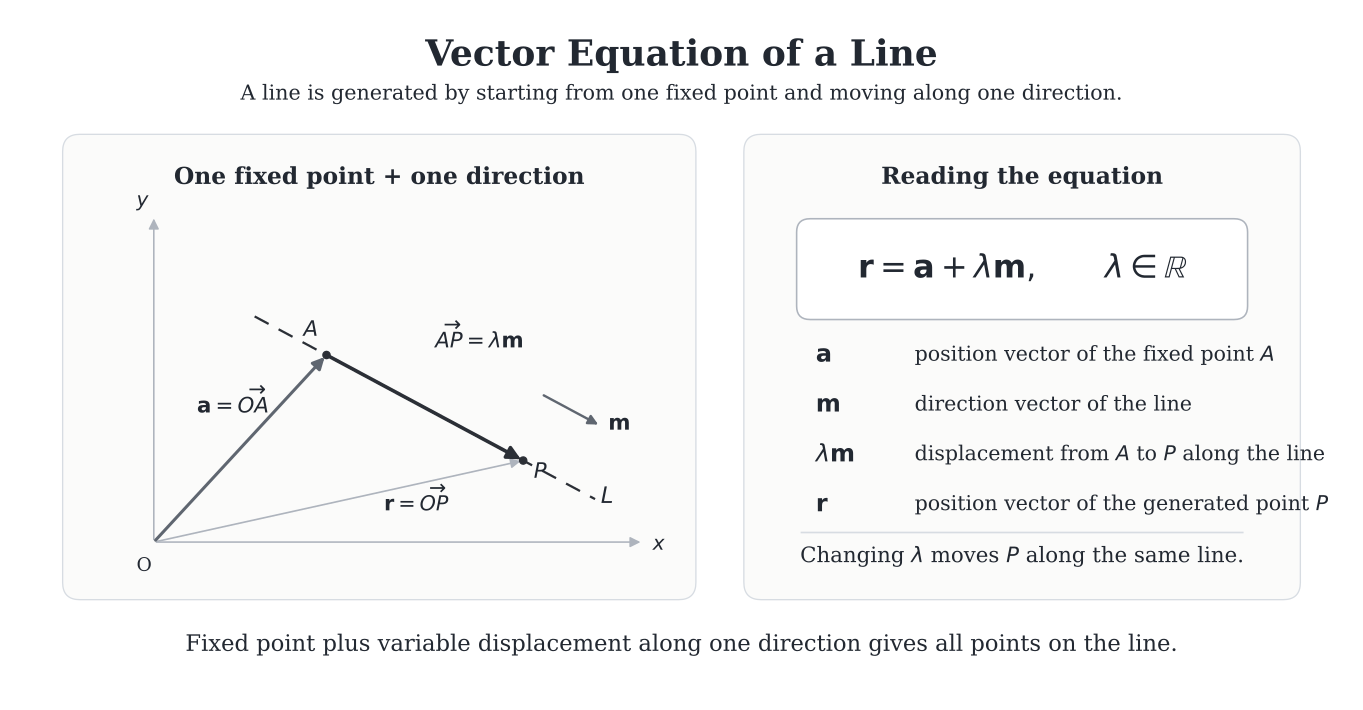 How to read the figure. The fixed point anchors the line; one shared parameter scales a non-zero direction vector to generate every point on it.
Line Through Two Points
If a line passes through and , then a direction vector is
Hence a vector equation is
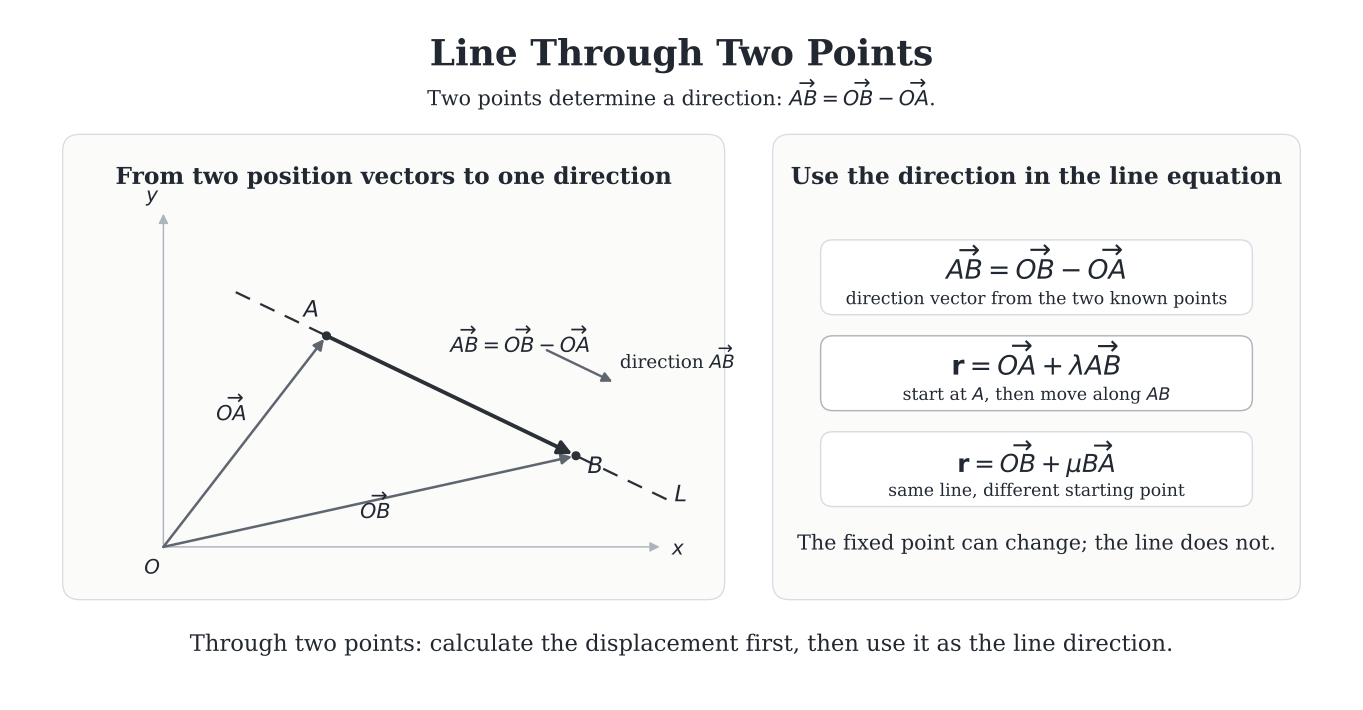 How to read the figure. is the chosen origin, and are position vectors, while is a displacement and therefore a direction vector for the line. Starting at and allowing to range over all real numbers reaches every point on the line.
The same line can be written in many ways. You may choose a different fixed point or a non-zero scalar multiple of the direction vector.
Cartesian Form of a Line
From
we get
When are non-zero, this can be written as
If a direction component is zero, the corresponding coordinate is fixed. For example, direction gives
To test whether a point lies on a line, substitute its coordinates and require the same parameter value in every component.
Relationships Between Lines
For two lines
start by comparing and .
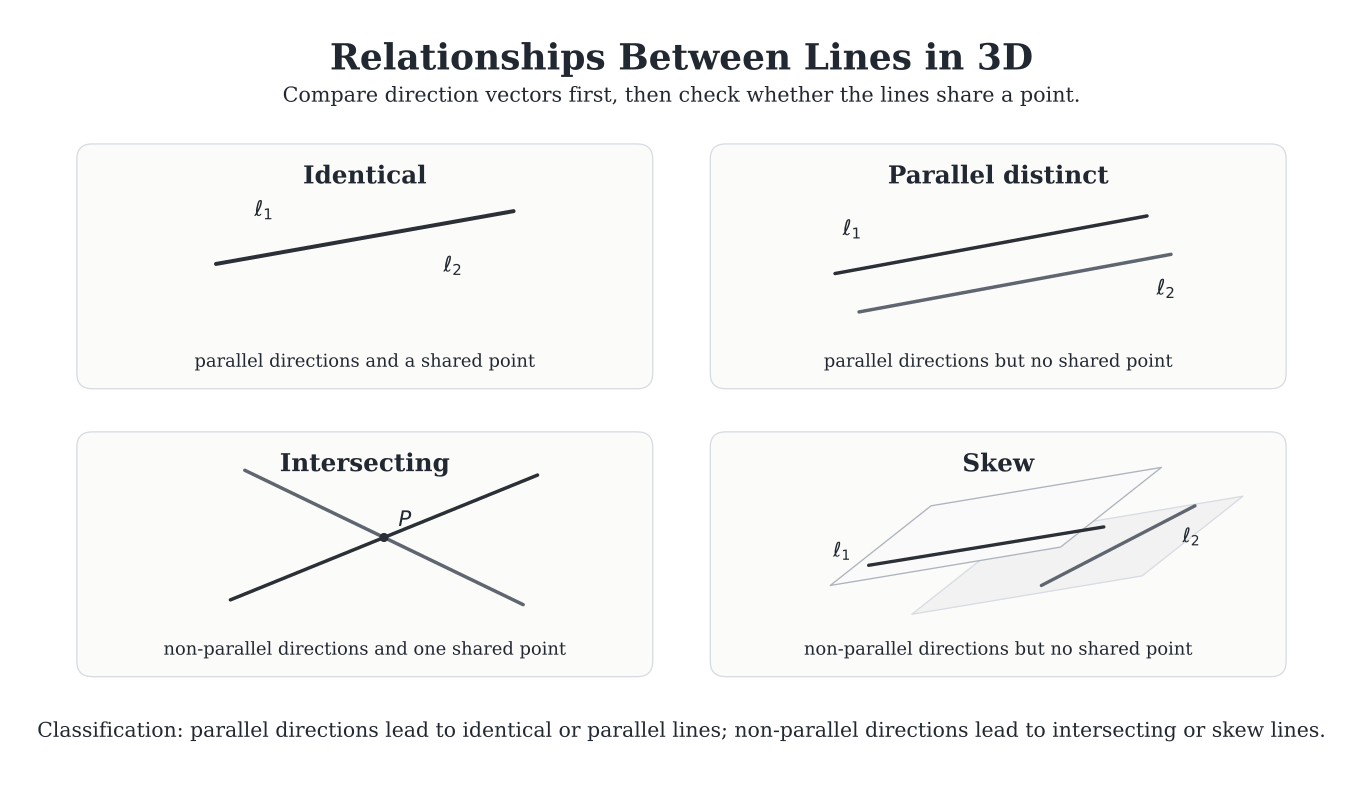 How to read the figure. The arrows labelled and are direction vectors of the two lines; they are not position vectors. For identical lines, every point on the common line is shared. If the directions are parallel, test whether the lines share any point to distinguish identical from distinct parallel lines. If the directions are not parallel, solve the two vector equations: in the intersecting panel, is the unique shared point; inconsistency gives skew lines.
Parallel or Identical
If and are scalar multiples, the lines have parallel directions.
Equivalently, for non-zero 3D direction vectors, you may test
This works because the vector product has magnitude
so it is zero when the direction vectors are parallel or anti-parallel.
This test only tells you that the directions are parallel. It does not yet tell you whether the two lines are the same line.
Then test whether a point from one line lies on the other line.
- If yes, the lines are identical.
- If no, the lines are distinct and parallel.
Intersecting or Skew
If and are not scalar multiples, solve
- If a consistent pair exists, the lines intersect.
- If the equations are inconsistent, the lines are skew.
Skew lines are possible only in 3D geometry. They are non-parallel lines that do not meet.
Planes in 3D
A plane can be described in two main ways.
Parametric Form
If a plane passes through a fixed point with position vector and has two non-parallel direction vectors and , then
The two directions must be non-parallel. Otherwise the expression generates only a line.
Normal Form
If is perpendicular to the plane and is the position vector of a fixed point on the plane, then
This says that the vector from the fixed point to any point on the plane lies inside the plane, so it is perpendicular to the normal vector.
Equivalently,
for some constant .
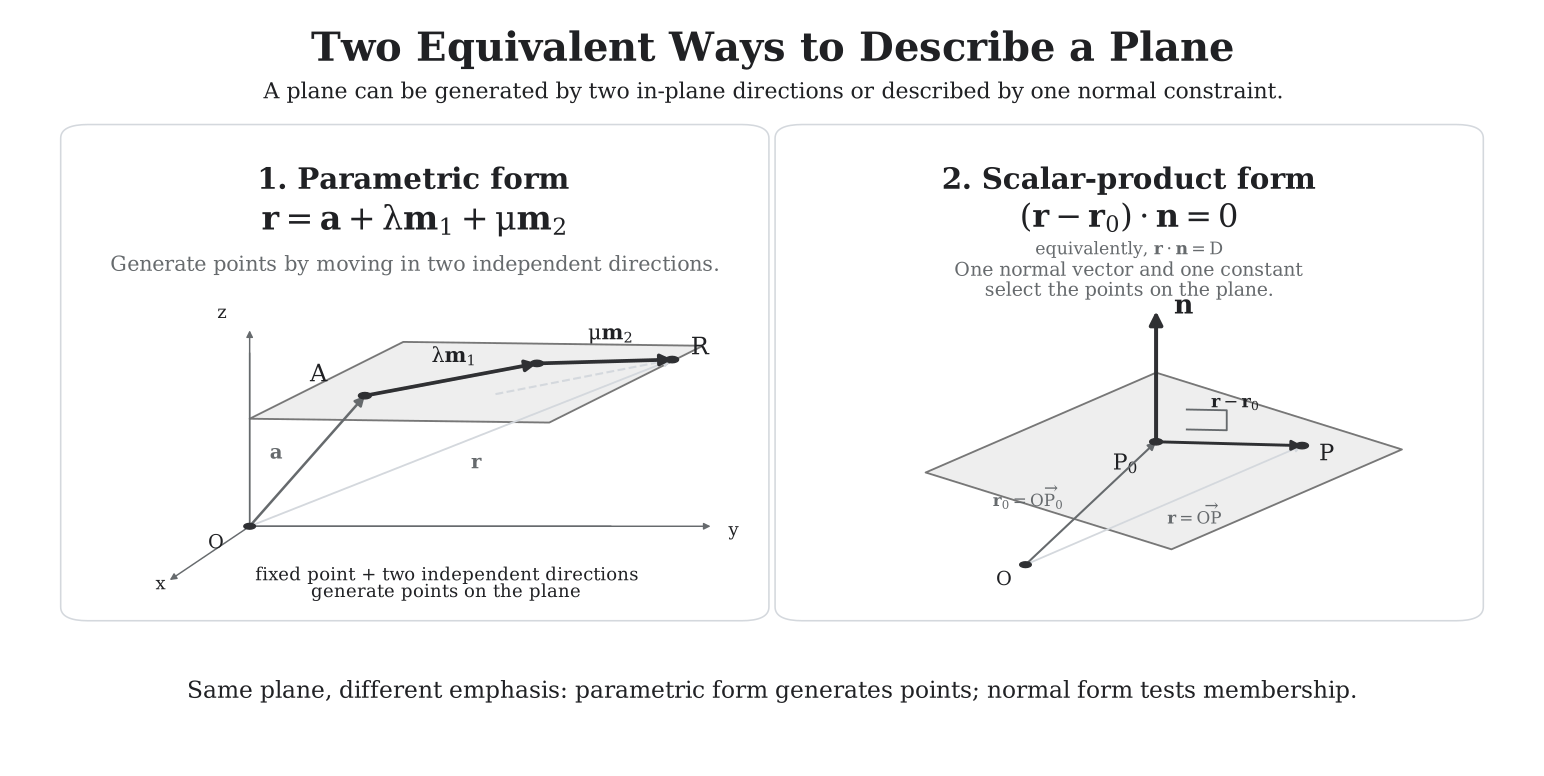 How to read the figure. In the left panel, locates the fixed point , while the non-parallel vectors and lie in and span the plane. In the right panel, is a fixed point on , is a general point on , and . The difference is an in-plane displacement, so it is perpendicular to the normal and . Equivalently, with . The special equation describes only a plane through the origin.
Cartesian Plane Equation
If
then
becomes
The vector
is a normal vector to the plane.
Converting and constructing planes
From two independent in-plane directions , form
Then the plane is . For three non-collinear points , use as a normal. Conversely, from a Cartesian plane, choose one point satisfying it and two independent vectors perpendicular to its normal. A point lies on the plane exactly when its position vector satisfies .
Example: through with directions and , a normal is , so and the plane is .
Relationships Involving Planes
Line and Plane
For
the key test is
This test compares the direction of the line with the normal direction of the plane.
- If , then has a component in the normal direction. The line is not parallel to the plane, so it must cut the plane at exactly one point.
- If , then is perpendicular to . This means the line direction is parallel to the plane, but it does not yet tell us whether the line is outside the plane or contained in it.
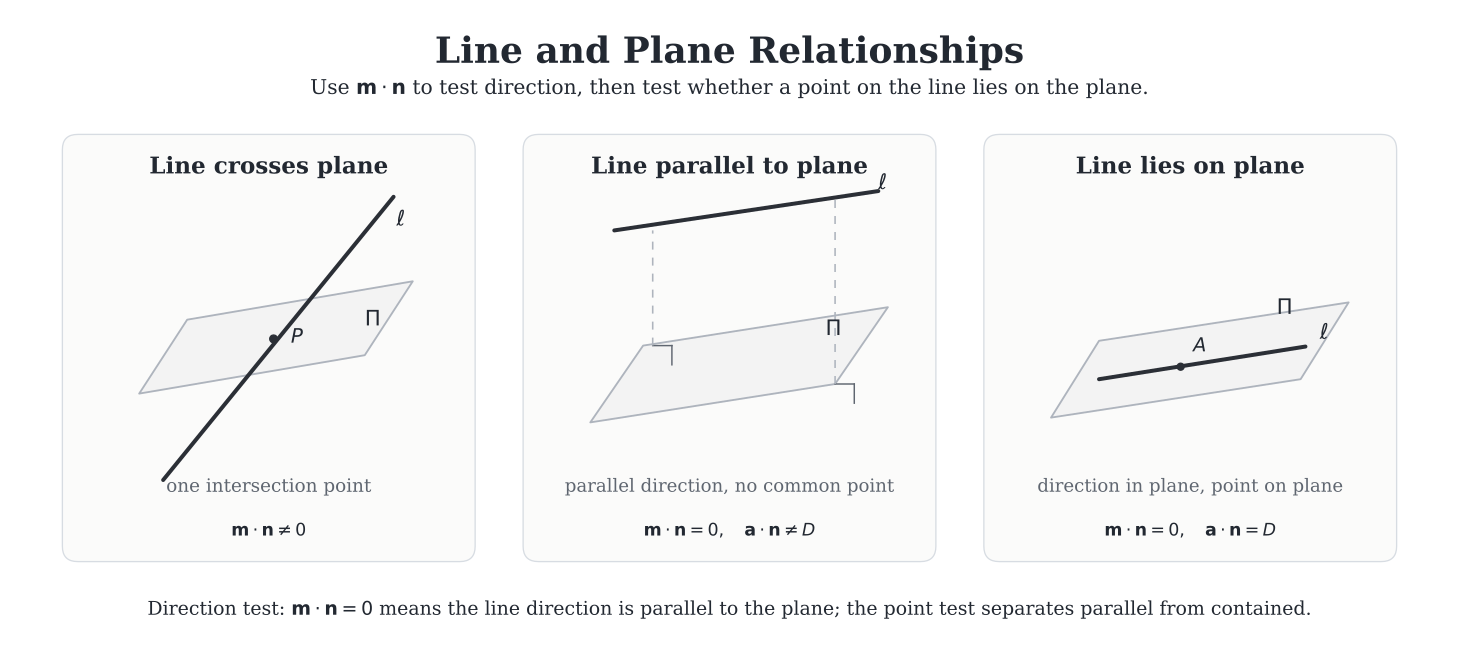 How to read the figure. is drawn along the line and is its direction vector; is drawn perpendicular to the plane and is its normal. First compute . A non-zero value means the line has a normal component and crosses the plane once. A zero value means only that the direction is parallel to the plane, so use to test whether the fixed point lies on the plane.
To distinguish the last two cases, check whether the fixed point on the line lies on the plane:
The full decision structure is:
- If , the line intersects the plane at one point.
- If and , the line is parallel to the plane but not on it.
- If and , the line lies entirely on the plane.
This is why the point test matters. The condition only says that the line direction is parallel to the plane; it does not decide whether the line itself is inside the plane.
If the line intersects the plane, the intersection point is found by substituting
into
and solving for .
Two Planes
For
compare the normal vectors.
The normal vector controls the orientation of a plane. Therefore, the first question is not whether the two equations look similar, but whether their normal vectors point in the same direction.
- If and are not parallel, the planes are not parallel. In 3D, two non-parallel planes meet in a line.
- If and are parallel, the planes have the same orientation. They may be distinct parallel planes, or they may be the same plane written in different forms.
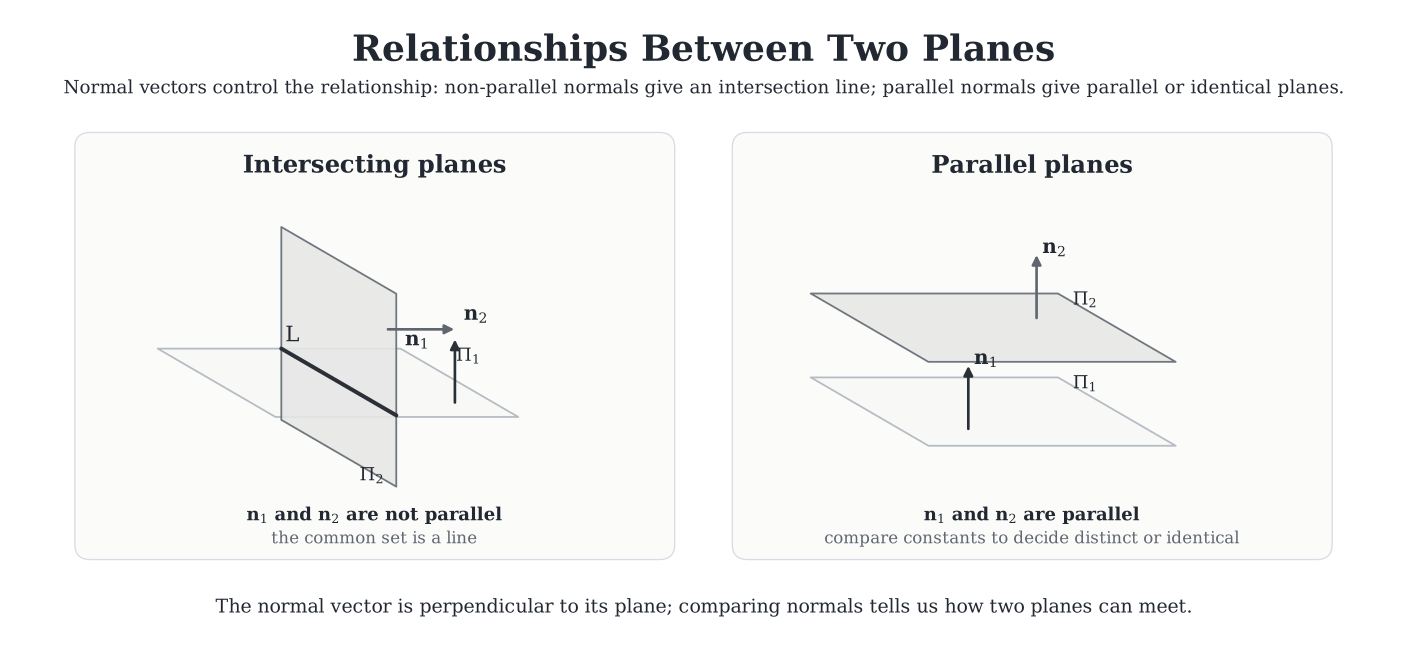 How to read the figure. Each normal label is placed beside its own arrow. If and are not parallel, the two shaded surfaces meet along the bold common line . If the normals are parallel, compare the complete equations using the same scale factor to distinguish identical from distinct parallel planes.
To test whether the normal vectors are parallel, check whether one is a scalar multiple of the other:
for some non-zero scalar . Equivalently, in three dimensions,
The vector-product test is useful when the scalar multiple is not immediately obvious.
If the normal vectors are parallel, compare the whole plane equations consistently. For example, if
then compare whether
- If , the two equations represent the same plane.
- If , the planes are distinct and parallel.
This constant check is essential. It is not enough to say that the normals are parallel, because parallel normals only tell us that the planes have the same orientation.
If the normal vectors are not parallel, the planes intersect in a line. To find the line of intersection, solve the two plane equations simultaneously. There will be one free parameter, because the common set is a line rather than a single point.
A practical workflow is:
- Compare and .
- If they are parallel, compare the constants using the same scalar multiple.
- If they are not parallel, solve the two plane equations and express the common points using a parameter.
Example:
represent the same plane, because the second equation is exactly twice the first.
But
represent distinct parallel planes, because the left side has been multiplied by but the constant has not.
For non-parallel planes, such as
the normals are not scalar multiples. Subtracting the equations gives , so . Substituting into gives . Letting gives the line
So the intersection of two non-parallel planes is not just a visual line; it is the set of all points satisfying both plane equations.
Three Planes
Three-plane problems are simultaneous-equation problems in geometric language. Each plane gives one linear equation in , and the question is asking for the common solution set of all three equations.
For
the coefficient vectors
are the normal vectors of the three planes. The algebra and geometry should agree:
- A unique solution means the three planes meet at one point.
- One free parameter means the common solution set is a line.
- Two free parameters means the common solution set is a plane, usually because the equations are dependent.
- An inconsistent system means there is no common point.
This is why row reduction or simultaneous solving is not just algebraic manipulation. It is a way of identifying the dimension of the intersection.
The safest workflow is:
- Write the three plane equations in standard linear form.
- Solve the simultaneous system systematically.
- Watch for contradictions, such as .
- Count the number of free parameters if the system is consistent.
- Translate the algebraic result back into geometry.
The common outcomes are:
| Algebraic result | Geometry |
|---|---|
| unique solution | three planes meet at one point |
| one parameter remains | three planes share a common line |
| two parameters remain | the three equations describe the same plane, or reduce to one plane condition |
| contradiction occurs | no common point |
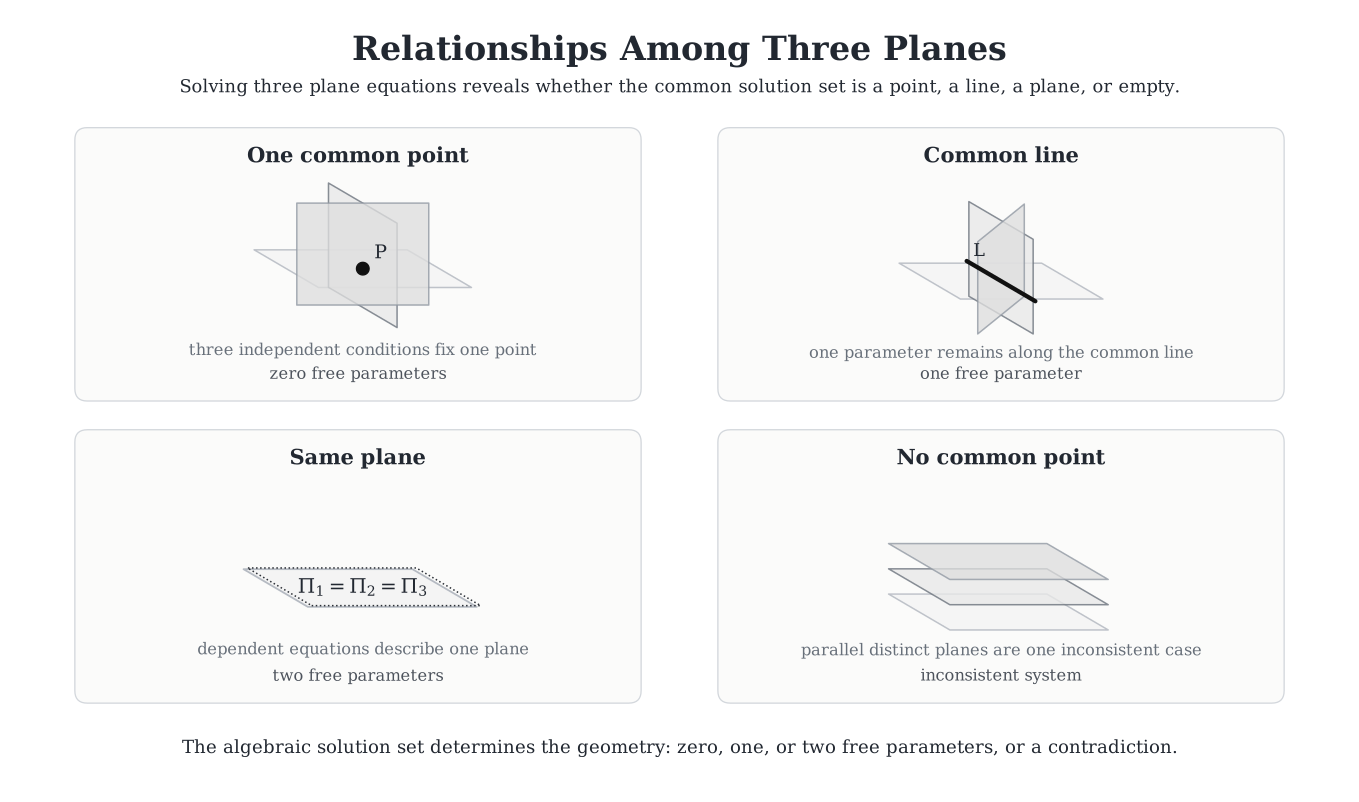 How to read the figure. Translate the simultaneous-system outcome into geometry. In the upper-left panel, is the single point common to all three planes. In the upper-right panel, the same bold line lies inside all three shaded plane surfaces, so . Zero, one and two free parameters correspond respectively to a point, a line and one common plane; inconsistency gives no common point. The lower-right drawing is one representative inconsistent arrangement, not the only possible one.
Examples of what the algebra is telling you:
- If solving gives , , , the planes meet at the single point .
- If solving gives , , , the common set is a line.
- If the system reduces to only , then the common set is a plane.
- If the system produces , the three planes have no common point.
Be careful with the phrase “the planes intersect pairwise”. Three planes may intersect two at a time without sharing one common point. The question is usually asking whether there is a point, line, or plane common to all three planes.
For exam work, the conclusion should be stated in both forms:
- algebraically, by giving the point, line equation, plane equation, or contradiction
- geometrically, by saying how the three planes are arranged
For example, if the solution is
then the geometric conclusion is that the three planes share a common line, not merely that “there are infinitely many solutions”.
Angles
Compact numerical angle examples
- Lines with directions and have , hence acute angle .
- Planes with normals and likewise meet at .
- A line of direction and a plane of normal satisfy , so the line-plane angle is approximately .
These examples use direction vectors for lines, normal vectors for planes, an absolute value for the usual acute angle, and degree mode.
Angle Between Two Lines
If the lines have direction vectors and , then the acute angle between them satisfies
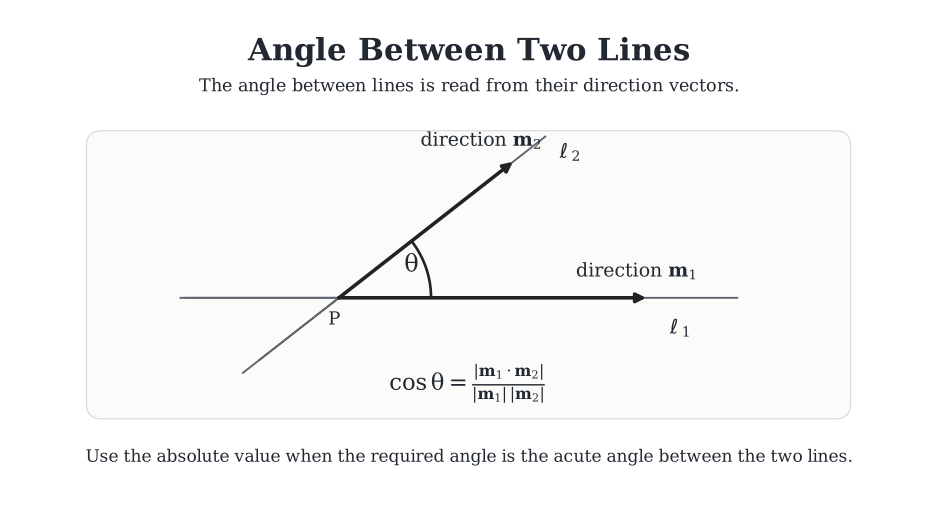 How to read the figure. Extract direction vectors rather than point vectors; the absolute dot product removes arbitrary reversal of either line direction and returns the acute angle.
The position of the lines does not affect the angle. Only their directions matter. This is why the formula uses direction vectors rather than position vectors of points on the lines.
The absolute value appears because a line has no preferred orientation. Reversing a direction vector changes to its negative, but it does not change the geometric line. Therefore, H2 questions usually ask for the acute angle between two lines:
If a question asks for the obtuse angle instead, find the acute angle first and subtract from .
A reliable workflow is:
- extract one direction vector from each line
- compute
- compute and
- substitute into the cosine formula
- check whether the question wants the acute or obtuse angle
Common traps:
- Do not use a point vector such as as the line direction.
- Do not forget the absolute value if the acute angle is required.
- Do not assume two skew lines cannot have an angle. Their angle is still defined by their direction vectors.
Angle Between Two Planes
The angle between two planes is the angle between their normal vectors:
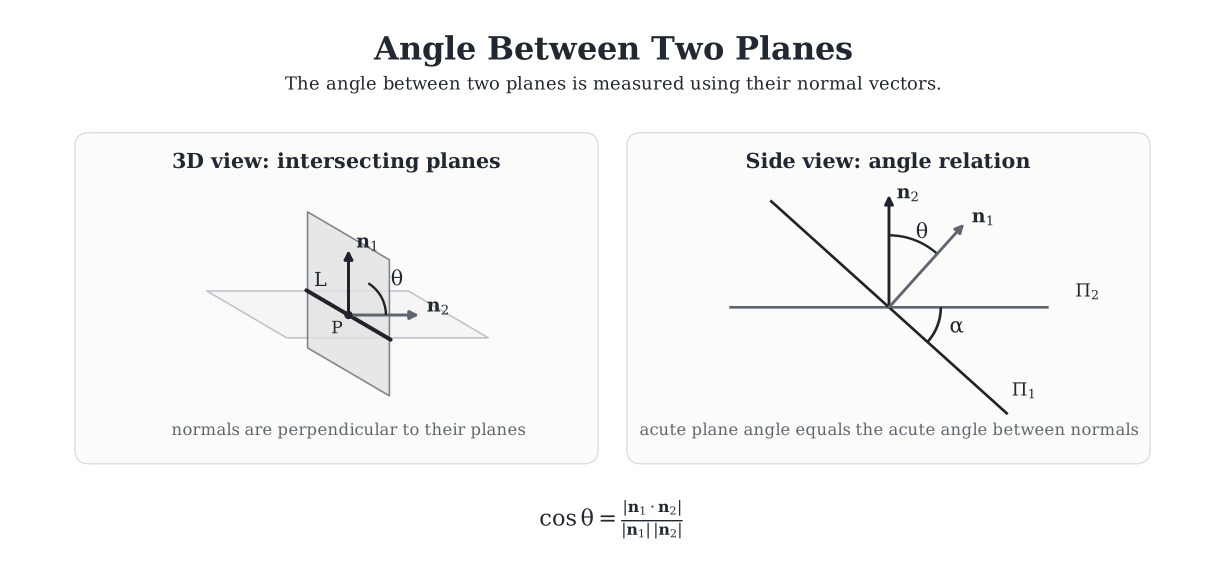 How to read the figure. In the perspective panel, the bold line is drawn exactly on both surfaces and therefore represents . Looking perpendicular to gives the middle cross-section. Each plane becomes a trace line, and its labelled normal is drawn perpendicular to that trace; the acute angle between the traces equals the acute angle between and . Hence the absolute dot-product formula applies. To build and rotate your own model, use the optional GeoGebra 3D Calculator; it opens a general construction tool, not a pre-built version of this diagram.
This formula works because the orientation of a plane is controlled by its normal vector. Instead of trying to measure the angle between two slanted surfaces directly, compare the directions perpendicular to those surfaces.
For a plane written as
a normal vector is
So the calculation is usually:
- extract the normal vector from each plane equation
- compute
- compute and
- use the cosine formula
- take the acute angle unless the question explicitly asks otherwise
The absolute value has the same role as in the angle-between-lines formula. A normal vector can be reversed without changing the plane, so and describe the same plane orientation. The acute angle between planes should not depend on which normal direction was chosen.
If the angle between the normal vectors is obtuse, the acute angle between the planes is its supplement:
Using
builds this acute-angle convention directly into the calculation.
Common traps:
- Do not use direction vectors lying in the planes unless they are chosen very carefully.
- Do not confuse the line of intersection with a normal vector.
- Do not forget that parallel planes have angle , because their normal vectors are parallel.
- Do not report an obtuse angle when the question asks for the angle between two planes in the usual acute sense.
Angle Between a Line and a Plane
The angle between a line and a plane is the angle between the line and its projection onto the plane. In the figure, the line meets the plane at , the point lies on the line, and is the projection of onto the plane. The angle is the angle between and .
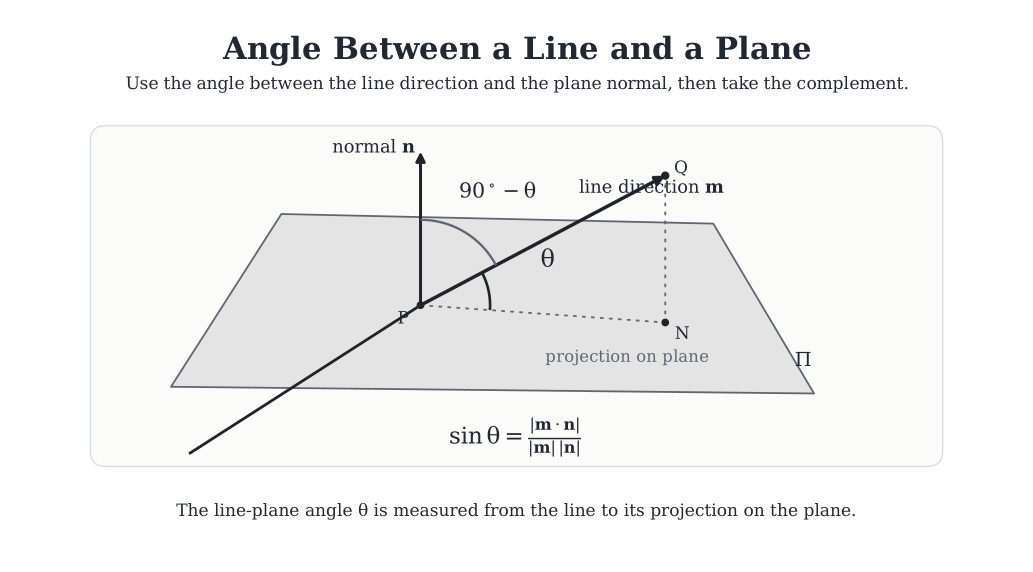 How to read the figure. Project the line direction onto the plane. The required acute angle is between the line and that projection; equivalently it is complementary to the angle with the normal, producing the sine formula.
This definition matters because the plane contains infinitely many lines through . The projection direction gives the smallest angle between the given line and any line lying in the plane.
If the line has direction vector and the plane has normal vector , then the normal vector is perpendicular to the plane. Therefore, the angle between and is the complement of the line-plane angle:
Using the dot product on and gives
Since , the working formula is
A reliable workflow is:
- identify the line direction vector
- identify a normal vector to the plane
- compute
- substitute into the sine formula
- report the acute line-plane angle
For example, if
and
then use
Special cases are useful checks:
- If , the line direction is parallel to the plane, so the line-plane angle is .
- If is parallel to , the line is perpendicular to the plane, so the line-plane angle is .
Common traps:
- Do not use the cosine formula directly with and as the final answer unless you want the angle between the line and the normal.
- Do not confuse a line lying in the plane with a line merely parallel to the plane; both have line-plane angle , but their positions are different.
- Do not forget the absolute value when the acute angle is required.
Distances
Distances in vector geometry are perpendicular distances.
The useful first question is always: perpendicular to what?
- For point-to-plane distance, use the plane normal direction.
- For point-to-line distance, use the perpendicular component away from the line direction.
Point to Plane
A point-to-plane distance is the shortest distance from a point to a plane. The shortest path is perpendicular to the plane, so the normal vector is the key object.
Suppose the plane is
and the external point has position vector . Let be any point on the plane, with position vector . Then
is a vector from the plane to the point.
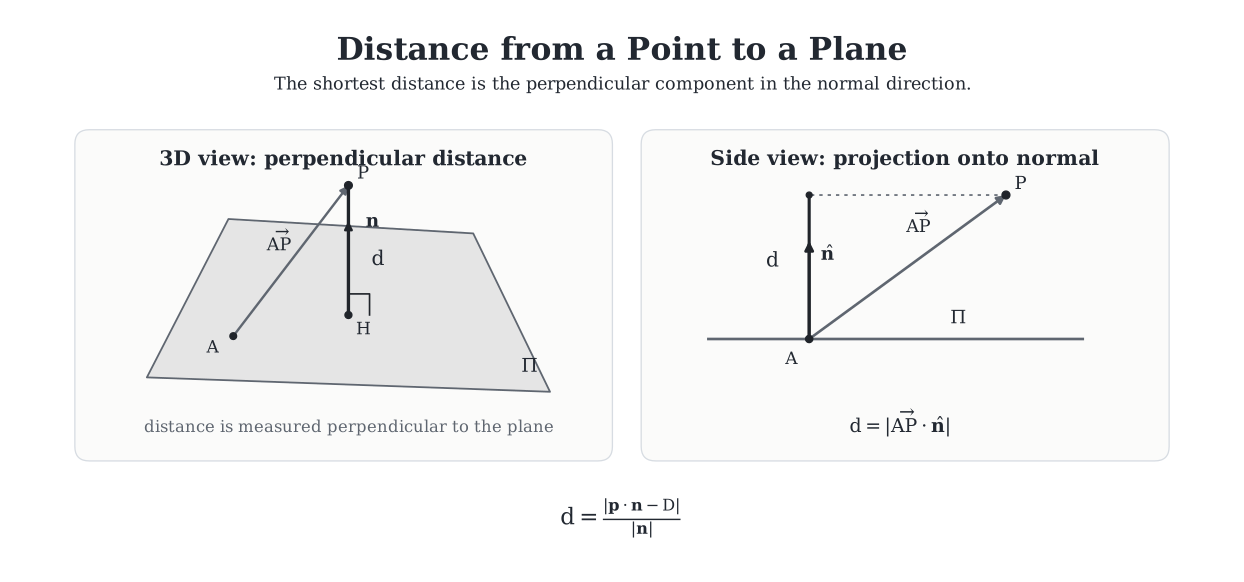 How to read the figure. is the origin, locates the given point, and locates the perpendicular foot on the plane. Hence is parallel to the normal , and its magnitude is the shortest distance. The symbol is a position vector; is the corresponding point.
The vector is usually not perpendicular to the plane. It can be split into:
- a component parallel to the plane
- a component perpendicular to the plane
Only the perpendicular component gives the distance. In the figure, is the foot of the perpendicular from to the plane, so the distance is .
If is a unit normal vector, then the perpendicular component of in the normal direction is
But the plane equation usually gives a normal vector that is not necessarily a unit vector. Since
we have
Now use the fact that lies on the plane. Therefore
So
Hence the standard formula is
The foot of the perpendicular has position vector
It should satisfy both and .
A reliable workflow is:
- write the plane in the form
- identify the point position vector
- compute
- take the absolute value
- divide by
Common traps:
- Do not use the length of unless that vector is perpendicular to the plane.
- Do not forget to divide by if is not a unit vector.
- Do not omit the absolute value; distance must be non-negative.
- If the plane is written as , rewrite it as or use the equivalent formula carefully.
Point to Line
A point-to-line distance is the shortest distance from a point to a line. The shortest segment must be perpendicular to the line.
For a line
and a point with position vector , the vector
joins a known point on the line to the point .
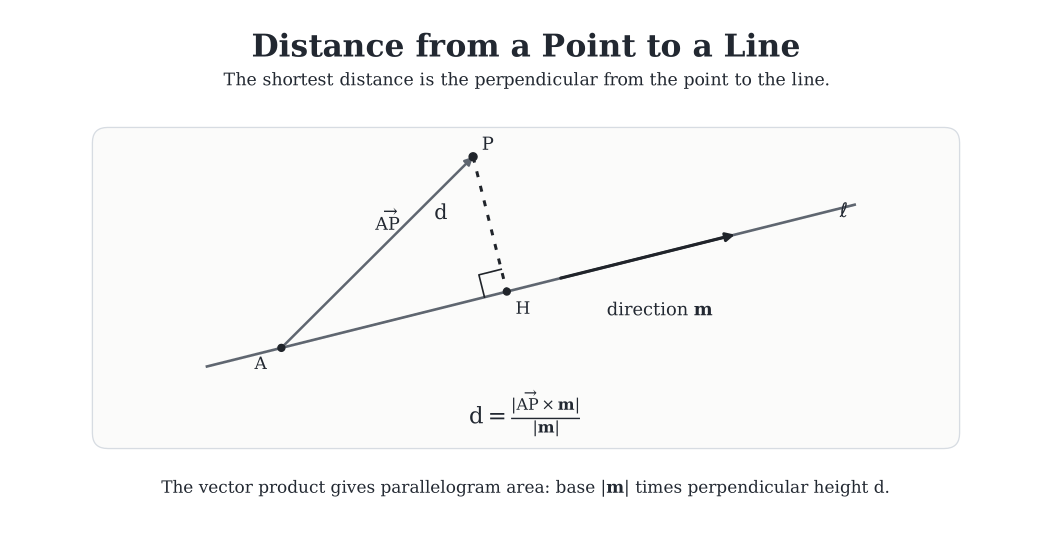 How to read the figure. Project onto the line direction to locate the foot; subtracting that parallel component leaves the shortest perpendicular displacement.
In the figure, is the foot of the perpendicular from to the line. The required distance is , not the length of the slanted vector .
There are two common ways to compute this distance.
The foot can be found directly. Write and impose , giving
Then .
Method 1: subtract the parallel component.
- Form , or equivalently .
- Project onto the line direction .
- Subtract that parallel component.
- Take the magnitude of the remaining perpendicular component.
Method 2: use the vector product area formula.
The magnitude
is the area of the parallelogram formed by and . The same area is also
Therefore
Equivalently,
This formula works in 3D because the vector product measures the area generated by two vectors. It is often faster than explicitly finding the foot .
Common traps:
- Do not use unless is already perpendicular to the line.
- Do not forget to divide by ; the vector product gives area, not height.
- Any point on the line may be used, but must be a direction vector of the line.
- If the question asks for the foot as well as the distance, use the projection method rather than only the vector-product formula.
Enrichment: Skew-Line Distance
The current 9758 summary excludes formal shortest-distance calculations between skew lines. If this appears in older notes, treat it as enrichment rather than core revision material.
Conceptually, the shortest distance between skew lines is along a direction perpendicular to both line directions, often found using a vector product.
Core Examples
Example 1: Line Through Two Points
Let and . Then
A vector equation of the line is
Example 2: Plane Through a Point and Two Directions
If a plane passes through
and is parallel to
then
Example 3: Line-Plane Intersection Test
For
and
we compute
Since this is non-zero, the line intersects the plane at exactly one point.
Consolidated worked checks
Membership and line intersection
For and , the first two coordinates give and ; the third coordinate also agrees, so the lines intersect at . If the third coordinate failed, the non-parallel lines would be skew. Checking every coordinate prevents a false intersection.
Line-plane intersection
For and , substitution gives , hence and intersection point . If the coefficient of were zero, test the fixed point: it would distinguish a contained line from a distinct parallel line.
Two-plane intersection
The planes and have normals and . Their intersection direction is , parallel to . Solving the equations gives and , so
Feet and distances
For point and plane , the foot formula gives and distance . For the -axis, and ; the line-foot formula gives and distance . In each case verify membership and perpendicularity.
Three-plane interpretation
Solve all three equations and count free parameters. A unique solution gives one common point; one free parameter gives a common line; two free parameters means the same plane; inconsistency means no common point. The inconsistent geometry may be all parallel, exactly two parallel, or three pairwise-intersecting planes whose intersection lines are not concurrent. Pairwise intersections alone therefore do not guarantee a common point.
Common Errors
- Treating the vector equation of a line as unique.
- Using two parallel direction vectors to define a plane.
- Confusing a direction vector in a plane with a normal vector to the plane.
- Saying a line is parallel to a plane from without checking whether it lies in the plane.
- Forgetting that two non-parallel lines in 3D may be skew.
- Thinking two non-parallel planes meet at one point. They meet in a line.
- Using the angle between a line and a plane normal when the question asks for the angle between the line and the plane.
- Treating distance formulas as arbitrary rather than as perpendicular projections.
Revision Checklist
- Can I explain why one parameter generates a line?
- Can I explain why two non-parallel parameters generate a plane?
- Can I convert between parametric and normal forms of a plane?
- Can I read a normal vector directly from ?
- Can I classify two lines as parallel, identical, intersecting, or skew?
- Can I classify a line and a plane using both the direction test and the point test?
- Can I classify two planes by comparing their normal vectors?
- Can I choose the correct vectors for line-line, plane-plane, and line-plane angles?
- Can I explain distance formulas using perpendicular components or projections?