Vector Foundations and Products
Overview
This branch develops the Vector I layer of the topic. The main purpose is to make vector algebra meaningful before it is used for lines, planes, angles, and distances.
A vector should be read as a directed movement. Column-vector notation is a compact way of recording that movement component by component.
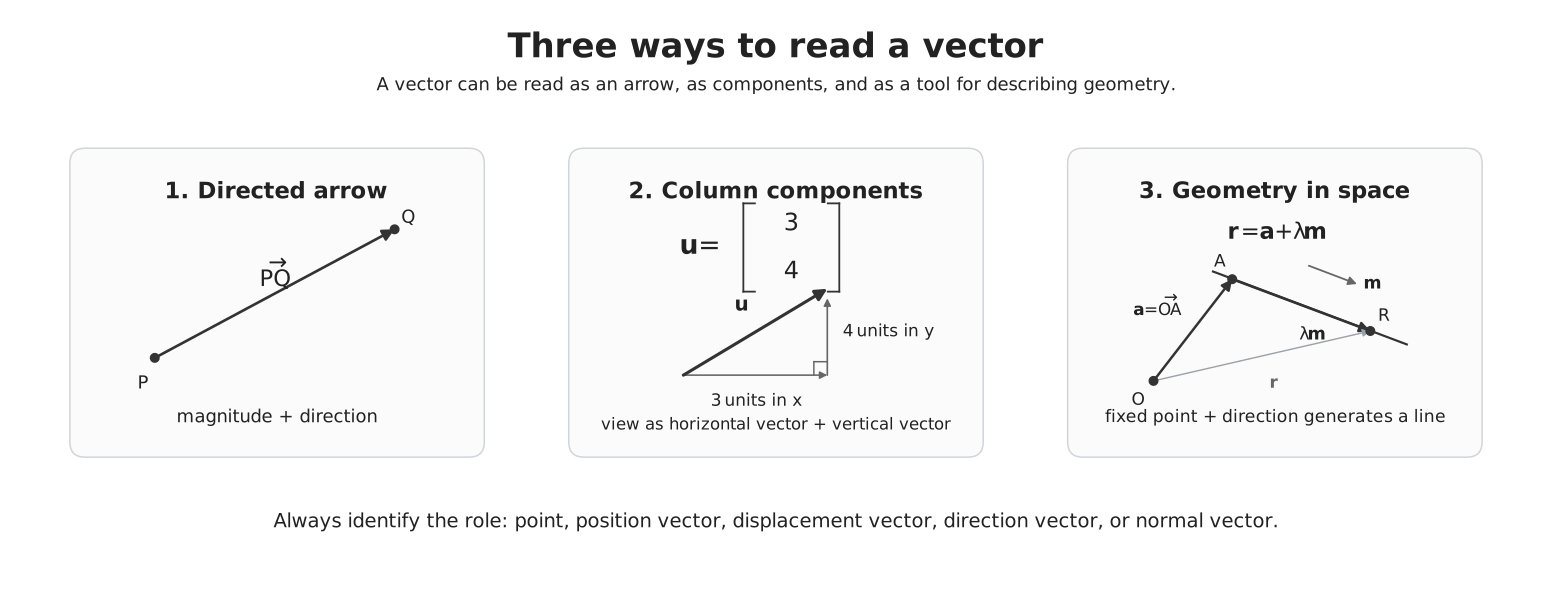 How to read the figure. The same vector idea appears in three roles: a directed arrow, a column-vector component description, and a direction used from a fixed point. The middle panel uses the JC convention : the upper component is the horizontal change and the lower component is the vertical change. In the third panel, locates , whereas is a scalable displacement along the line.
Scalars, Vectors, and Components
A scalar has magnitude only. A vector has magnitude and direction.
Examples of scalars include distance, speed, mass, and time. Examples of vectors include displacement, velocity, force, and acceleration.
In two dimensions,
means a movement of units in the first coordinate direction and units in the second coordinate direction.
In three dimensions,
Two vectors are equal when their corresponding components are equal. For non-zero vectors this is equivalent to having the same magnitude and direction; the zero vector has magnitude but no defined direction. Vectors do not need to start at the same point in a diagram.
The standard basis vectors are . Thus . Vector addition and scalar multiplication are componentwise; vector division is not defined.
Magnitude and Unit Vectors
The magnitude of
is
If , the unit vector in the direction of is
This operation keeps the direction but changes the magnitude to .
Position and Displacement Vectors
A position vector locates a point from the origin. A displacement vector compares two points directly.
If and have position vectors and , then
This is not just a formula. It says:
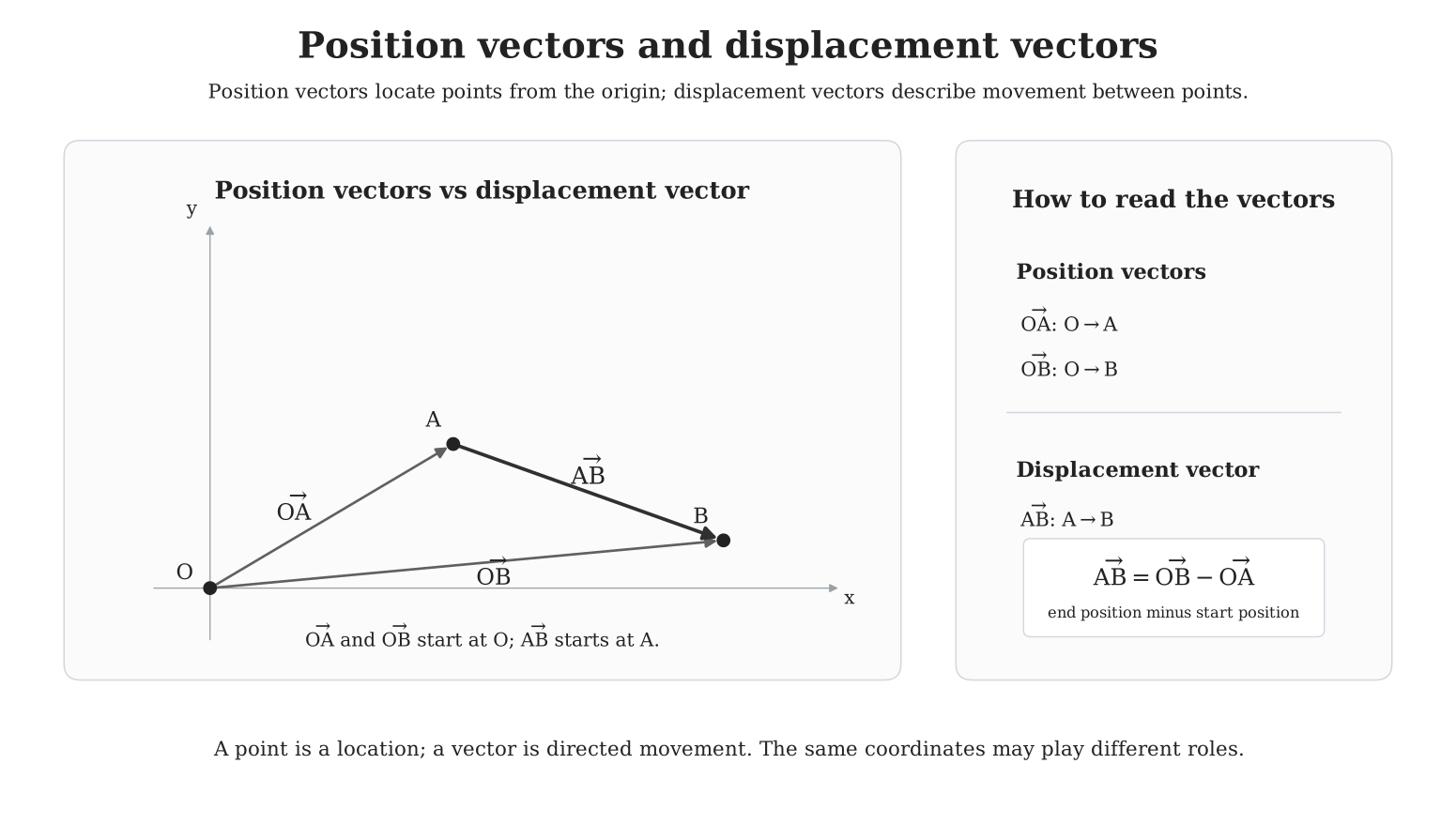 How to read the figure. Follow , then rearrange to obtain ; the origin cancels from the displacement.
Ratio Theorem
Ratio theorem is a position-vector method for locating a point on a line segment or produced line.
Suppose divides internally in the ratio, where ,
Then
The weights are crossed because is closer to the endpoint with the larger opposite weight.
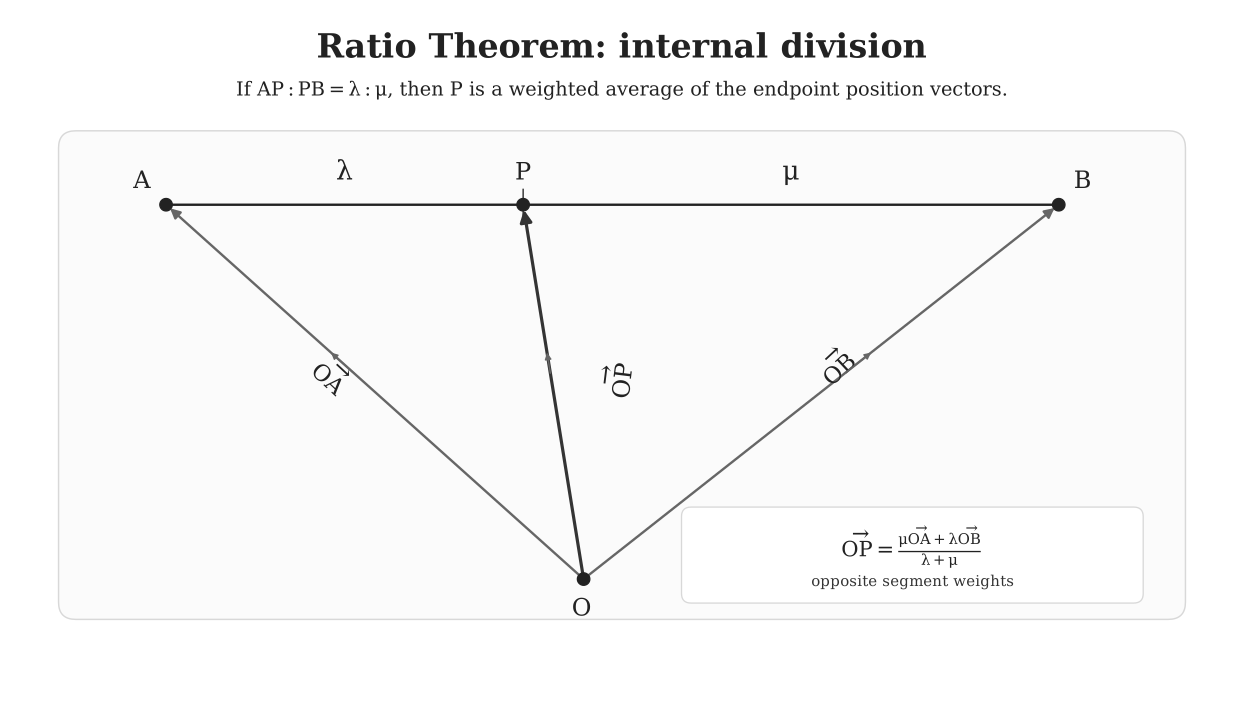 How to read the figure. For internal division, . Hence and ; this directly checks the crossed weights.
Midpoint Case
If is the midpoint of , then
so
External Division
If lies on the produced line beyond and with , then directed-vector algebra gives
Reverse the endpoint order if the point lies beyond . Always draw the order of points and verify the two directed segment vectors have the intended ratio.
Do not use the internal-division formula blindly when lies outside the segment .
Vector Addition and Subtraction
Vector addition combines movements.
If
then
Geometrically, this can be read using the triangle law or the parallelogram law.
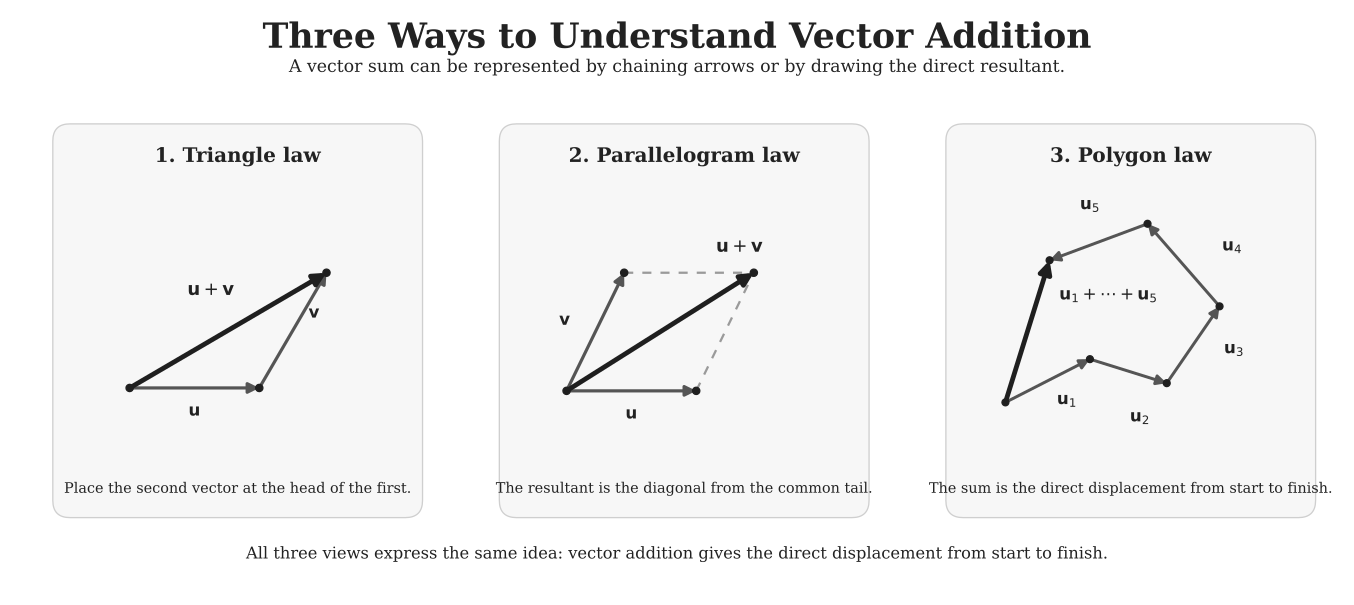 How to read the figure. In the triangle law, place at the head of ; the arrow from the original tail to the final head is . In the parallelogram law, draw both from a common tail and use the diagonal. The polygon law repeats the head-to-tail construction for any finite list of vectors.
Subtraction is addition of the negative vector:
Scalar Multiplication and Parallel Vectors
For a scalar ,
has the same line of direction as .
- If , the direction is unchanged.
- If , the direction is reversed.
- If , the result is the zero vector.
Two non-zero vectors and are parallel if
for some scalar .
This is often the quickest way to test collinearity in coordinate problems.
Scalar Product
The scalar product is defined componentwise for all vectors. For non-zero vectors it also has the geometric form
where is their angle.
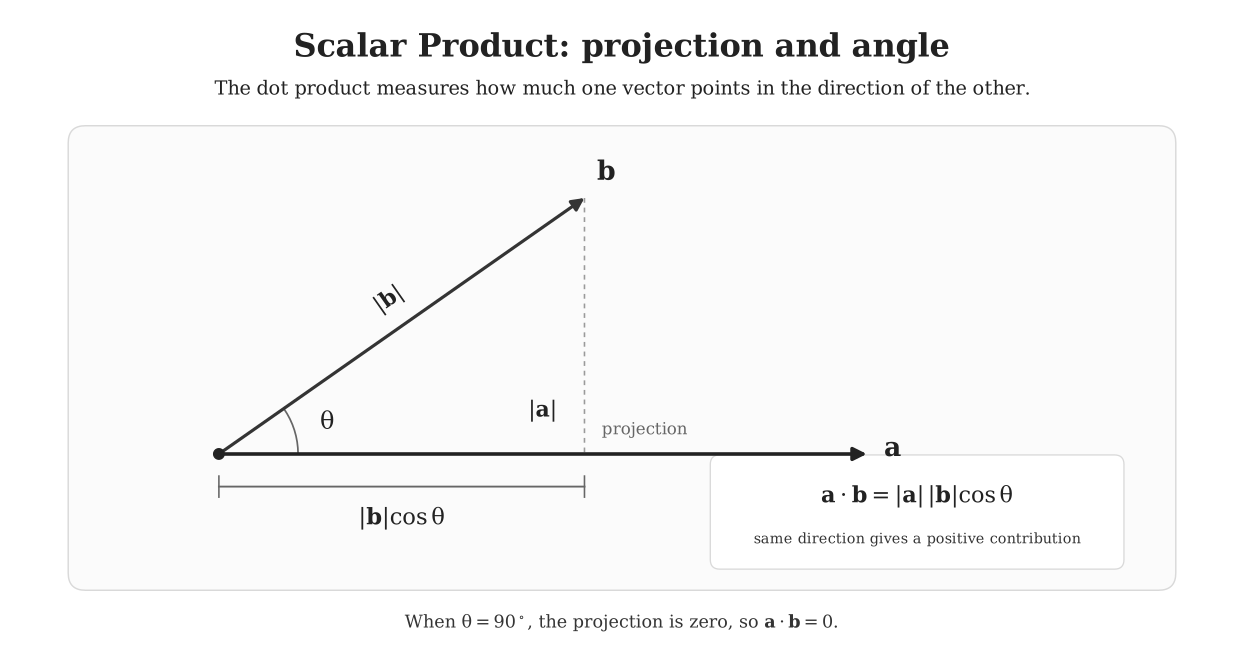 How to read the figure. Drop a perpendicular from the head of to the line in the direction; its foot is . The thick grey arrow from the common tail to is the vector projection . The dashed arrow from to the head of is the perpendicular remainder . The scalar projection is signed; the geometric segment length is its absolute value.
For components,
The scalar product returns a scalar, not a vector.
What It Measures
The scalar product measures directional agreement.
For non-zero vectors, a positive, zero or negative dot product means an acute, right or obtuse angle respectively. The zero-vector case is excluded because it has no direction.
Useful laws are , distributivity, and .
Finding Angles
If and are non-zero, then
For acute angles between lines, use an absolute value if direction vectors may point in opposite chosen directions:
Projections and Resolving
The signed scalar component of in the direction of a unit vector is
It may be negative. The non-negative projection length is . The vector projection is
For any non-zero direction vector ,
Resolving into parts parallel and perpendicular to gives
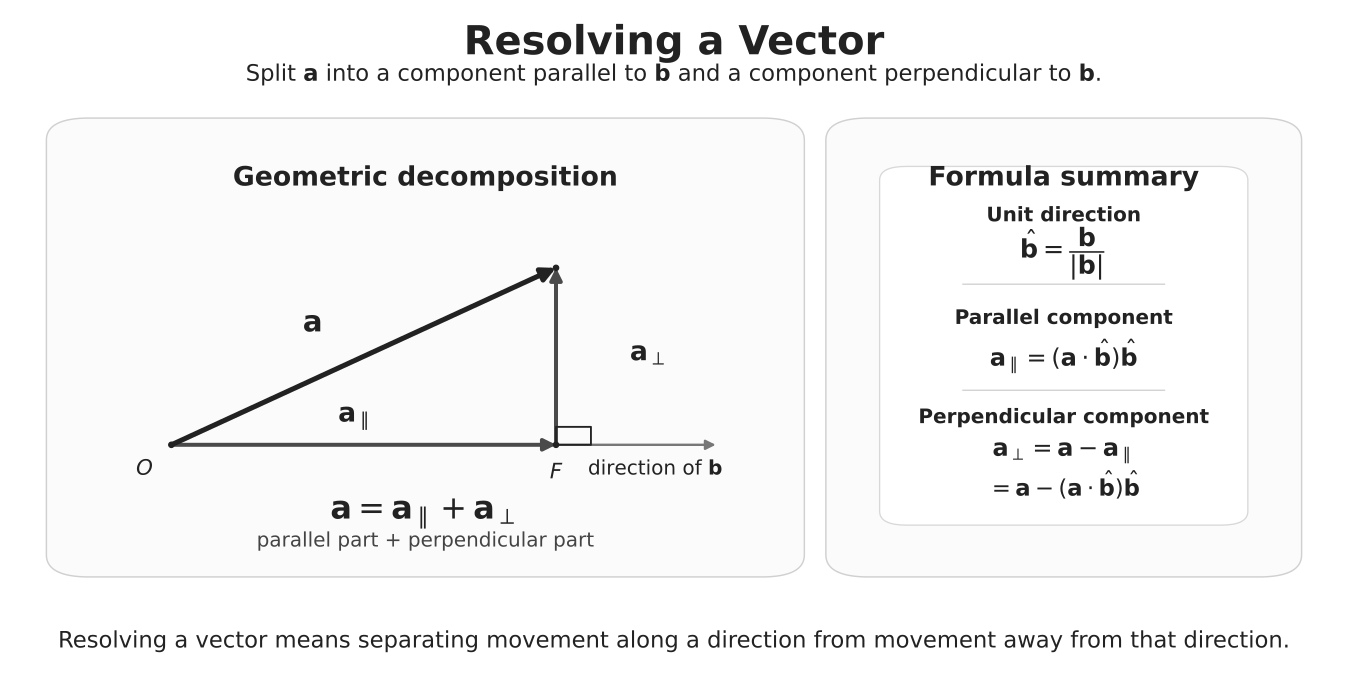 How to read the figure. Project onto the chosen non-zero direction to obtain the parallel component, then subtract it from the original vector. The remainder must have zero dot product with the direction, and the two components must sum back to the original.
Vector Product
For non-zero, non-parallel 3D vectors, is a non-zero vector perpendicular to both, with direction set by the right-hand rule. If the inputs are parallel, the product is , which has no direction.
Its magnitude is
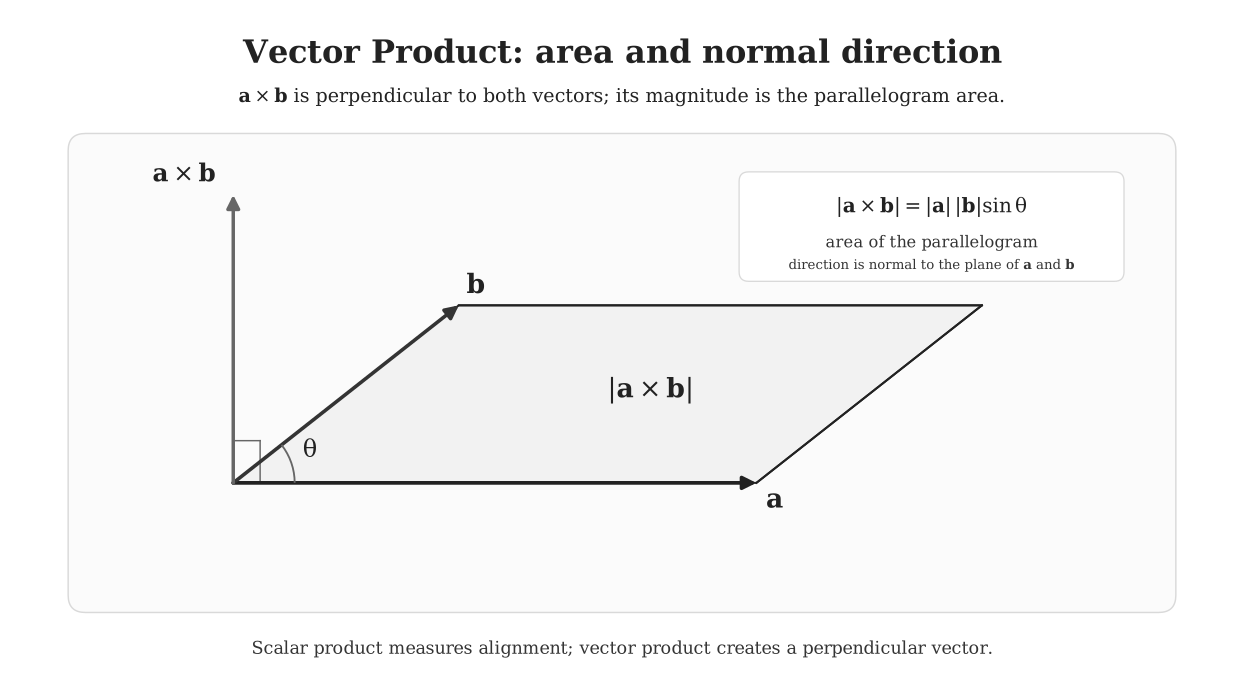 How to read the figure. The ordered product points by the right-hand rule; reversing the order reverses the normal. Its magnitude is parallelogram area, while half the magnitude is triangle area.
Order matters:
The parallelogram area is and the triangle area is . The product is distributive and compatible with scalars, but it is not commutative.
For
the vector product can be calculated by
This formula is easier to reconstruct if it is read as a component-by-component calculation rather than memorised as three unrelated expressions.
Write
Then set up the calculation as
This determinant layout is a calculation device. The first-row sign pattern is
Expanding along the first row gives
Equivalently,
The middle sign is the common trap. One safe way to calculate is:
- For the component, cover the first column and calculate .
- For the component, cover the second column and calculate the negative of .
- For the component, cover the third column and calculate .
For example, if
then
You should still check the meaning after calculating: the result should be perpendicular to both original vectors. Here,
and
So the calculated vector is perpendicular to both and , as a vector product should be.
Use the vector product when you need:
- a vector perpendicular to two given vectors
- the area of a parallelogram
- a normal vector to a plane
- a test for parallel vectors, since for parallel non-zero vectors
Core Examples
Example 1: Displacement from Position Vectors
If
then
Example 2: Ratio Theorem
Suppose
If is the midpoint of , then
Example 3: Projection
Let
Since is already a unit vector, the projection of in the direction of is
The perpendicular component is
Example 4: Non-midpoint ratio and collinearity
Let and . If , then
Indeed, and , so . More generally, distinct points are collinear when two displacement vectors from the same point are scalar multiples, such as .
Example 5: Resolution along a non-unit direction
For and ,
The perpendicular component is . Their sum is , and .
Example 6: Dot-product angle and cross-product area
For and ,
Also , so the parallelogram area is and the triangle area is . Reversing the order gives but does not change the area.
Common Errors
- Confusing a vector with the point where an arrow is drawn.
- Treating a position vector and displacement vector as the same object.
- Forgetting that means ending position minus starting position.
- Applying the internal Ratio Theorem to an external division problem.
- Assuming vector division exists.
- Treating as a vector.
- Forgetting that scalar product measures directional agreement through cosine.
- Using vector product when a scalar projection is needed.
- Forgetting that vector product is a 3D operation in this syllabus context.
- Losing the negative sign in the middle component of a vector product.
Revision Checklist
- Can I explain why a vector is not just a pair or triple of numbers?
- Can I move between arrows and column vectors?
- Can I derive from a diagram?
- Can I use the Ratio Theorem and identify internal versus external division?
- Can I test parallelism using scalar multiples?
- Can I use scalar product for angles, perpendicularity, and projections?
- Can I use vector product to find a perpendicular vector or area?
- Can I resolve a vector into parallel and perpendicular components?