Probability Distribution and CDF
Scope Label
Core 9758. This note covers the distribution-table and cumulative-probability language needed for discrete random variables.
Use it with the hub Discrete Random Variables.
Notation Recap
This note assumes that is a discrete random variable.
Keep three objects separate:
| Symbol | Meaning |
|---|---|
| the random variable | |
| one possible value of the random variable | |
| the event that takes the value |
So is the probability of an event, even though it is written using numerical notation.
From Experiment to Distribution
There is a natural chain:
- start with a random experiment
- define a random variable from that experiment
- identify the possible values of the variable
- attach probabilities to those values
- use the distribution to calculate probabilities and summaries
The experiment comes first. The random variable is built from the experiment. The distribution is built from the random variable.
For example, suppose two fair coins are tossed and is the number of heads.
| Outcome | Value of |
|---|---|
The possible values of are , and the probability distribution is:
The distribution no longer lists the original outcomes. It lists the possible numerical values of and their probabilities.
Probability Mass Function
For a discrete random variable, write
This is the probability mass function (PMF). Some older notes call it a “probability distribution function” or discrete “pdf”; here it is a mass function, not a continuous probability density.
For a discrete random variable, PMF thinking answers “exactly this value”.
For example:
- exactly heads
- exactly defective items
- exactly arrivals
- exactly successes
Conceptually, the distribution function is the full probability model for the variable. It tells us:
- which values are possible
- how likely each value is
- how later quantities such as expectation and variance can be calculated
Two structural facts must always hold:
for every possible value, and
across all possible values.
These facts encode that the possible values are exhaustive and mutually exclusive.
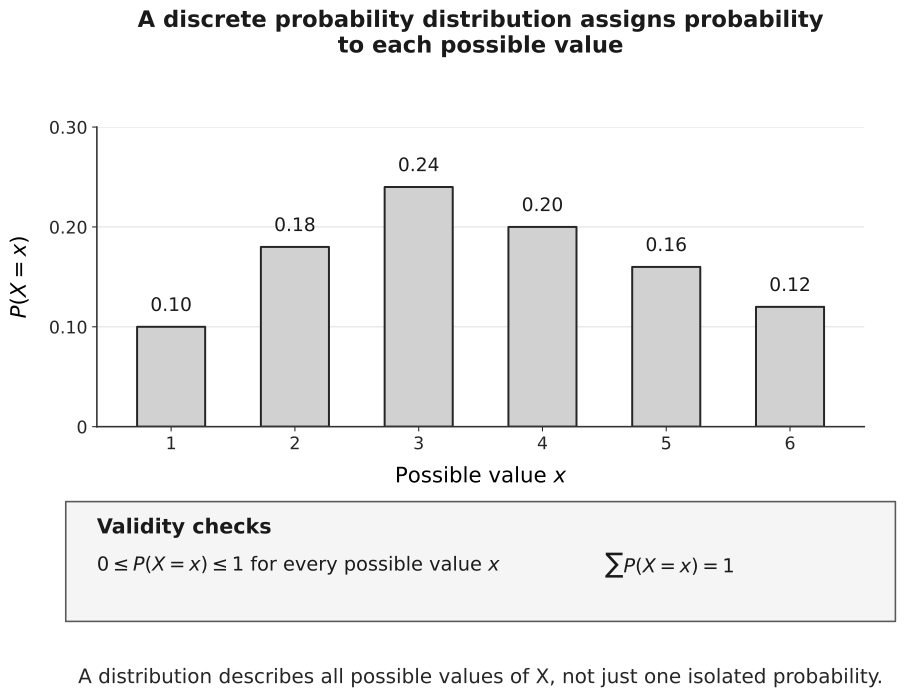 How to read this figure. A discrete probability distribution assigns a valid probability to each possible value and the total must sum to .
Checking and Constructing a Valid Distribution
A proposed distribution must be checked before it is used.
Ask two questions:
- Are all probabilities valid?
- Do all probabilities add to ?
For example, suppose has distribution:
To make this a valid distribution:
So:
and hence:
Therefore:
The important idea is not just solving for . It is using the fact that all possible values of must account for total probability .
Cumulative Distribution Function
The cumulative distribution function is defined for every real by
For a discrete random variable, is non-decreasing and constant between successive support values. At a support value , it jumps upward by .
The cumulative distribution function records running probability totals.
For a discrete random variable ,
is the probability that the value of does not exceed .
The PMF and CDF answer different questions:
- the PMF gives probability at a single value
- the cdf gives total probability up to a value
That is why the cdf is naturally:
- between and
- non-decreasing
The cdf is useful when the wording includes:
- at most
- not more than
- up to
- no greater than
For example, if represents the number of defective items in a sample, then:
means the probability of at most defective items:
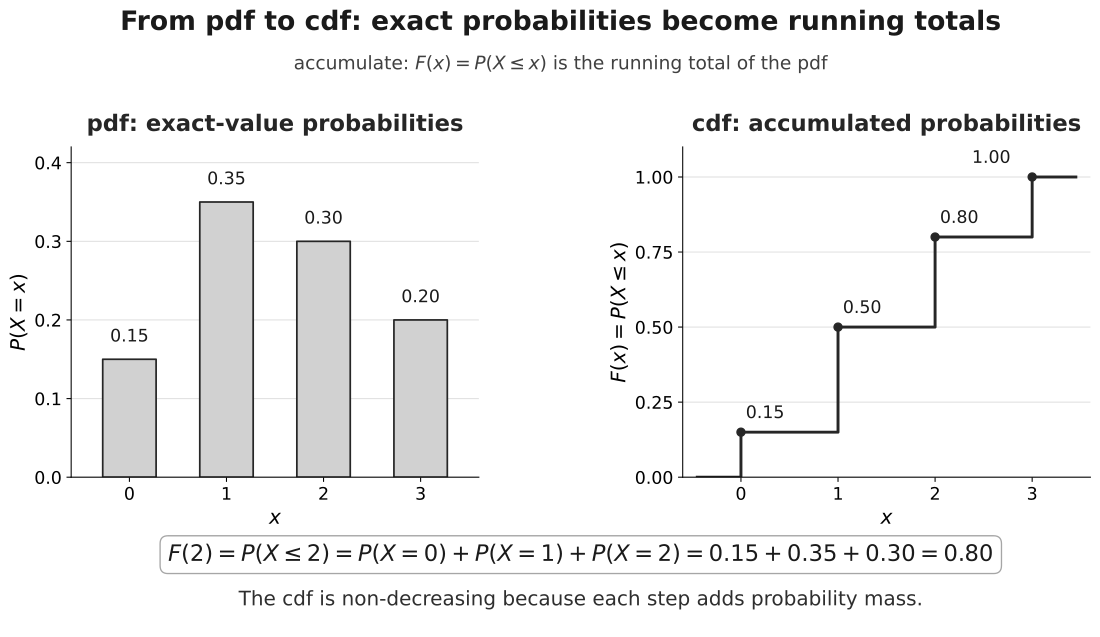
How to read this figure. Each PMF mass produces an upward jump of the same size in . At a support value, the closed point gives the included CDF value because is right-continuous; the open point gives the excluded left-limit level, which belongs to the preceding plateau only up to (but not including) that support value.
Translating Inequality Language
Many discrete-random-variable questions are about translating words into precise inequality notation.
For integer-valued :
This is because if only takes integer values, being less than means being at most .
Similarly:
This uses the complement.
For an interval:
This removes everything up to , leaving .
Translation Guide
| Wording | Mathematical form | Common method |
|---|---|---|
| exactly | use the PMF | |
| at most | use cdf | |
| not more than | use cdf | |
| fewer than | convert if is integer-valued | |
| at least | often use complement | |
| more than | often use complement | |
| between and inclusive | subtract cumulative probabilities carefully |
The main habit is to convert words into precise probability notation before calculating.
Worked Example: Distribution and CDF
Let be the number of heads when two fair coins are tossed.
The probability distribution is:
The cdf is:
For example:
Also:
The values are simple here, but the method is the same for larger distribution tables.
Common Pitfalls
| Mistake | Better thinking |
|---|---|
| Using a table before checking that probabilities sum to | First verify that the proposed distribution is valid |
| Treating and as the same object | The PMF gives exact-value probability; the CDF gives accumulated probability |
| Translating as for integer-valued | If is integer-valued and is an integer, means |
| Forgetting endpoint inclusion in intervals | Read , , , and carefully |
| Using complement without checking the boundary | The shift-by-one shortcut requires an integer-valued variable and an integer threshold |
Revision Checklist
- Can you build a distribution table from a simple experiment?
- Can you check that all probabilities are valid?
- Can you use to find an unknown constant?
- Can you form a CDF table from a PMF table?
- Can you explain why a cdf is non-decreasing?
- Can you translate “at most”, “fewer than”, “at least”, and “between” correctly?