Expectation, Variance, and Independent Observations
Scope Label
Core 9758. This note covers the main numerical summaries and transformation laws for discrete random variables.
Use it with the hub Discrete Random Variables and the distribution branch Probability Distribution and CDF.
What Information This Note Assumes
This note assumes that is a discrete random variable with a known probability distribution.
That means the possible values of and the corresponding probabilities are known, either from a table, from a formula, or from a named model.
For a distribution table,
the probabilities must satisfy:
Only after the distribution is valid should expectation and variance be calculated.
Expectation
The expectation is the weighted average of the values of the random variable.
It has the same physical units as . Also for any constant .
For a discrete random variable,
This formula should be read structurally:
- each possible value contributes
- more likely values contribute more heavily
- the result describes the long-run average value
For example, if is the score from one fair die toss, then:
So:
This does not mean the next die roll will be . It means that if the die is rolled many times, the average score tends to settle near .
Expectation is therefore not necessarily a value the random variable actually takes.
Expectation of a Function of
Sometimes we need the expectation of a function of the random variable, not just the expectation of itself.
If is a function of , then:
In particular:
This is important because variance is often calculated using:
When calculating variance from a probability distribution table, it is often useful to add columns for and .
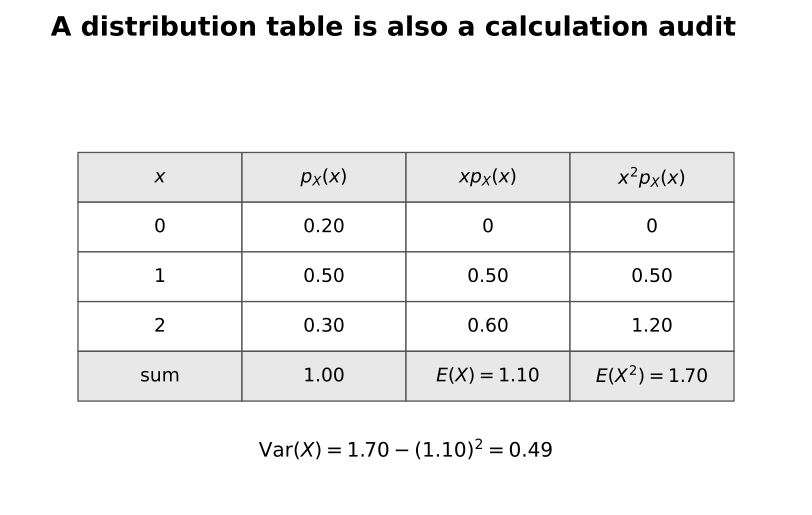
How to read this calculation audit. First verify that the probabilities sum to . The third column adds the weighted values to obtain ; the fourth adds the weighted squares to obtain . Variance is then . Keeping these contributions separate makes arithmetic and probability errors easier to locate.
Linearity of Expectation
Expectation behaves especially well under addition and scaling.
For constants and :
More generally:
This is true even when and are not independent.
The meaning is simple:
- multiplying by scales the centre by
- adding shifts the centre by
- adding random variables adds their expectations
So expectation is not just a calculation target. It is a way of reasoning about how the centre of a random quantity changes.
Variance and Standard Deviation
The variance measures spread around the expectation.
The definition is:
This says that variance is the average squared distance from the mean.
The equivalent working form is:
This follows by expanding with :
This is usually the more convenient formula for calculation.
A reliable workflow is:
- calculate
- calculate
- use
- take the square root if the standard deviation is required
The standard deviation is:
It gives spread in the original units of the variable.
Variance has squared units; standard deviation has the original units. For a constant , .
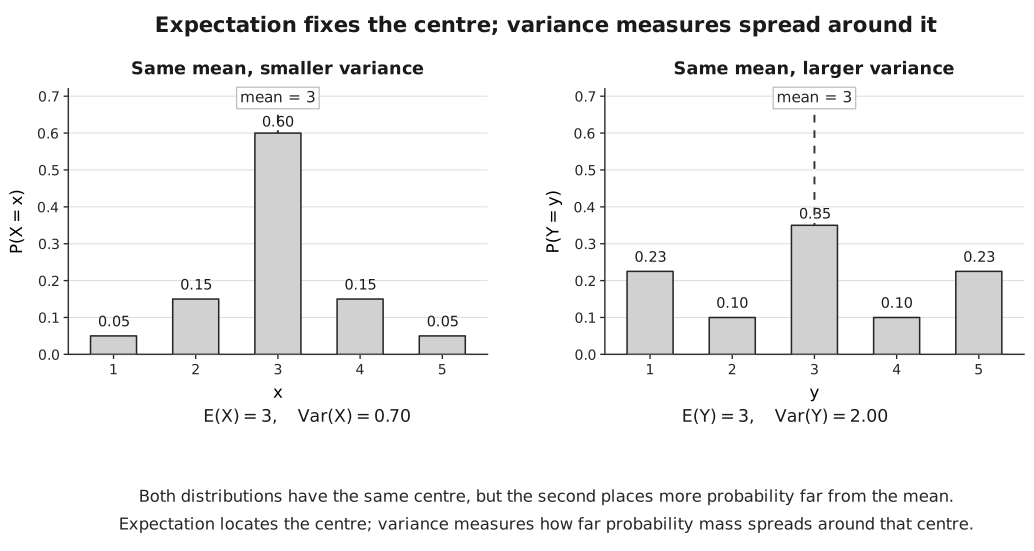
How to read this figure. Both displayed PMFs have total mass and the same mean. The broader PMF gives more weight far from the mean and therefore has larger variance.
Transformation Laws for Variance
Variance does not behave like expectation.
For constants and :
Adding a constant shifts every value by the same amount. It changes the centre, but it does not change the spread:
Multiplying by stretches distances from the mean by a factor of . Since variance uses squared distances, the variance is multiplied by :
This is why the following is wrong:
A useful comparison is:
but:
This difference is one of the most important technical points in this topic.
For standard deviation,
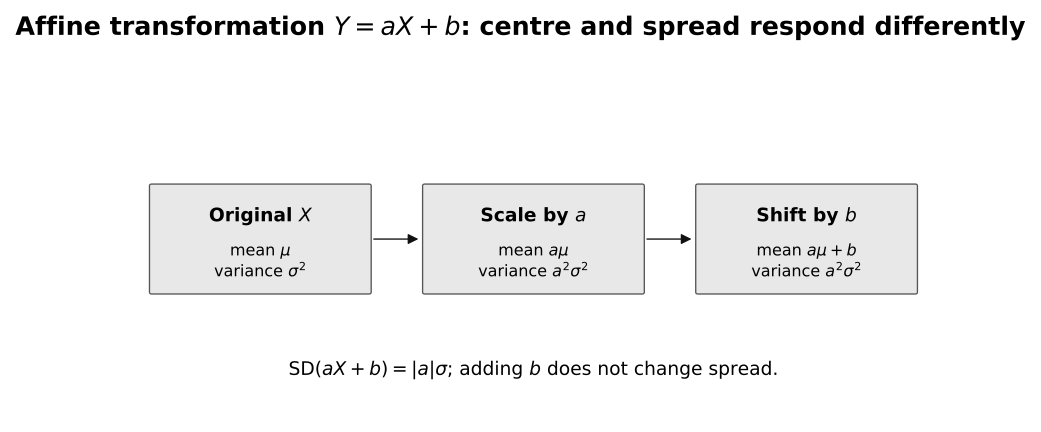
How to read this transformation. Multiplying by changes both centre and spread; adding shifts every value equally and therefore changes the mean but not the spread. The square on in the variance law also explains why a negative scale factor cannot make variance negative.
For example, if and , then for ,
Worked Example: Expectation and Variance
Suppose is the number of heads when two fair coins are tossed.
The expectation is:
Now calculate :
Hence:
The standard deviation is:
Independent Observations of the Same Random Variable
If an experiment is repeated independently and each observation has the same distribution, the resulting random variables are independent and identically distributed.
For example:
- may be the result of the first die roll
- may be the result of the second die roll
- is the sum of two independent observations
The conceptual point is not only that there is a formula. Repeated observations create new random variables with their own distributions.
If and are independent observations of the same discrete random variable , then:
Also:
For independent variables, variances add. Without independence, do not assume they add.
More generally, if are independent observations of the same random variable , then:
“Identically distributed” alone does not imply independence, and independence alone does not imply identical distributions. Both conditions are present in independent repeated observations of the same .
and:
Why Is Not the Same as
The random variable is not the same random variable as .
Let be the score from one fair die roll.
The random variable means:
- roll once
- double the score
So can take only the values:
The random variable means:
- roll the die twice independently
- add the two scores
So can take the values:
The value is possible for , but impossible for .
Their variances also differ:
but:
So equal-looking algebraic expressions do not automatically describe the same random variable.
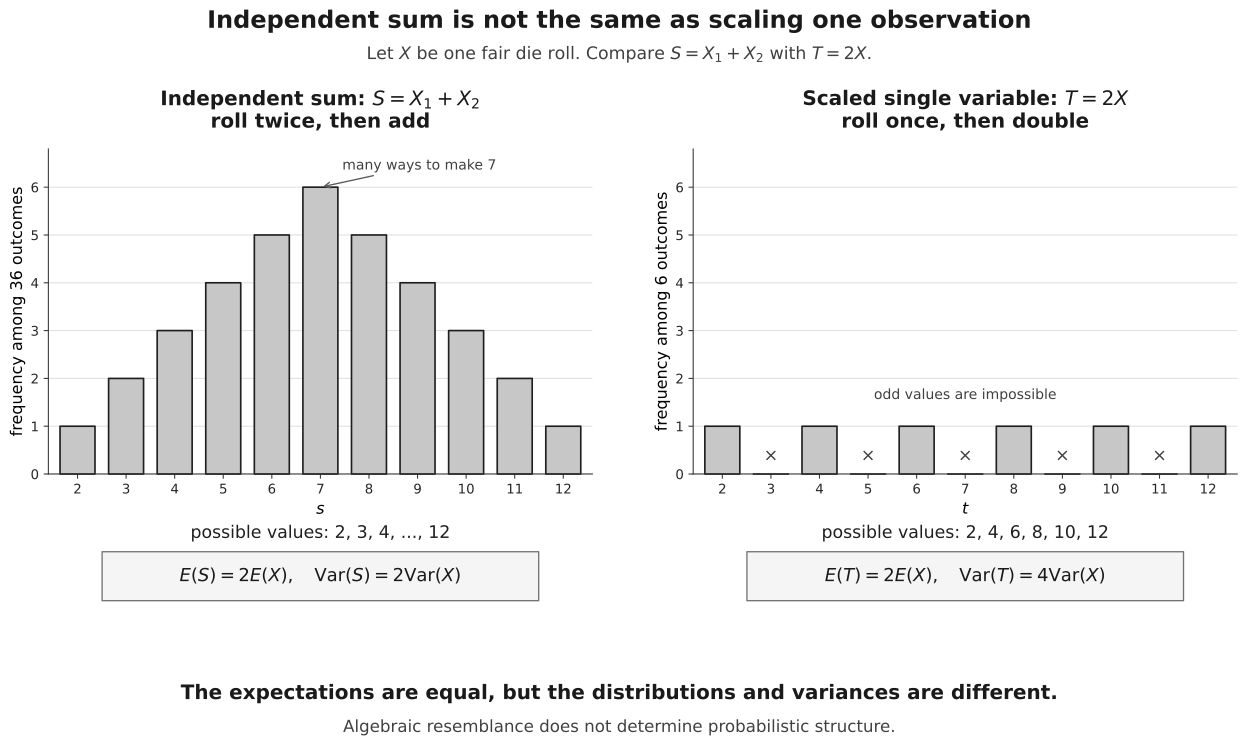
How to read this figure. Both panels use probability on the vertical axis. has many paths to central sums, while maps each single outcome to one even value; their supports and variances therefore differ.
Common Pitfalls
| Mistake | Better thinking |
|---|---|
| Thinking expectation must be a possible value | Expectation is a long-run weighted average, not necessarily an actual outcome |
| Forgetting to calculate before variance | Use |
| Treating variance like expectation | , but |
| Adding variances without independence | For independent variables, variances add; without independence, do not assume they add |
| Treating as the same random variable as | Repeated independent observations create a different distribution |
Revision Checklist
- Can you interpret as a weighted average?
- Can you explain why need not be a possible value of ?
- Can you calculate and from a distribution table?
- Can you use ?
- Can you explain the difference between variance and standard deviation?
- Can you apply correctly?
- Can you apply correctly?
- Can you define as repeated independent observations?
- Can you explain why and are different random variables?