Substitution and Second-Order Enrichment
Scope Label
Enrichment / extension. Given substitutions and simple directly integrable second-order equations are useful extensions. The saved 9758 summary emphasizes first-order separable differential equations as the core route, so this note is retained for completeness and mathematical maturity rather than as the main core revision path.
Use this after First-Order Separable and Modelling.
Why This Is Separate
Both methods in this note are useful, but they do a different job from the core separable method.
- A given substitution changes the variables so that an unfamiliar first-order equation becomes familiar.
- A simple second-order equation gives information about the second derivative, so recovering requires two integrations.
Keeping these ideas in a branch prevents the hub from becoming too dense while preserving useful extension material.
Solving by a Given Substitution
Some first-order differential equations are not immediately separable, but can be reduced to a solvable form using a substitution supplied in the question.
A common substitution example is the homogeneous first-order case, where the equation depends on the ratio . In that setting, the substitution turns the ratio into the new variable .
A common example is
where is treated as a function of .
The purpose is reduction:
The Critical Derivative Step
If
then is not a constant. It depends on .
Differentiate using the product rule:
This is the step students most often miss.
The substitution changes both:
- becomes ;
- becomes .
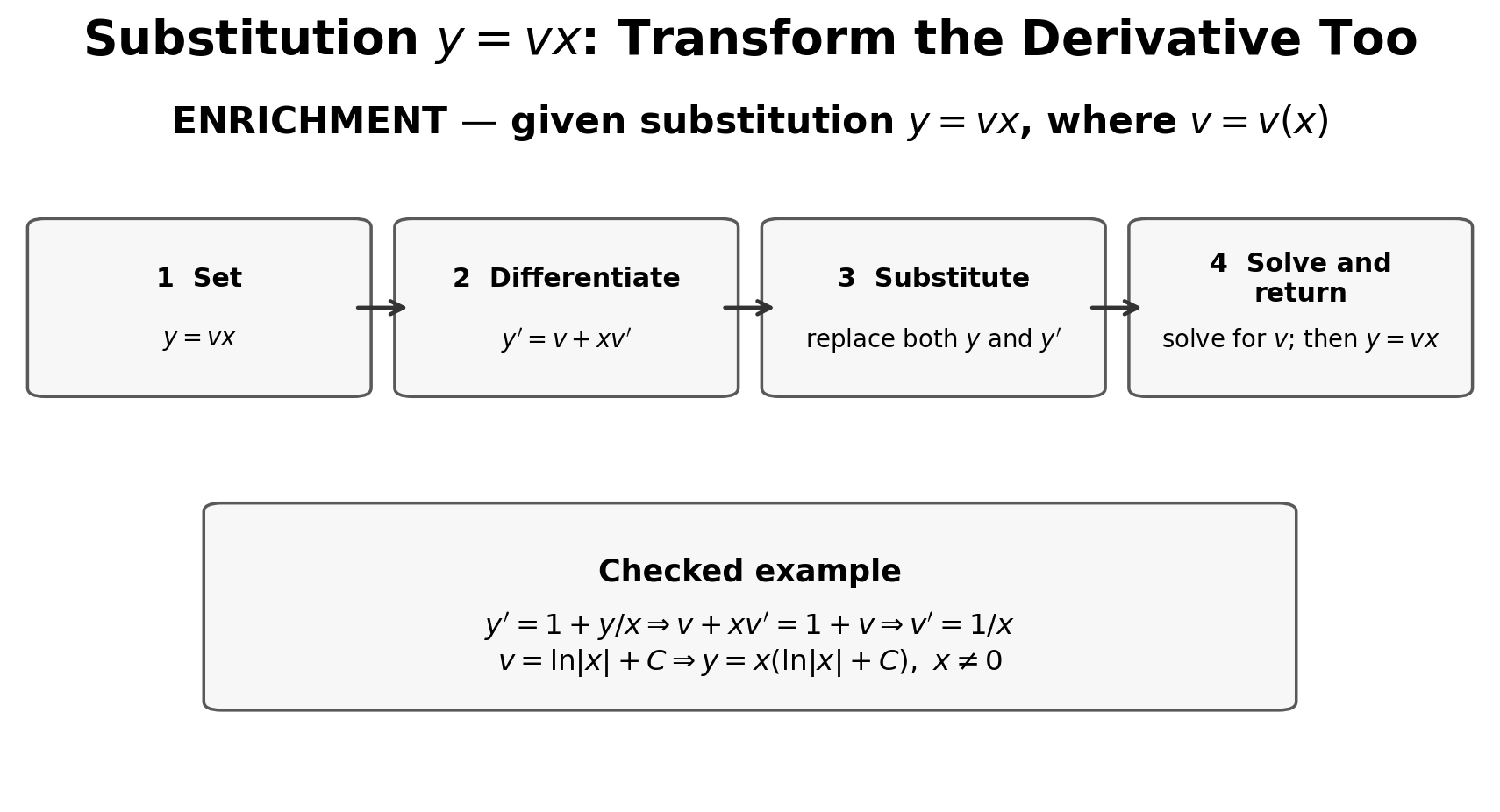 How to read the figure. Here , so the product rule changes as well as . Substitute both expressions, solve the reduced equation in , then restore and state any restriction such as .
In particular, for , the derivative relationship is
This formula is the scientific centre of the method.
Substitution Workflow
For a given substitution such as :
- Differentiate the substitution with respect to .
- Replace using the substitution.
- Replace using the derivative relationship.
- Simplify the new differential equation.
- Solve in the new variables.
- Convert back to the original variables.
The final answer should usually be in terms of and , not .
Worked Example:
For , solve
using
Then
and
Since and , substitution gives
Cancelling from both sides and dividing by gives
Integrating:
Therefore
Differentiating gives , verifying the solution.
The exact algebra depends on the question, but the structural discipline is always the same: transform the derivative correctly first.
Simple Second-Order Equations
The simple second-order form treated here is
This means the second derivative is given directly as a function of .
To recover , integrate twice:
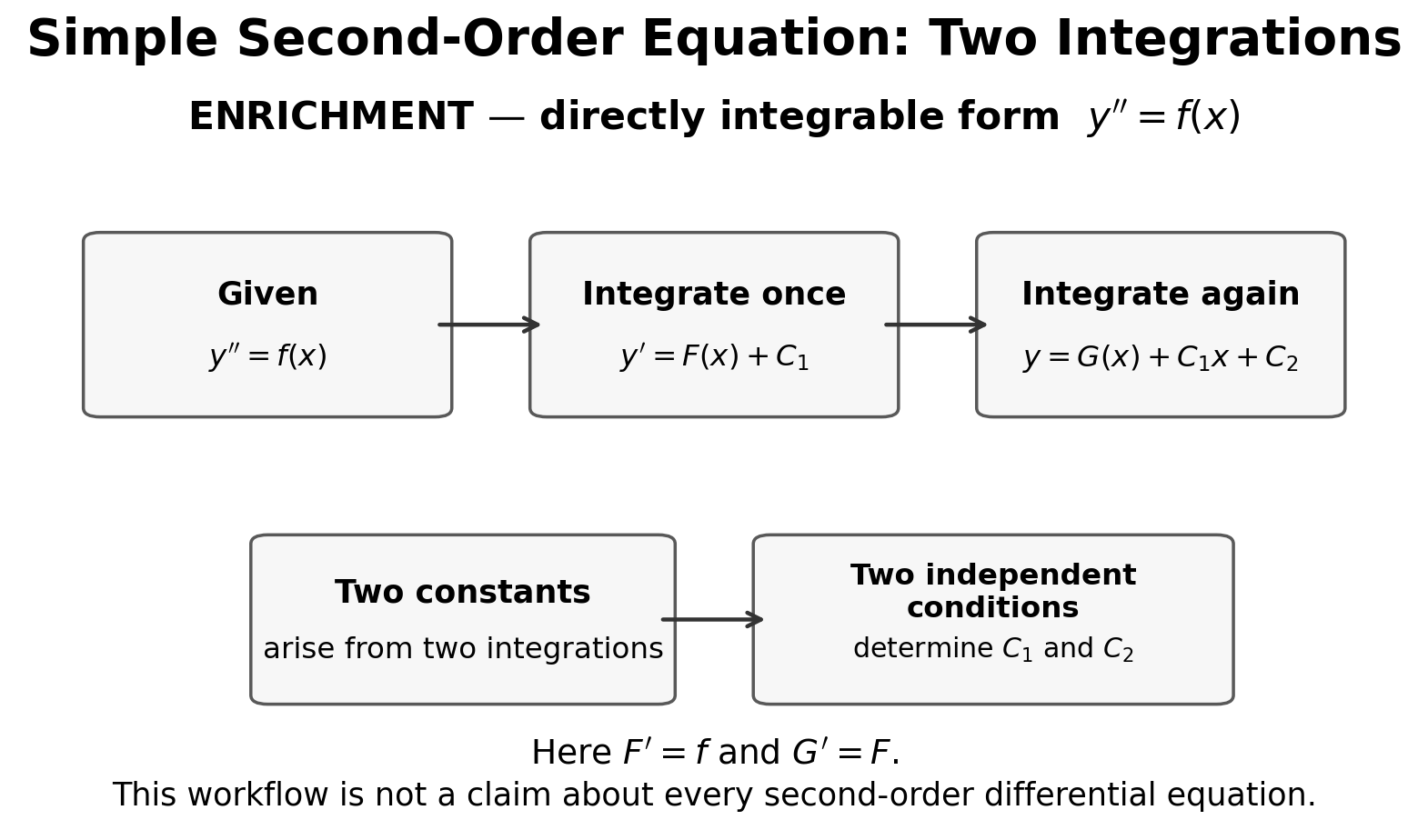 How to read the figure. This statement applies to the directly integrable enrichment form , not every second-order differential equation. Two integrations introduce two independent constants, which require two independent conditions.
Why Two Constants Appear
First integration:
Second integration:
If
then
The constants and arise from the two integrations.
Worked Example: Repeated Integration
Solve
Integrate once:
Integrate again:
This is the general solution.
If and , then and , so . The particular solution is
It satisfies both conditions and differentiating twice returns . Conditions could instead be two values of at different points; what matters is that they are independent.
Further Enrichment: Forming a Differential Equation
An -parameter family can sometimes be differentiated enough times to eliminate its arbitrary constants. For example, from , differentiating twice gives . This reverse process is useful mathematical enrichment but is not part of the core separable-equation route established by the saved syllabus summary.
Common Pitfalls
- Treating as a constant when using .
- Replacing but forgetting to replace .
- Leaving the final answer in when the question asks for and .
- Forgetting one of the two constants in a second-order equation.
- Applying conditions before the general solution has the correct number of constants.
- Treating enrichment methods as the core route without checking syllabus scope.