Data Transformations and Linearisation
Scope Label
Core 9758. Data transformations are explicitly part of the current correlation-and-regression scope.
Role in the Topic
This branch explains what to do when the original scatter diagram is not approximately linear but suggests a structured non-linear relationship.
Use it with:
Why Transform Data?
Correlation and linear regression are designed for linear patterns.
If the scatter diagram is curved, a straight-line regression on the original variables may be misleading. However, some curved relationships can be rewritten as straight-line relationships by transforming one or both variables.
This is called linearisation.
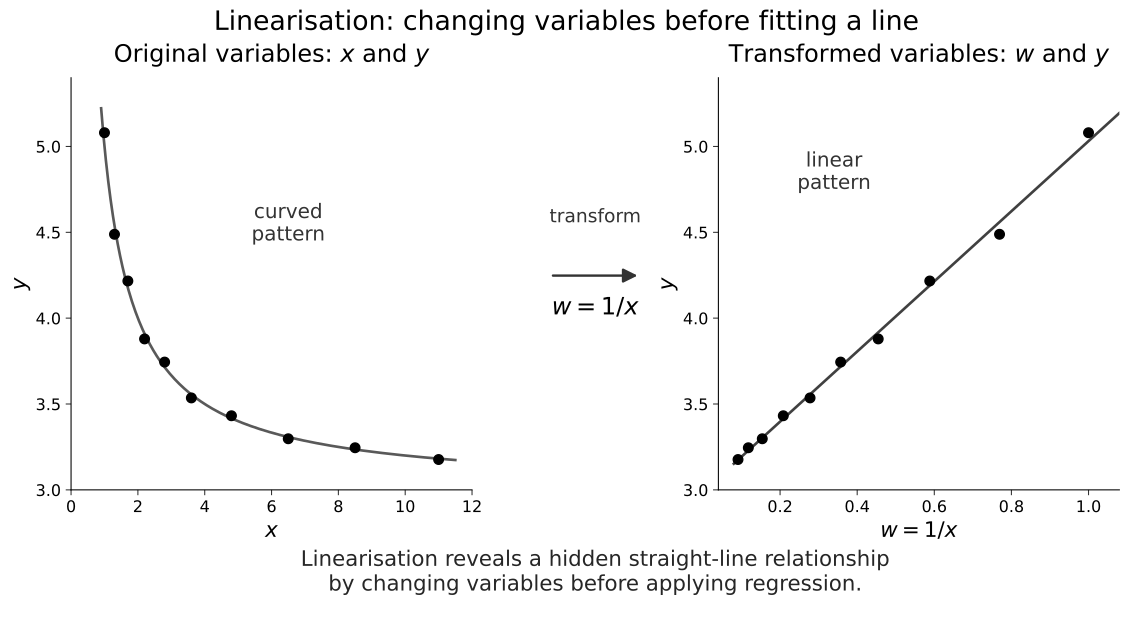 How to read this figure. The reciprocal transformation is meaningful only for . Approximate linearity of against supports the reciprocal model over the observed domain; it does not license arbitrary extrapolation.
The aim is not to force every dataset into a line. The aim is to test a plausible model form.
The Linearisation Workflow
A reliable workflow is:
- Inspect the original scatter diagram.
- Identify a plausible non-linear model.
- Define the transformed variable or variables.
- Draw or inspect the transformed scatter diagram.
- Compute for the transformed variables.
- Fit a regression line to the transformed variables.
- Interpret the fitted model in the original context.
Among proposed H2 transformations, the model with closest to is often better supported on its transformed scale, but the transformed scatter and context must also agree. This does not universally minimise prediction error on the original response scale.
Common Transformation Forms
The goal is to rewrite the model in the form
for suitable transformed variables and .
| Original model | Transformation | Linear form |
|---|---|---|
| , | let | |
| let | ||
| , | let | |
| , normally | let | |
| , | let , |
Logarithmic transformations require positive values where the logarithm is taken. For example, is only defined when .
Reading Parameters After Linearisation
After transformation, the regression line may not directly use the original parameters.
For example, suppose
Taking logarithms gives
If the transformed regression line is
then
So
The intercept and gradient of the transformed line must be translated back carefully.
Choosing Between Models
When several possible transformations are suggested, compare:
- the transformed scatter diagrams
- the values of for the transformed data
- the reasonableness of the model in context
- the domain restrictions introduced by the transformation
Do not choose a model from calculator output alone.
A good exam sentence is:
The plot of against is approximately linear and has closest to , so an exponential model is most suitable among the proposed models.
Compact model-selection example
For the six pairs
a calculator gives
The scatter of against is approximately linear and its is closest to , so the reciprocal model is best supported among these candidates. Regression of on gives
and hence, in the original variable,
This conclusion compares only the proposed models over the observed domain; it is not proof that the reciprocal law holds universally.
Core Example: Power Model
Suppose a relationship is suspected to have the form
Taking logarithms:
So if we plot against and obtain an approximately straight-line pattern, the model is supported.
If the fitted transformed line is
then
Hence
and the fitted original model is
Core Example: Reciprocal Model
Suppose the data decrease quickly at first and then level off. A possible model is
Let
Then
So the transformed scatter diagram should plot against , not against .
If the fitted transformed line is
then the original fitted model is
At , use the transformed input to obtain . The estimate still requires a reliability check against the observed -range and transformed scatter.
Common Pitfalls
- Applying linear regression to a clearly curved original scatter diagram without considering transformation.
- Choosing the largest without checking the transformed scatter diagram.
- Forgetting domain restrictions such as or before taking logarithms.
- Treating the intercept and gradient of the transformed line as if they were always the original parameters.
- Back-transforming incorrectly, especially in exponential and power models.
- Forgetting to interpret the final model in the original variables.
Revision Checklist
- Can you explain why linearisation is useful?
- Can you match common model forms to the correct transformed variables?
- Can you decide whether to plot against , against , against , or against ?
- Can you recover original parameters after a logarithmic transformation?
- Can you explain why a transformed model still needs contextual judgement?