Standard Conic Forms and Features
Overview
This branch is the feature-reading reference for Conic Sections. Use it when the question gives a conic in recognisable standard form, or after completing the square has revealed that standard form.
The central habit is to read the equation as geometry: centre or vertex, symmetry, axes, vertices, radius, semi-axis lengths, and asymptotes where relevant.
Enrichment: Why These Curves Are Called Conics
The word conic comes from cone.
A conic section is a curve formed when a flat plane cuts a right circular double cone. The double cone has two halves, called nappes. Depending on how the plane cuts the cone, a different curve is formed.
This gives a single geometric origin for four curves that may otherwise seem unrelated:
- a circle is formed when the plane cuts the cone horizontally
- an ellipse is formed when the plane cuts through one nappe at a slant, without being parallel to the cone surface
- a parabola is formed when the plane cuts through one nappe parallel to the cone surface
- a hyperbola is formed when the plane cuts through both nappes
The important idea is not just the picture of the cone. The important idea is that these four curves belong to one family.
This matters because, without the cone picture, the topic can feel like four separate lists of equations:
But the cone picture tells us that they are connected. They are different outcomes of the same geometric process.
For H2 graphing, we usually do not work directly with the three-dimensional cone. Instead, we work with equations in the coordinate plane. The goal is therefore to connect two views of the same object:
- the geometric view: what kind of curve it is and what features determine its shape
- the algebraic view: how those features appear in the equation
So the cone explains why these curves form one family, while the standard equations show how to study them precisely.
What to Look For When Sketching a Conic
Sketching a conic is not mainly about plotting many points.
A good sketch comes from identifying the few structural features that determine the curve. Once these features are known, the shape is mostly forced.
Different conics require different features.
For a circle, identify:
- the centre
- the radius
- axial intercepts, if useful
For example, from
the centre is and the radius is .
For an ellipse, identify:
- the centre
- the horizontal and vertical semi-axis lengths
- axial intercepts, if useful
For example, from
the centre is , the horizontal semi-axis length is , and the vertical semi-axis length is .
For a hyperbola, identify:
- the centre
- the vertices
- the direction of the branches
- the asymptotes
- axial intercepts, if useful
For a hyperbola, the asymptotes are not optional decoration. They control the long-range direction of the branches and should be drawn clearly, usually as dashed lines.
For a parabola, identify:
- the vertex
- the line of symmetry
- the direction of opening
- axial intercepts, if useful
For example,
has vertex and opens horizontally, while
has vertex and opens vertically.
The equation of the conic should usually be shown beside the sketch. This reminds us that the drawing is not just a rough picture. It is a visual interpretation of a precise algebraic equation.
Intercepts should be checked, not guessed. Some conics have two intercepts, some have one, some have none, and some just touch an axis. These details should come from the equation, not from the appearance of a rough sketch alone.
A reliable sketching workflow is:
- Rewrite the equation into standard form if necessary.
- Identify the type of conic.
- Read the centre or vertex from the standard form.
- Mark the structural features that determine the curve.
- Check axial intercepts if they are needed.
- Draw the curve using these features.
The central habit is:
Do not sketch first and interpret later.
Read the equation first, then let the geometry guide the sketch.
Circle
A circle is the set of all points in a plane that are the same distance from a fixed point.
The fixed point is called the centre, and the fixed distance is called the radius.
This definition is important because it explains the equation of a circle. If the centre is
and a point on the circle is
then the condition for to lie on the circle is
Using the distance formula,
Squaring both sides gives the standard form of a circle:
For a non-degenerate circle, . Since
its possible coordinates satisfy
If the completed equation has , the locus is the single point ; if , there are no real points.
So the equation is not an arbitrary formula. It is just the distance condition written algebraically.
The simplest case occurs when the centre is the origin. If , then the equation becomes
The general form
is the same circle shifted so that its centre is now instead of .
This standard form should be read geometrically:
- is the centre of the circle
- is the radius
- appears on the right-hand side, so the radius is the square root of that value
For example, from
we read
So the centre is
and the radius is .
A circle has uniform symmetry around its centre. In particular, it is symmetric about every line passing through the centre. For coordinate sketches, the most useful symmetry lines are often
and
These are the vertical and horizontal lines through the centre.
When sketching a circle, first mark the centre. Then use the radius to locate the four extreme points:
For
the four extreme points are
These points help determine the shape without plotting many random points.
A circle may not be given in standard form at first. For example,
does not immediately show the centre or radius. Completing the square gives
Now the geometry is visible: the centre is and the radius is .
This is why completing the square is a structural step, not just algebraic tidying. It reveals the hidden centre and radius.
In a general quadratic equation, equal same-sign coefficients of and suggest a circle. For example, both and have coefficient in
However, this is only a clue. The equation should still be rewritten into standard form to check that the radius is real.
For instance, if completing the square leads to
then there is no real circle, because the left-hand side is always non-negative.
So for a circle, the main habit is:
Read the equation as a constant-distance condition from a centre.
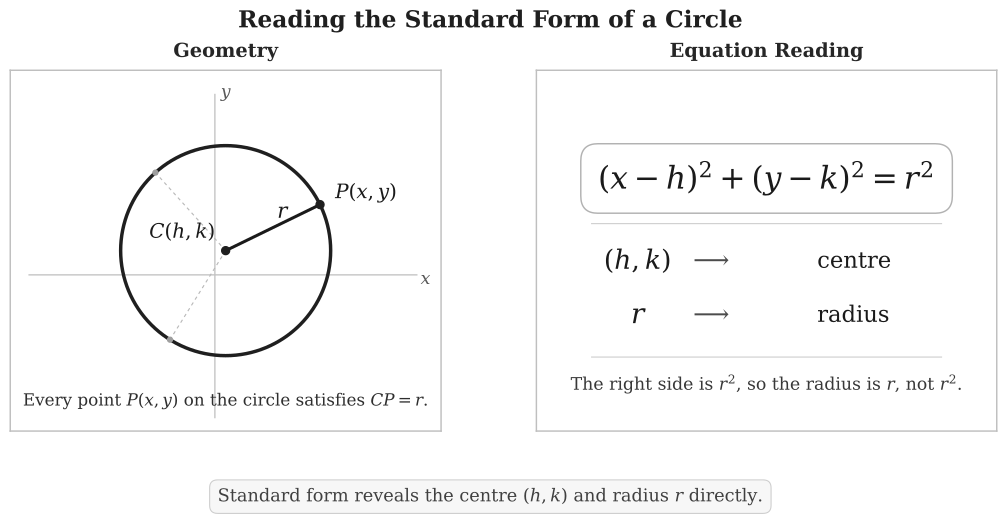 How to read the figure. The centre is the fixed point and every point on the curve is distance from it. Projecting the four extreme points onto the axes gives and .
What the algebra tells you
For a circle, the squared terms have a very special pattern.
In an equation of the form
a circle is possible only when the coefficients of and are equal and have the same sign.
For example,
has equal coefficients for and , so it may represent a circle.
But this coefficient pattern is only a clue. It does not yet tell us the centre or radius. To see the actual circle, we must complete the square:
Now the geometry is visible. The centre is and the radius is .
There is also an important warning. Equal same-sign coefficients suggest a circle, but the final equation must still have a non-negative value on the right-hand side. For instance,
does not represent a real circle, because the left-hand side cannot be negative.
So the algebra gives a two-step reading:
- equal same-sign coefficients suggest a circle
- completing the square confirms the circle and reveals its centre and radius
What to identify
When sketching or interpreting a circle, the main features are:
- the centre
- the radius
- the axial intercepts, if they exist
- whether the circle passes through the origin
- whether the circle just touches an axis
The centre and radius are the essential features. They determine the basic position and size of the circle.
The intercepts tell us where the circle meets the coordinate axes. They should be checked from the equation, not guessed from a rough sketch.
It is also useful to know whether the circle passes through the origin. For a circle with centre and radius ,
the origin lies on the circle exactly when
This is because substituting into the equation gives
Similarly, the circle just touches the -axis when the horizontal distance from the centre to the -axis equals the radius:
It just touches the -axis when the vertical distance from the centre to the -axis equals the radius:
These checks are not just extra details. They help locate the circle relative to the coordinate axes.
The useful habit is:
Do not only ask what type of conic it is.
Ask where the curve sits in the coordinate plane.
Ellipse
A circle has the same radius in every direction from its centre. An ellipse is similar in spirit, but it is stretched differently in different directions.
So an ellipse can be thought of as a circle-like curve with a horizontal size and a vertical size.
Enrichment — two-focus definition
Geometrically, an ellipse is the set of all points whose sum of distances from two fixed points is constant. These two fixed points are called the foci. For a non-degenerate ellipse this constant must exceed the distance between the foci. The 9758 core route below uses the standard coordinate form instead.
If is a point on the ellipse and the foci are and , then
This definition explains the geometric origin of the ellipse. However, for most H2 sketching questions, the more useful form is the standard coordinate form:
Here and . Because each squared fraction is non-negative and neither can exceed ,
These restrictions are exactly the coordinates of the left/right and lower/upper extreme points.
This form should be read directly as geometry.
The centre is
The horizontal semi-axis length is
The vertical semi-axis length is
Here, means the horizontal distance from the centre to the ellipse, and means the vertical distance from the centre to the ellipse. It is not necessary that .
From the centre , the ellipse reaches the following four extreme points:
So the full horizontal width is
and the full vertical height is
This is the key difference between a circle and an ellipse. For a circle, the distance from the centre to the curve is the same in every direction. For an ellipse, the horizontal and vertical distances are controlled separately.
For example, consider
Since
and
we read:
- centre:
- horizontal semi-axis length:
- vertical semi-axis length:
The four extreme points are
These points are usually enough to guide a good sketch.
An ellipse has central symmetry about its centre. It is also symmetric about the horizontal and vertical lines through the centre:
and
So the centre is the balancing point of the whole curve.
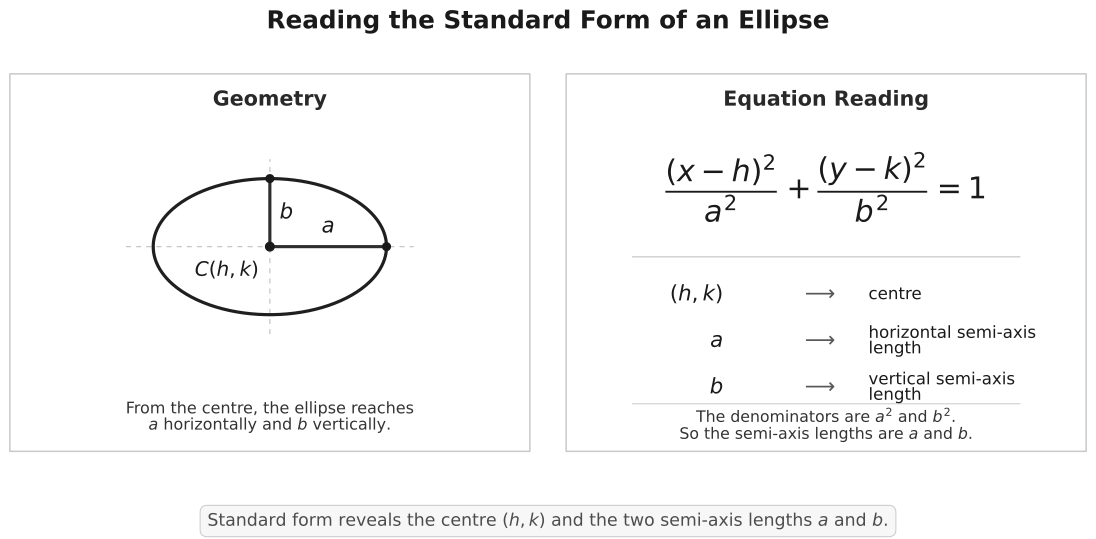 How to read the figure. Start at . Move units horizontally and units vertically to mark the four extreme points. These same distances give the complete coordinate restrictions and .
What the algebra tells you
For a general quadratic equation without an term,
an ellipse is suggested when the coefficients of and have the same sign.
If those coefficients are equal, the curve may be a circle. If they have the same sign but are unequal, the curve may be a non-circular ellipse.
So the rough distinction is:
- equal same-sign coefficients suggest a circle
- unequal same-sign coefficients suggest an ellipse
- opposite-sign coefficients suggest a hyperbola
But this coefficient pattern is only a first clue. To confirm that the equation really represents an ellipse, we still need to complete the square and rewrite it into standard form.
For example, after completing the square, an ellipse should have the form
where
If the completed equation is a sum of positive multiples of squares equal to , then gives a real ellipse after division by , gives the single centre point, and gives no real points.
For instance,
cannot represent a real ellipse, because the left-hand side is always non-negative.
A circle can also be viewed as a special ellipse where the horizontal and vertical semi-axis lengths are equal.
What to identify
When sketching or interpreting an ellipse, identify:
- the centre
- the horizontal semi-axis length
- the vertical semi-axis length
- the four extreme points
- the axial intercepts, if they exist
- whether the ellipse just touches an axis
The centre gives the location of the ellipse.
The semi-axis lengths tell us how far the ellipse extends horizontally and vertically from the centre.
The four extreme points give a simple framework for drawing the curve.
Axial intercepts should be checked from the equation, not assumed from the sketch. A shifted ellipse may have no -intercepts, no -intercepts, or may just touch an axis.
For
the ellipse just touches the -axis when the horizontal distance from the centre to the -axis equals the horizontal semi-axis length:
It just touches the -axis when the vertical distance from the centre to the -axis equals the vertical semi-axis length:
The useful habit is:
Do not only recognize the equation as an ellipse.
Read from the equation where the ellipse is centred, how far it extends, and how it sits relative to the axes.
Hyperbola
Enrichment — two-focus definition
A hyperbola is the set of all points for which the absolute difference of distances from two fixed points is a positive constant. These two fixed points are called the foci. For a non-degenerate hyperbola, the constant is smaller than the distance between the foci. The 9758 core route below uses the standard coordinate forms instead.
If is a point on the hyperbola and the foci are and , then
The absolute value is important because there are two branches. On one branch, points are closer to than to . On the other branch, points are closer to than to . This is one reason a hyperbola appears as two disconnected open curves rather than one closed loop.
For H2 sketching, the most useful forms are the two standard coordinate forms.
A hyperbola opening left and right has the form
In this note’s axis-fixed notation, is always the horizontal denominator length and is always the vertical denominator length. Some textbooks instead place under whichever term is positive; do not mix the two conventions.
Its centre is
and its vertices are
A hyperbola opening up and down has the form
Its centre is again
and its vertices are
The key reading rule is:
The positive squared term tells the direction in which the hyperbola opens.
So if the positive term contains , the branches open left and right. If the positive term contains , the branches open up and down.
This is the main structural difference from an ellipse. In an ellipse, the squared terms are added:
In a hyperbola, one squared term is subtracted. That subtraction changes the curve from a closed loop into two open branches.
Asymptotes are part of the object
For a hyperbola, the asymptotes are not optional decoration. They are the guiding lines that control the long-range direction of the branches.
For both standard forms above, the asymptotes pass through the centre and have equations
To see why, replace the right-hand side by to obtain the pair of guide lines
Factoring gives
which rearranges to . Far from the centre, the constant becomes small relative to the squared terms, so the branches approach these lines.
The branches of the hyperbola approach these lines as they move farther away from the centre.
The constants and should therefore be read with the orientation in view. In this note’s axis-fixed convention, is always the horizontal denominator length and is always the vertical denominator length:
- in the horizontal-opening form, is the transverse semi-length and the vertices are
- in the vertical-opening form, is the transverse semi-length and the vertices are
- for both forms, the asymptote slopes are
This is slightly different from an ellipse. For an ellipse, and are semi-axis lengths. For a hyperbola, they help build the vertex positions and asymptote directions.
For example, consider
Here,
Since the positive squared term is , the hyperbola opens left and right.
The centre is
The vertices are
and
The asymptotes are
These features provide the framework for the sketch: mark the centre, mark the vertices, draw the dashed asymptotes, then draw two branches opening left and right while approaching the asymptotes.
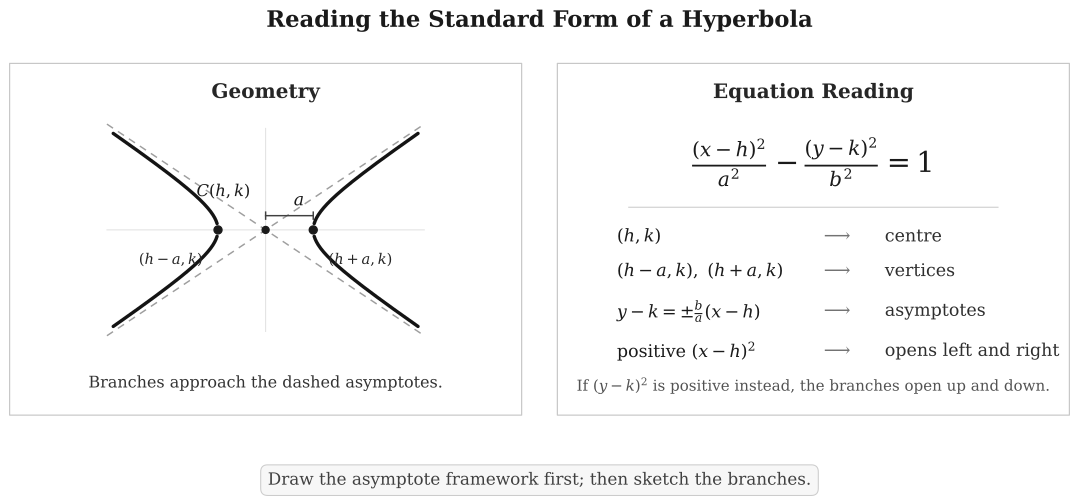 How to read the figure. The centre is the intersection of the two dashed asymptotes, not a point on a branch. The positive squared term determines whether the branches open horizontally or vertically; the vertices are the nearest permitted points to the centre.
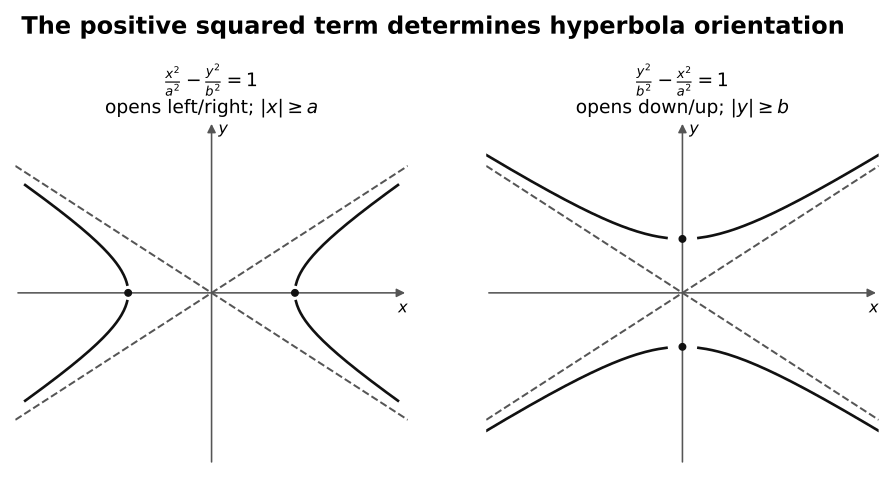 How to read the figure. Compare the positive squared term in the two equations. A positive -term gives horizontal branches and excludes ; a positive -term gives vertical branches and excludes . Both orientations use the same asymptote slopes under this note’s axis-fixed notation.
What the algebra tells you
For a general quadratic equation without an term,
a hyperbola is suggested when the coefficients of and have opposite signs.
For example,
has opposite signs on the squared terms, so it may represent a hyperbola.
But the coefficient pattern is only a first clue. Completing the square is still needed to reveal the centre, orientation, vertices, and asymptotes.
For instance, after completing the square, the equation should be rewritten into one of the standard forms:
or
Only then can the sketch be drawn reliably.
The possible-coordinate restrictions follow directly from the positive term. For
we have , so or , while is unrestricted. For the vertical form, is unrestricted and or .
If completing the square gives a difference of squared terms equal to , the locus is the pair of intersecting asymptote lines, not a hyperbola. A non-zero right-hand side must first be normalised; its sign determines which squared term becomes positive.
What to identify
When sketching or interpreting a hyperbola, identify:
- the centre
- the direction of opening
- the vertices
- the asymptotes
- the axial intercepts, if they exist
The centre is where the asymptotes cross.
The direction of opening is determined by the positive squared term.
The vertices mark where the branches are closest to the centre.
The asymptotes give the long-range direction of the branches.
Axial intercepts should be checked from the equation, not inferred from the rough shape. A shifted hyperbola may have two intercepts, one intercept, or no intercepts on a given axis.
A reliable sketching workflow is:
- Rewrite the equation into standard form if necessary.
- Read the centre.
- Decide whether the hyperbola opens horizontally or vertically.
- Mark the vertices.
- Draw the asymptotes as dashed lines.
- Sketch the branches approaching the asymptotes.
- Check axial intercepts if they are required.
The useful habit is:
For a hyperbola, do not draw the branches first.
Draw the asymptote framework first, then let the branches follow it.
Parabola
A parabola is different from the other conics in an important way.
A circle and an ellipse are closed curves. A hyperbola has two open branches. A parabola has one open branch with a single direction of opening.
For graph sketching, the essential facts are the vertex, axis of symmetry, and direction of opening.
As enrichment geometry, a parabola can also be described as the set of all points that are equally far from a fixed point and a fixed line.
The fixed point is called the focus.
The fixed line is called the directrix.
So a point lies on the parabola when
Every point on the parabola is equidistant from the focus and the directrix. Only the vertex lies midway between the focus and the directrix along the axis of symmetry.
For the core graphing path, the vertex is the main organising feature of a parabola. Unlike a circle or an ellipse, a parabola has no centre. Unlike a hyperbola, it has no asymptotes. Its position and direction are controlled by its vertex and its axis of symmetry.
A parabola is therefore a vertex-driven conic.
There are two standard orientations.
A horizontally opening parabola has the form
Here . The possible values are and
Its vertex is
and its axis of symmetry is
It opens to the right if
and opens to the left if
For enrichment, the focus is
and the directrix is
A vertically opening parabola has the form
Again . Now and
Its vertex is
and its axis of symmetry is
It opens upwards if
and opens downwards if
For enrichment, the focus is
and the directrix is
The sign of determines the direction of opening. In the focus-directrix interpretation, is the distance from the vertex to the focus and also from the vertex to the directrix.
For example, consider
This matches the form
So
The vertex is therefore
Also,
so
Since , the parabola opens to the right.
Its axis of symmetry is
For enrichment, its focus is
and its directrix is
This example shows how the equation gives the sketching information directly.
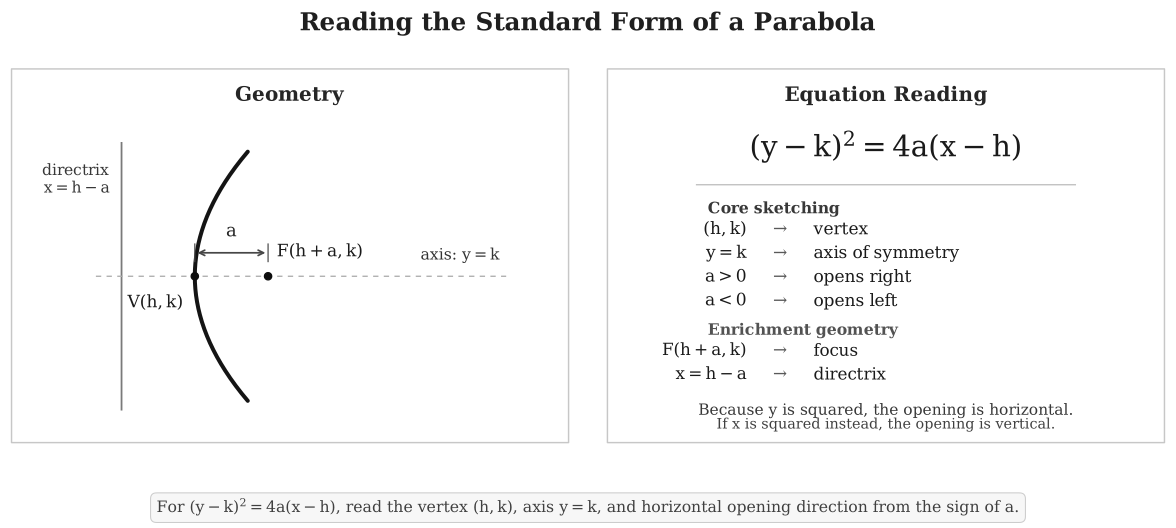 How to read the figure. The displayed case has , so opens right from the vertex and has . The focus and directrix are enrichment geometry; the equal distances define the curve, while the vertex lies midway between them along the axis.
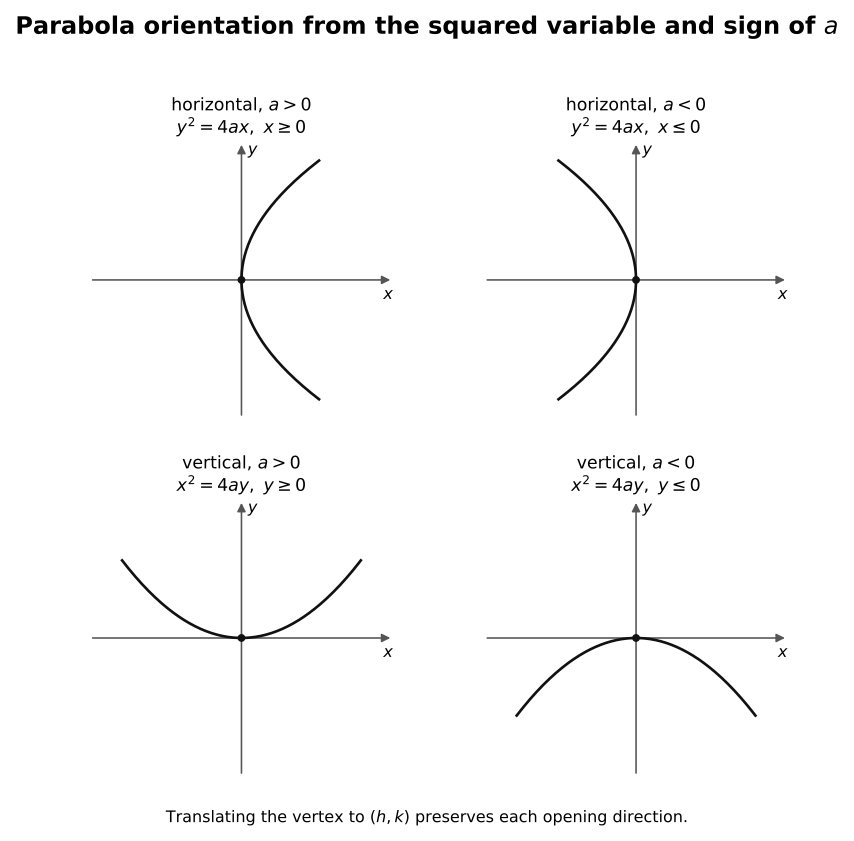 How to read the figure. First identify which variable is squared: a squared gives horizontal opening, while a squared gives vertical opening. Then use the sign of to choose right/left or up/down and to state the corresponding coordinate restriction.
What the algebra tells you
For a general quadratic equation without an term,
a parabola is suggested when exactly one of and is zero.
That means exactly one of and appears.
For example,
has a term but no term, so it may represent a horizontally opening parabola.
However, this coefficient pattern is only a first clue. Completing the square is still needed to reveal the vertex, axis of symmetry, and direction of opening.
For a genuine parabola in these standard forms, the other variable must appear linearly after rearrangement. The completed-square form is what confirms that the equation really behaves as a parabola rather than as a degenerate or impossible equation.
For instance,
can be rewritten as
Now the structure is visible:
- vertex:
- axis of symmetry:
- opens to the right because , so
A graph such as
is already familiar as a quadratic function. In this topic, however, we read it as a conic graph: through its vertex, symmetry, direction of opening, and standard form.
What to identify
When sketching or interpreting a parabola, identify:
- the vertex
- the axis of symmetry
- the direction of opening
- the focus and directrix, if required
- the axial intercepts, if they exist
The vertex is where the curve turns.
The axis of symmetry passes through the vertex. In the focus-directrix view, it also passes through the focus.
The direction of opening is determined by the standard form and the sign of .
The intercepts should be solved from the equation, not guessed from a rough sketch.
A reliable sketching workflow is:
- Rewrite the equation into standard form if necessary.
- Identify the vertex.
- Identify the axis of symmetry.
- Use the sign of to decide the direction of opening.
- Mark the focus and directrix if required.
- Check axial intercepts if they are needed.
- Sketch the single branch opening from the vertex.
The useful habit is:
For a parabola, do not look for a centre or asymptotes.
Find the vertex, then read the direction of opening.
Core integrated sketch examples
These examples show how restrictions and intersections complete the structural sketch.
Ellipse: tangency appears as one repeated intersection
For
the centre is , with and . Setting gives
so is the single -intercept: the ellipse is tangent to the -axis at . Setting gives
so these are the two exact -intercepts.
Hyperbola: restrictions explain the central gap
For
the centre is , the vertices are and , and or . Its asymptotes are
Setting gives , while setting gives no real solution. The restriction and the missing -intercept agree with the two separated branches.
Parabola: intersection with an axis and a line
For
the vertex is , the axis is , and . Setting gives the -intercept ; setting gives no real -intercept. To intersect the parabola with the vertical line , substitute :
so the two intersections are and . Substitution, not the sketch, determines whether a line cuts, touches, or misses a conic.