Conic Classification and Sketching Workflow
Overview
This branch is the method reference for Conic Sections. Use it when the conic is not already in a readable standard form.
The central habit is: do not classify too early. Complete the square, rewrite the equation, check that the conic has real points, and only then read the features needed for a sketch.
Converting General Equations into Standard Form
A conic is not always given in a form where its geometry is easy to see.
For example, an axis-aligned equation may first appear as
This is not the most general quadratic curve: it assumes there is no term. A non-zero coefficient can rotate the conic and lies outside the standard axis-aligned 9758 graphing route used here.
In this form, the centre, vertex, radius, semi-axis lengths, vertices, or asymptotes may be hidden.
The purpose of rewriting the equation into standard form is to make these hidden features visible.
The main tool is completing the square.
Completing the square is not just algebraic tidying. It moves the equation into the natural coordinate frame of the conic.
For circles, ellipses, and hyperbolas, completing the square usually reveals the hidden centre.
For parabolas, completing the square reveals the hidden vertex and the direction of opening.
For example,
does not immediately show the location of the circle. Grouping terms and completing the square gives
so
Now the geometry is visible:
- the curve is a circle
- the centre is
- the radius is
A parabola works slightly differently. For example,
can be rewritten as
so
Now the structure is visible:
- the curve is a parabola
- the vertex is
- since , we have
- the parabola opens to the right
So completing the square should be understood as revealing the hidden geometric frame of the curve.
A disciplined workflow
A reliable method is:
-
Collect the -terms and -terms separately.
This allows each variable to be handled in its own group.
-
Factor out the coefficient of each squared term where needed.
For example,
Complete the square inside the bracket, not before factoring.
-
Complete the square carefully.
Rewrite expressions into forms such as
or
-
Rearrange into a recognized standard form.
The aim is to obtain one of the familiar forms for a circle, ellipse, hyperbola, or parabola.
-
Check whether the resulting equation is geometrically valid.
Not every equation with the right coefficient pattern gives a real conic.
-
Read the geometric features from the standard form.
Depending on the conic, identify the centre, vertex, radius, semi-axis lengths, vertices, asymptotes, axis of symmetry, or direction of opening.
The crucial habit is:
Do not classify the conic too early.
First reorganize the equation, then read the geometry.
Checking validity
After completing the square, always check whether the standard form can actually represent real points.
For example,
does not represent a real circle, because the left-hand side is always non-negative.
Similarly,
does not represent a real ellipse.
So a same-sign coefficient pattern may suggest a circle or ellipse, but the completed-square form must still be checked.
For hyperbolas and parabolas, completing the square is also needed, not just to confirm the conic type, but to find the features needed for a reliable sketch.
Use the completed equation to distinguish genuine and degenerate cases:
- a positive sum of squared terms equal to gives a circle or ellipse after normalisation;
- the same sum equal to gives one point, while gives no real points;
- a difference of squared terms equal to non-zero can be normalised to a hyperbola; if , it factors into two intersecting lines;
- a parabola candidate needs the non-squared variable to have a non-zero linear coefficient after rearrangement. Otherwise the equation may describe two parallel lines, one repeated line, or no real points.
Fast Classification from Coefficients
Before completing the square, the coefficients of and can give a useful first guess.
For equations of the form
with no term, the main coefficient patterns are:
| Coefficients of and | First guess |
|---|---|
| circle candidate | |
| and | ellipse candidate |
| hyperbola candidate | |
| exactly one of is zero, and the other variable remains linearly with non-zero coefficient | parabola candidate |
This table is useful because it quickly suggests what kind of standard form to expect.
However, it is only a first-pass diagnosis. It does not yet give the final answer.
For example, equal same-sign coefficients may suggest a circle, but completing the square is still needed to find the centre and radius. The final radius must also be real.
Unequal same-sign coefficients may suggest an ellipse, but the completed-square form must have a positive right-hand side after being arranged into standard form.
Opposite-sign coefficients may suggest a hyperbola, but completing the square is still needed to find the centre, direction of opening, vertices, and asymptotes.
If exactly one squared term appears, a parabola is suggested, but completing the square is still needed to find the vertex, axis of symmetry, and direction of opening.
For a genuine parabola in the standard graphing forms, the other variable must still appear linearly after rearrangement. If the completed-square form degenerates or gives no real points, the coefficient clue alone is not enough.
A circle can also be viewed as a special case of an ellipse where the horizontal and vertical semi-axis lengths are equal. This is why the coefficient patterns for circle and ellipse are closely related.
Common mistakes
A common mistake is to classify from coefficient signs alone.
For example, seeing opposite signs and immediately writing “hyperbola” is not enough. The equation still needs to be rewritten so that the centre and asymptotes can be found.
Another common mistake is to see same-sign squared terms and immediately write “ellipse,” even if the completed-square form has no real points.
The safe method is:
- Inspect the coefficients for a first guess.
- Complete the square.
- Rewrite into standard form.
- Check that the equation represents real points.
- Extract the sketching features.
- Only then name and sketch the conic.
This balances speed with rigor:
- coefficient inspection gives a fast first guess
- standard form gives the actual conclusion
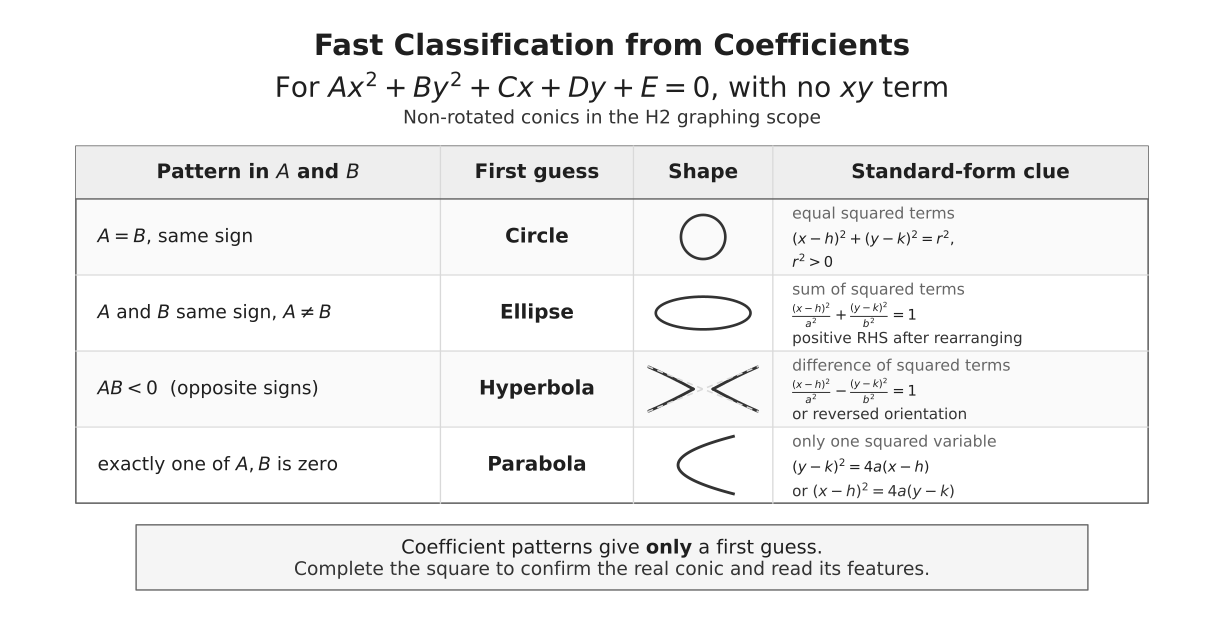 How to read the figure. This decision map applies only to an axis-aligned quadratic equation with no term. Compare the and coefficients: same non-zero sign suggests a circle or ellipse, opposite signs suggest a hyperbola, and only one squared variable suggests a parabola. Every row gives a candidate, not a conclusion. Complete the square, check whether real points exist or a degenerate case occurs, and only then read the centre, vertex, axes, asymptotes, or opening direction.
Graphing Calculator Use
A graphing calculator is useful in this topic, but it should be used as support, not as the source of the mathematical conclusion.
The calculator can help you see the rough shape of a conic. It can also help you check whether your sketch is reasonable. However, the explanation of the curve should still come from the equation.
In particular, the calculator is useful for:
- getting a quick visual impression of the curve
- checking the overall shape after you have rewritten the equation
- estimating intercepts or points when exact values are not required
- detecting whether your hand sketch is clearly inconsistent with the graph
But the calculator does not replace algebra.
Important features should still be found analytically, especially:
- the exact centre or vertex
- the exact radius or semi-axis lengths
- the exact vertices of a hyperbola
- the equations of the asymptotes of a hyperbola
- exact axial intercepts when required
- whether the completed-square form represents real points
For example, a graphing calculator may show that a curve looks like a hyperbola, but it will not by itself explain why the asymptotes are
That information comes from the standard form of the equation.
There is also a practical limitation. When circles or ellipses are drawn using ordinary function mode, the equation often has to be split into an upper branch and a lower branch. The graph may then appear visually separated, even though the actual conic is one continuous closed curve.
So the calculator picture should be corrected by mathematical understanding.
A good habit is:
Use the graphing calculator to check your sketch, not to replace the reasoning behind it.
Worked Graphing Examples
These examples focus on the common graphing task: rewrite the equation, identify the conic, then read the geometric features needed for a sketch.
Each example follows the same discipline: reveal standard form first, classify second, and sketch from exact features rather than from visual guesswork.
Example 1: Circle from completed squares
Determine the centre and radius of
Group and complete the square:
Hence
So the curve is a circle with centre and radius .
Example 2: non-unit coefficients before completing squares
Rewrite and sketch
Factor before completing each square:
Hence
and normalising gives
The centre is . The horizontal semi-axis length is and the vertical semi-axis length is , so and .
The four extreme points are
These points give the frame of the ellipse.
Example 3: Hyperbola with asymptotes
For
the positive squared term is the -term, so the hyperbola opens left and right.
The centre is and the vertices are
The asymptotes are
The sketch should be built from the centre, vertices, and dashed asymptotes before drawing the branches.
Example 4: Parabola with vertex, focus, and directrix
The vertex and opening direction are core graphing features. The focus and directrix are included here as enrichment geometry.
Rewrite
by completing the square:
This matches
So the vertex is and , giving . The parabola opens to the right, its focus is , and its directrix is
Common Pitfalls
1. Classification pitfalls
A common mistake is to classify a conic too early.
For example, seeing same-sign coefficients of and may suggest a circle or ellipse, but the equation still needs to be rewritten into standard form.
Similarly, seeing opposite signs may suggest a hyperbola, but this does not yet give the centre, vertices, or asymptotes.
The correction is:
Use coefficient patterns as clues, then complete the square to confirm the conic.
Another classification mistake is treating a circle and an ellipse as the same just because both have same-sign squared terms.
The distinction is:
- equal same-sign coefficients suggest a circle
- unequal same-sign coefficients suggest an ellipse
A circle may be viewed as a special ellipse, but in sketching questions it still has its own key feature: a single radius in every direction.
2. Completing-square and standard-form pitfalls
A frequent algebraic error is completing the square before factoring out the coefficient of the squared term.
For example,
should first be written as
and then completed inside the bracket.
Another mistake is forgetting that standard forms contain squared quantities such as , , and .
For example, in
the radius is
not .
In
the horizontal and vertical semi-axis lengths are
and
not and .
Another important mistake is ignoring whether the final standard form is geometrically valid.
For instance,
does not represent a real circle, because the left-hand side cannot be negative.
The correction is:
After completing the square, check both the form and the constants.
3. Sketching pitfalls
A conic sketch should not be based on appearance alone. It should be based on structural features.
For a circle, do not forget the centre and radius.
For an ellipse, do not forget the centre and the horizontal and vertical semi-axis lengths.
For a hyperbola, do not forget the asymptotes. The asymptotes are not decoration; they guide the directions of the branches.
For a parabola, do not look for a centre. A parabola is controlled by its vertex, axis of symmetry, and direction of opening.
Another common sketching mistake is assuming intercepts exist. A shifted conic may have no -intercepts, no -intercepts, or may just touch an axis.
The correction is:
Mark the structural features first, then solve for intercepts only when they are needed.
4. Calculator-use pitfalls
A graphing calculator can give a useful picture, but it may not give exact information.
It may show an intercept approximately, but exact values should be found by substituting
for -intercepts and
for -intercepts.
It may show the rough direction of a hyperbola, but the asymptotes should be obtained from the standard form.
It may show a closed curve in an incomplete or visually broken way if the conic has been entered as separate function branches.
The correction is:
Let algebra determine the features; let the calculator check the visual result.
Revision Checklist
Conceptual understanding
- Can I explain why circles, ellipses, parabolas, and hyperbolas are all called conic sections?
- Can I describe how the cone picture gives one family of curves rather than four unrelated graph types?
- Can I explain the difference between centre-driven conics and vertex-driven conics?
- Can I explain why a hyperbola has asymptotes but a circle and ellipse do not?
Algebraic conversion
- Can I rewrite a general equation into standard form by completing the square?
- Can I remember to factor before completing the square when the squared-term coefficient is not ?
- Can I read , , and correctly from , , and ?
- Can I check whether the completed-square form represents real points?
Classification
- Can I use coefficient patterns to make a first guess?
- Can I avoid treating that first guess as a full conclusion?
- Can I distinguish equal same-sign coefficients from unequal same-sign coefficients?
- Can I recognize that exactly one squared term suggests a parabola?
Sketching
- Can I identify the centre and radius of a circle?
- Can I identify the centre and semi-axis lengths of an ellipse?
- Can I identify the centre, vertices, and asymptotes of a hyperbola?
- Can I identify the vertex, axis of symmetry, and direction of opening of a parabola?
- Can I check intercepts from the equation instead of assuming them from the sketch?
Judgment and tool use
- Can I use the graphing calculator as a visual check rather than as the main reasoning?
- Can I find exact features analytically when the calculator gives only approximations?
- Can I explain why the standard form gives more information than a rough graph?
The main takeaway is:
First reveal the standard form, then read the geometry.