Normal Distribution Probability And Standardisation
Scope Label
Core 9758. This note covers the normal model, normal probabilities as areas, symmetry, and standardisation. It deliberately stops before inverse-normal parameter solving and linear combinations, which are handled in separate branches.
What This Note Assumes
You should already know:
- continuous probabilities are areas under density curves;
- for a continuous random variable;
- describes centre and describes spread.
The normal distribution is a special continuous model with a particular symmetric bell shape.
The Normal Distribution as a Model
A normal random variable is written
This notation says:
- is the mean and centre of the distribution;
- is the variance;
- is the standard deviation.
The parameter conditions are and , so the variance is positive.
The second parameter is variance, not standard deviation.
For example, if a measurement is normally distributed with mean and standard deviation , write
or equivalently
When standardising or using a calculator that asks for standard deviation, use , not .
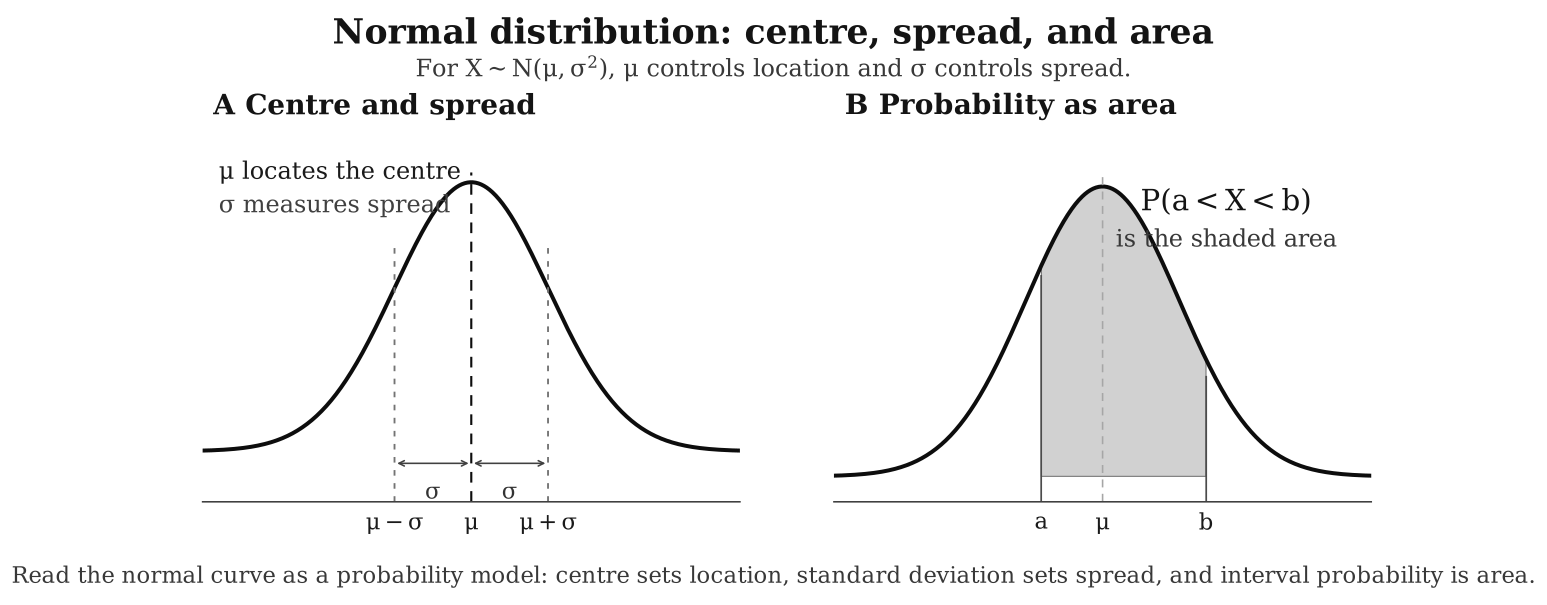 How to read this figure. The vertical axis is density , not probability. Probability is the area under the curve between boundaries; sets the centre and sets the spread.
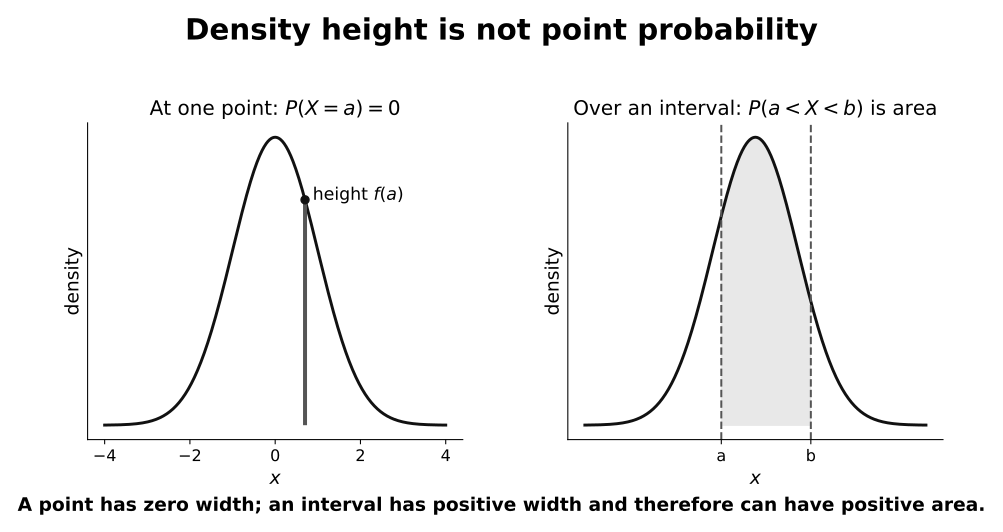
How to read this figure. The curve height is a density value, not . A single point has zero width and therefore zero probability; an interval has positive width and its probability is the shaded area.
Shape and Symmetry
The normal curve is:
- continuous;
- bell-shaped;
- symmetric about ;
- highest at the mean;
- more spread out when is larger.
Its mathematical support is the whole real line. The tails approach the horizontal axis but never meet it. By symmetry and unimodality,
The total area under the curve is .
Because the curve is symmetric about ,
For any positive ,
Symmetry only applies when distances from the mean are equal. The interval
is symmetric about , but
is not.
Is a Normal Model Appropriate?
A normal model is a plausible approximation, not a conclusion obtained from a familiar context word. Check whether:
- the variable is continuous;
- one symmetric, single-peaked cluster is plausible;
- extreme values thin out on both sides;
- impossible values in the model’s infinite tails have negligible probability for the parameters used;
- the population is not an obvious mixture of separated groups.
For example, adult heights within one reasonably homogeneous group may be modelled approximately by a normal distribution. By contrast, the number of days since a birthday is discrete, and a mixture of two separated height populations may be bimodal; neither mechanism is automatically normal. A mass that must be positive can still be approximated normally when its mean is many standard deviations above zero, making the impossible negative tail negligible.
A sample or histogram that looks roughly bell-shaped supports plausibility but does not prove that the underlying distribution is exactly normal.
Standard-Deviation Landmarks
For a normal distribution, the standard deviation gives a useful scale for judging how far a value is from the centre.
Approximately:
- of values lie within one standard deviation of the mean;
- of values lie within two standard deviations of the mean;
- of values lie within three standard deviations of the mean.
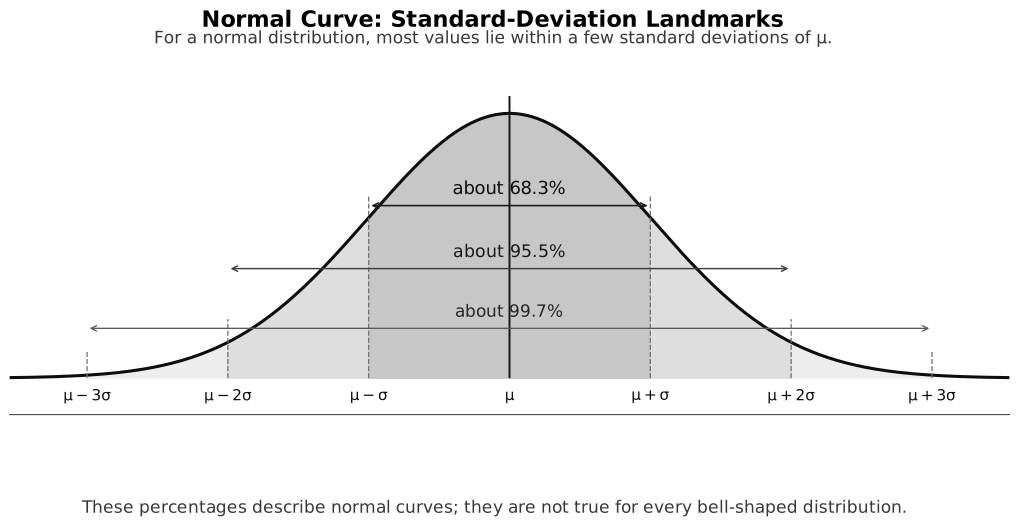 How to read this figure. Each percentage is the total central area between and : about for , for , and for . The percentage does not represent curve height.
These percentages are useful for intuition and checking answers, but they are not a substitute for exact calculator or table work when exact probabilities are required.
Meaning of and
Changing shifts the curve horizontally:
- larger moves the curve right;
- smaller moves the curve left;
- the shape is unchanged if stays fixed.
Changing changes the spread:
- smaller gives a narrower and taller curve;
- larger gives a wider and flatter curve;
- the centre is unchanged if stays fixed.
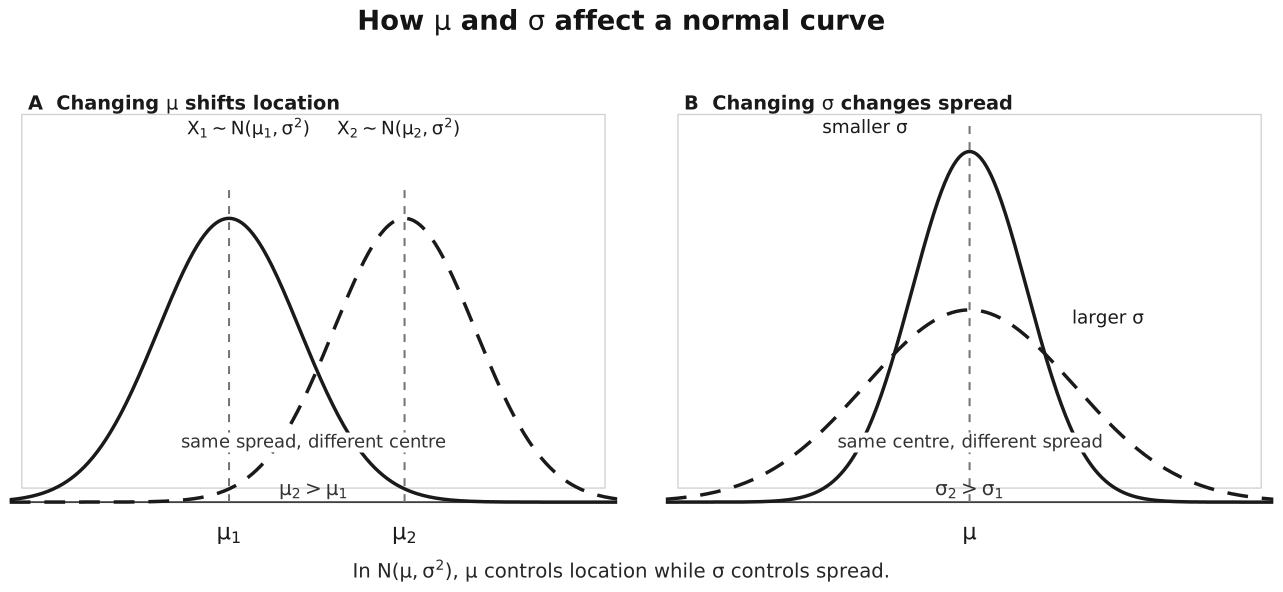 How to read this figure. In the location comparison, spread is held fixed while changes. In the spread comparison, the centre is held fixed while larger produces a wider, lower curve with the same total area .
Normal Probabilities as Areas
For a normal random variable, probabilities are areas under the normal curve.
The main region types are:
| Region type | Probability form | Meaning |
|---|---|---|
| Left tail | area to the left of | |
| Right tail | area to the right of | |
| Central interval | area between and |
Before calculating, identify the region. This prevents common errors such as treating and as interchangeable.
Endpoint inclusion does not matter because a continuous random variable assigns zero probability to any single point: . Therefore:
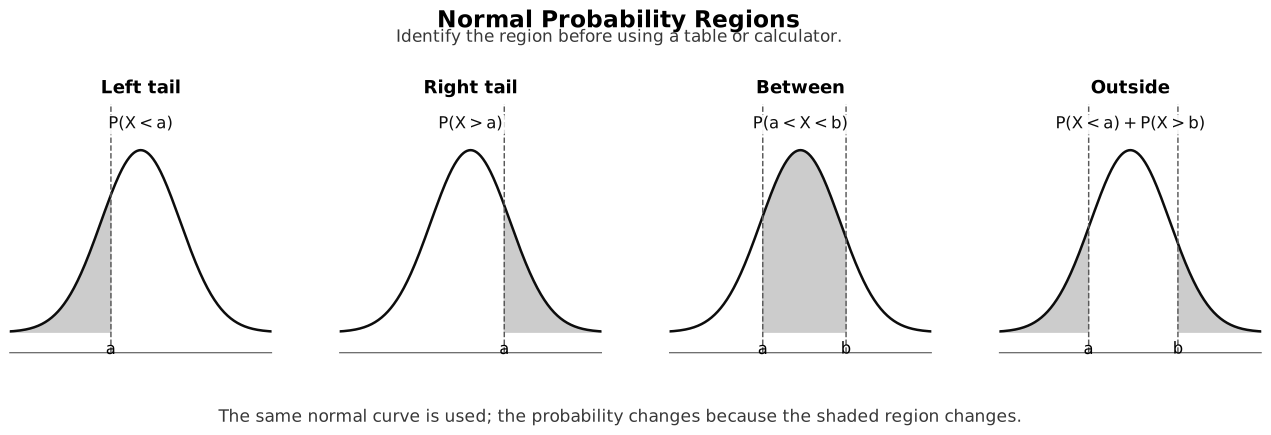 How to read this figure. Match the inequality signs to the shaded region before calculating. “Between” is one central strip; “outside” is the sum of two disjoint tails. Open or closed endpoints give the same area for a continuous variable.
Standard Normal Distribution
The standard normal distribution is
It has:
- mean ;
- variance ;
- standard deviation .
The standard normal distribution is not a separate topic from normal distribution. It is the reference scale used to compare normal variables.
It is convenient to write
Thus an interval probability is , and symmetry gives .
Standardisation
If
then
Standardisation has two meanings:
- subtract to recentre the distribution at ;
- divide by to measure distance in standard-deviation units.
A -score answers:
How many standard deviations is this value from the mean?
Examples:
- means the value is at the mean;
- means one standard deviation above the mean;
- means two standard deviations below the mean.
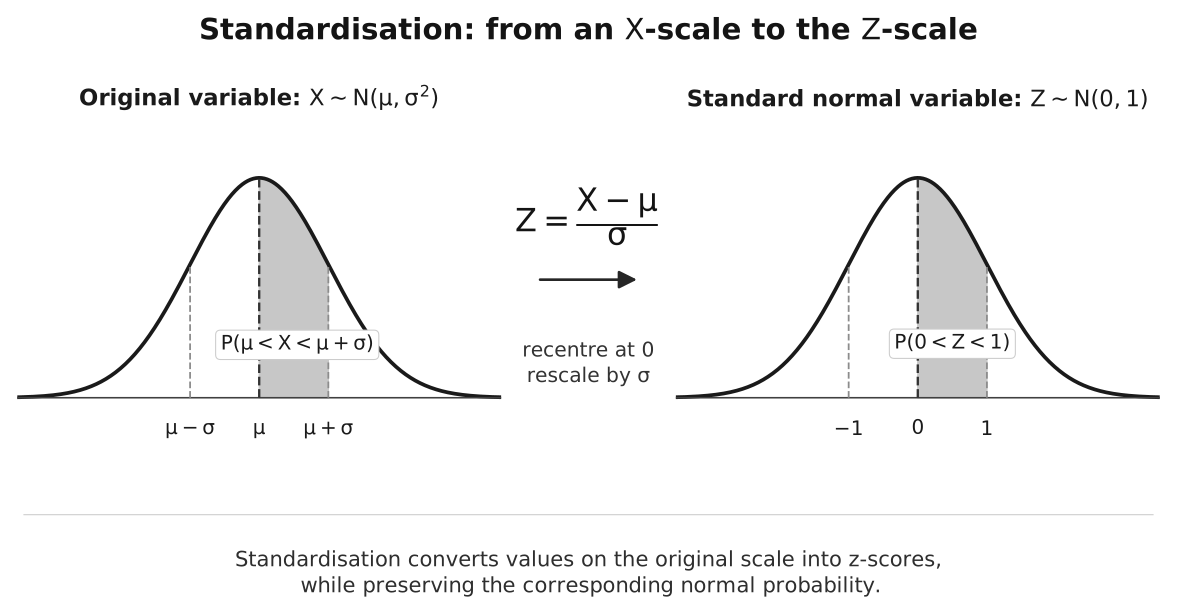 How to read this figure. Corresponding - and -boundaries enclose equal areas. Subtracting moves the centre to ; dividing by measures horizontal distance in standard deviations.
Direct Probability Workflow
To find a direct normal probability:
- Define the random variable.
- State its distribution.
- Identify and .
- Identify the required region.
- Standardise each boundary if working manually.
- Use a table or calculator after the region is clear.
- Interpret the probability in context.
For a boundary ,
Then rewrite the probability in terms of .
Core Example: Right-Tail Probability
Suppose
Find
The boundary is . Standardising,
So
Using a table or calculator,
The answer is small because is two standard deviations above the mean.
Core Example: A Probability Between Two Bounds
Let . Find .
The two standardised boundaries are
Hence
This is a CDF difference: area to the left of the upper boundary minus area to the left of the lower boundary.
Core Example: Outside Two Bounds
For the same variable, find .
The bounds are two standard deviations below and above the mean, so
The two shaded tails are disjoint, so their probabilities add.
Calculator Discipline
Use the calculator only after the mathematical structure is clear.
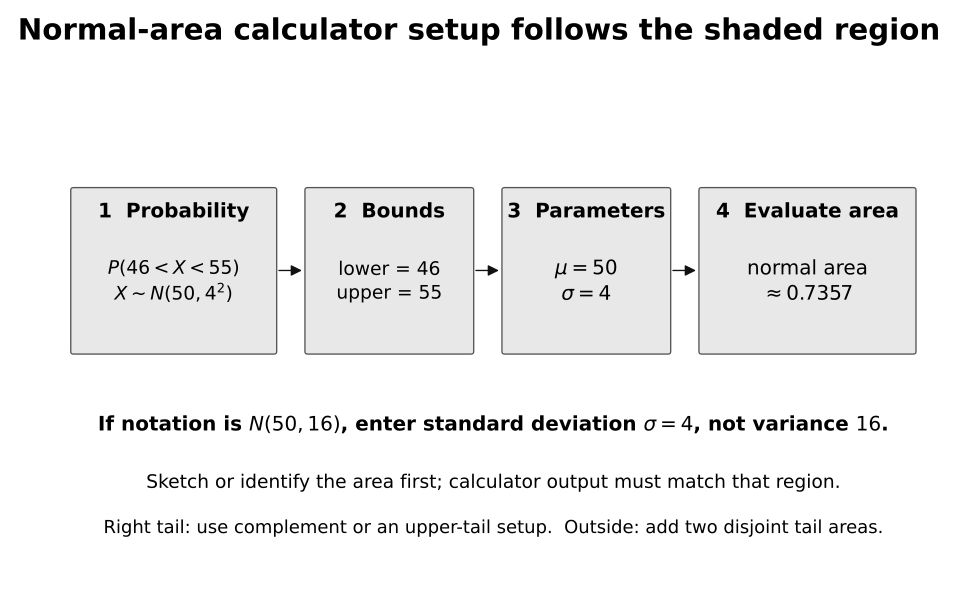
How to read this figure. Translate the shaded region into lower and upper bounds, then supply and the standard deviation . If the distribution is written , the calculator input is , not . The displayed area must match the probability notation before accepting the output.
A device-neutral workflow is:
- sketch or name the required region;
- write the probability notation;
- identify lower bound, upper bound, , and ;
- evaluate the normal area (or use a left-tail CDF and complement/difference);
- check that the size of the answer is plausible from the sketch;
- interpret the probability in context.
Check:
- Did you enter the standard deviation rather than the variance?
- Did you identify whether the region is left-tail, right-tail, or central?
- Did you use the correct lower and upper bounds?
- Did you keep the context and units clear?
If
then use standard deviation , not variance , in standardisation and calculator input.
Common Pitfalls
| Pitfall | Better thinking |
|---|---|
| Using as the standard deviation | The standard deviation is . |
| Forgetting that probabilities are areas | Sketch the region before calculating. |
| Applying symmetry to unequal distances | Check distances from . |
| Treating as a meaningless number | is distance from mean in standard-deviation units. |
| Using the calculator first | Set up the distribution and region first. |
Revision Checklist
- Can you read correctly?
- Can you explain how and affect the curve?
- Can you identify left-tail, right-tail, and central regions?
- Can you standardise a boundary value?
- Can you interpret a -score?
- Can you avoid entering variance when the calculator needs standard deviation?