Linear Combinations Of Normal Variables
Scope Label
Core 9758. This note covers linear combinations of independent normal random variables. Sample means appear here only as a normal-combination result and a bridge to sampling; detailed sampling-distribution work belongs in Sampling and Estimation.
What This Note Assumes
You should already know:
- uses variance as the second parameter;
- ;
- ;
- variances of independent random variables add.
The new normal-specific fact is closure:
Linear combinations of independent normal variables are still normal.
General Rule
If and are independent normal random variables, where
then, for constants and that are not both zero,
Read the rule in two layers:
- the expression remains normally distributed;
- the mean and variance are calculated using expectation and variance laws.
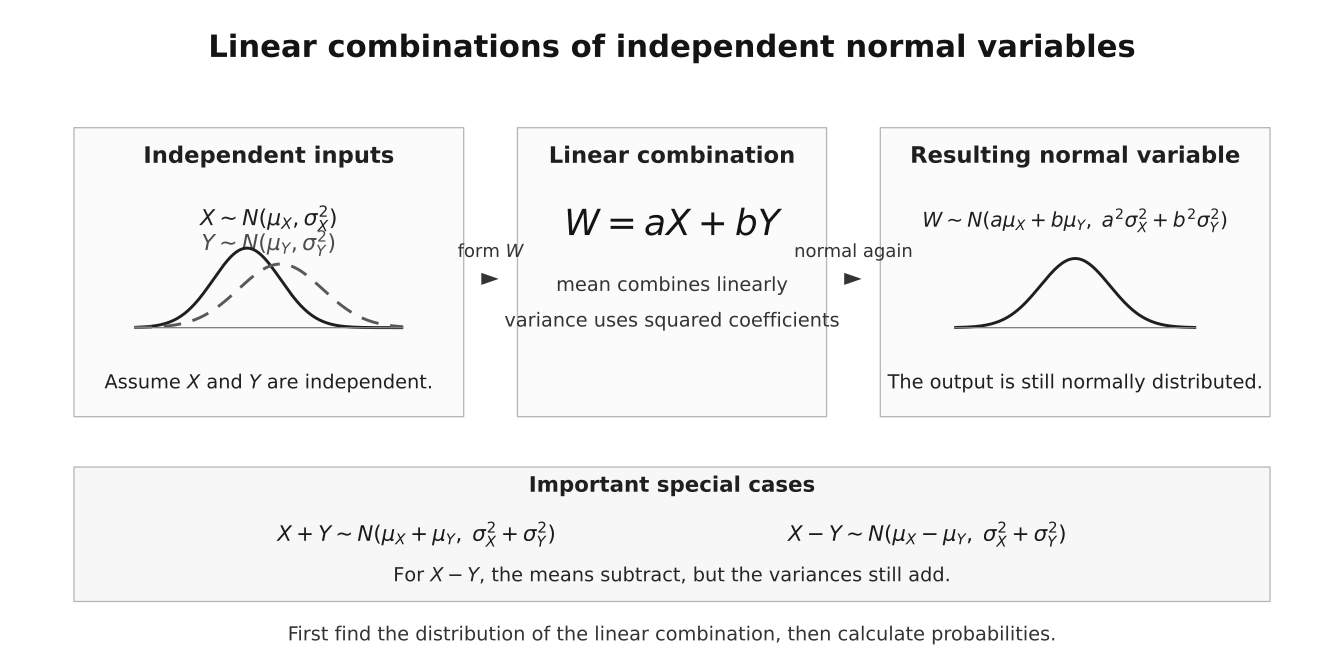 How to read this figure. Define first. The mean keeps the signs of and ; under independence, the variance has no covariance term and therefore uses .
If , then is the constant rather than a non-degenerate normal variable.
Sums and Differences
If and are independent, then
and
The variance of is still a sum:
provided and are independent.
This happens because
The minus sign changes the mean, but it does not make the variance subtract.
Independence is a sufficient condition for the simple variance formula used here.
Enrichment context. More generally,
The covariance term is zero for independent variables. Core 9758 questions in this branch normally state independence so that the simpler rule applies; the covariance formula is included only to explain the condition precisely.
Scalar Multiples
If
then, for ,
If , then is the constant with variance .
For example, if
then
or equivalently
Do not write if the notation expects variance as the second parameter.
Weighted Sums
For independent normal variables,
is also normal. The constant shifts the mean but does not change the variance.
If
then
and
Once the distribution of is found, normal probability methods can be applied to .
Core Example: A Weighted Combination
Let and be independent, and define
Then
and
Therefore
For example,
The constant shifts the mean only; the negative coefficient changes the sign of the contribution to the mean but is squared in the variance.
Sample Means of Independent Normal Variables
If
are independent and identically distributed normal random variables with
then
is also normal:
The mean stays at , but the variance is divided by .
To see why,
where independence justifies adding the variances.
This result prepares for sampling and estimation. In this note, the reason is not the Central Limit Theorem; it is the closure of independent normal variables under linear combination.
Independent total versus scaling one observation
Do not confuse a sum of independent observations with times one observation. If are independent copies of , then
But for the same single random variable ,
The independent total contains separately varying observations; repeats the same realised value. Dividing the independent total by gives .
Core Example: Sum of Independent Normal Variables
Suppose the masses of two independent components are normally distributed:
and
Let
Then
and
So
To find
standardise using standard deviation :
Thus
The key step is finding the distribution of before calculating probability.
Core Example: Difference of Independent Normal Variables
Suppose
and and are independent.
Let
Then
and
So
The variance is , not .
If the question asks for an absolute difference, split it into two tails. For example,
Using ,
Workflow for Combination Questions
- Define the new random variable.
- Check independence if a variance-addition rule is needed.
- Calculate the new mean.
- Calculate the new variance using squared coefficients.
- State the new normal distribution.
- Only then calculate the required probability or boundary.
This order matters. Many mistakes happen because students try to standardise before identifying the correct distribution.
Common Pitfalls
| Pitfall | Better thinking |
|---|---|
| Adding standard deviations | Add variances, not standard deviations. |
| Subtracting variances for | Coefficients are squared, so variance still adds under independence. |
| Forgetting independence | The simple variance rule needs independence. |
| Losing the normality condition | The closure statement here is for normal variables. |
| Writing the second parameter as standard deviation | In notation, the second parameter is variance. |
| Treating sample mean results as CLT here | For normal variables, is normal by normal closure; CLT is later sampling theory. |
Revision Checklist
- Can you state the distribution of for independent normal and ?
- Can you state the distribution of and explain why the variance adds?
- Can you handle ?
- Can you find the distribution of a sample mean of independent normal variables?
- Can you distinguish variance from standard deviation in the final notation?
- Can you check whether independence is needed before using the simple variance rule?