Inverse Normal And Parameter Questions
Scope Label
Core 9758. This note covers the value-from-area side of normal-distribution work: inverse normal, unknown parameters, and probability inequalities involving boundary values.
What This Note Assumes
You should already know:
- means the second parameter is variance;
- normal probabilities are areas;
- standardisation uses ;
- right-tail and left-tail probabilities are different regions.
Direct Probability Versus Inverse Normal
Direct normal probability starts with a boundary value and asks for an area:
value -> areaInverse normal starts with an area and asks for the boundary value:
area -> valueFor example,
means the value cuts off left-tail area .
The central idea is:
Inverse normal reasoning locates a boundary from a known area.
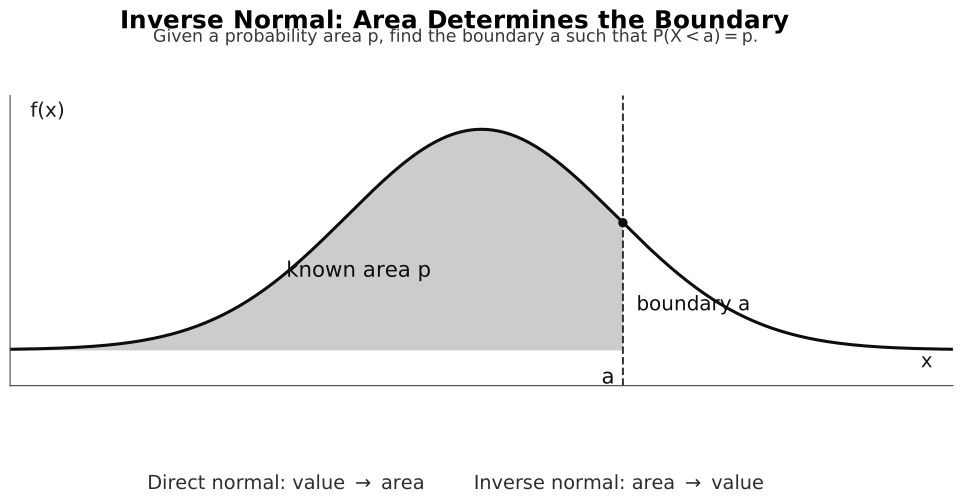 How to read this figure. The shaded left-tail area is given, so inverse normal first finds the corresponding standard-normal quantile and then converts it to the boundary . Endpoints carry zero probability.
Common Inverse Normal Forms
A left-tail form is already in calculator-friendly form:
Inverse quantiles require .
A right-tail form should often be converted to a left-tail form:
means
A central symmetric form may look like
Here is a half-width.
If the region is symmetric about , the remaining area is split equally between the two tails.
Do not split tail areas equally unless the interval is actually symmetric about the mean.
Core Example: Right-Tail Inverse Normal
Suppose and find such that .
Inverse-normal functions use a left cumulative area, so convert first:
The corresponding standard-normal quantile is , hence
The boundary is above the mean, consistent with a small right tail.
Core Example: Symmetric Central Area
Suppose . Find the symmetric interval about containing probability .
The total tail area is , so each tail has area . The upper endpoint therefore has cumulative area
Since , the half-width is . The interval is approximately
Equal tail splitting is valid here because the required interval is explicitly centred at the mean.
Core Example: A Non-Symmetric Interval
Let and find such that .
The lower boundary is fixed and the interval is not centred at , so do not split the remaining area equally. Instead,
Now , so the cumulative area to is approximately . Thus
This CDF-addition method works because the known area to the left of and the required interval area are adjacent and disjoint.
Core Example: Finding a Boundary Value
Suppose
Find such that
This is inverse normal because the probability is known and the boundary is unknown.
First find the standard normal value such that
Using a table or calculator,
Convert back to the -scale:
Thus
So
This means about of values lie below under this model.
Unknown Parameters
Some questions give probability statements and ask for , , or both.
The key idea is:
A normal probability statement can be converted into a -score equation.
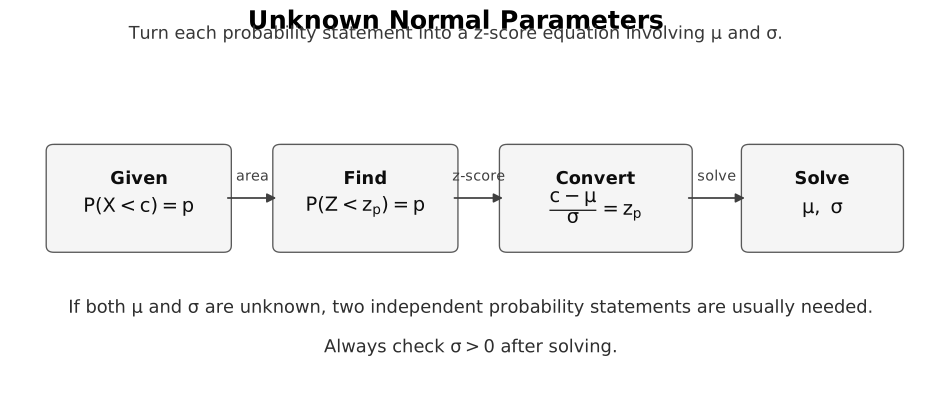 How to read this figure. One probability statement normally produces one -equation and can determine one unknown parameter. If both and are unknown, two probability statements that produce non-redundant equations are normally needed; always retain .
Suppose
and
The probability corresponds to
Therefore,
This gives one equation involving and .
Unknown-Parameter Workflow
-
Define and write its distribution.
-
Translate each probability statement into a standard normal statement.
-
Find the matching -value.
-
Form an equation using
-
Solve the equation or simultaneous equations.
-
Check the sign: a boundary below should have negative , while one above should have positive .
-
Check that .
-
Interpret the result in context.
One probability statement usually gives one equation. If both and are unknown, two probability statements that produce non-redundant equations are usually needed.
Core Example: Finding and
Suppose
and
From standard normal values,
and
So
and
These give
and
Subtract:
Thus
Substituting back gives
So
approximately.
Ranges of Possible Values
Some questions ask for a range of boundary values, such as
or
These are not asking for a probability. They are asking which values of make the probability statement true.
Use this method:
- Replace the inequality with equality.
- Solve the boundary case.
- Decide which side of the boundary satisfies the original inequality.
The monotonic directions can be summarised as follows. Let be the boundary satisfying .
| Required condition | Equivalent boundary range |
|---|---|
Left-tail area increases with ; right-tail area decreases with .
Core Example: Range of Boundary Values
Suppose
Find the range of such that
First solve the equality:
For the standard normal distribution,
So
Hence the unrounded boundary is
As increases, the left-tail area increases. Therefore,
when . Thus the precise calculator-based conclusion is
If the question requests values to 3 significant figures, report the cutoff as while keeping the unrounded value for deciding the inequality.
Core Example: A Right-Tail Boundary Inequality
For , find such that .
Solve the boundary equality , equivalently . The unrounded cutoff is
As moves right, the right-tail area decreases. Therefore the required range is
Round the cutoff only when the question specifies a precision, and use the unrounded value when deciding whether a candidate satisfies the strict inequality.
This direction is the opposite monotonic picture from a left-tail probability: increases with , whereas decreases.
Symmetry in Maximum-Probability Interval Questions
Sometimes a question fixes the width of an interval and asks for the greatest possible probability inside it.
For a normal distribution, a fixed-width interval captures the greatest area when it is centred at the mean. For example, if
is to be made as large as possible while is fixed, then the best position is usually the symmetric one:
This works because the normal curve is highest at the mean and decreases symmetrically away from it. It is a symmetry argument, not a calculator shortcut.
Common Pitfalls
| Pitfall | Better thinking |
|---|---|
| Treating inverse normal as another probability calculation | Inverse normal finds a value from an area. |
| Forgetting to convert a right tail | means left-tail area . |
| Splitting tails equally without symmetry | Equal tail split only works for symmetric central regions. |
| Using variance instead of standard deviation in | Use , not . |
| Accepting from algebra | Standard deviation must be positive. |
| Solving inequality questions without checking direction | After finding the equality boundary, test which side satisfies the condition. |
Revision Checklist
- Can you distinguish direct probability from inverse normal?
- Can you convert a right-tail inverse question into a left-tail area?
- Can you find a boundary value from a probability?
- Can you form a -score equation from a probability statement?
- Can you solve for or from normal probability information?
- Can you handle probability inequalities involving boundary values?