Maclaurin Series
Overview
A power series in is an infinite polynomial-like expression
where are constants.
The central idea is:
many non-polynomial functions can be represented near a suitable point by an infinite polynomial.
For H2 Mathematics, the main centre is . A power series expanded about is called a Maclaurin series.
This topic sits naturally after sequences and series because it changes the question from:
What does this infinite sum do?
to:
Can this infinite sum represent a familiar function?
Why Maclaurin Series Matter
Maclaurin series are useful because polynomials are easy to handle.
They allow us to:
- approximate functions such as , , , and
- estimate values such as or
- justify small-angle approximations
- expand products, quotients, and composite functions
- differentiate or integrate suitable functions term by term
- understand local behaviour near
The word local matters. A low-order Maclaurin polynomial usually approximates a function best near the centre of expansion.
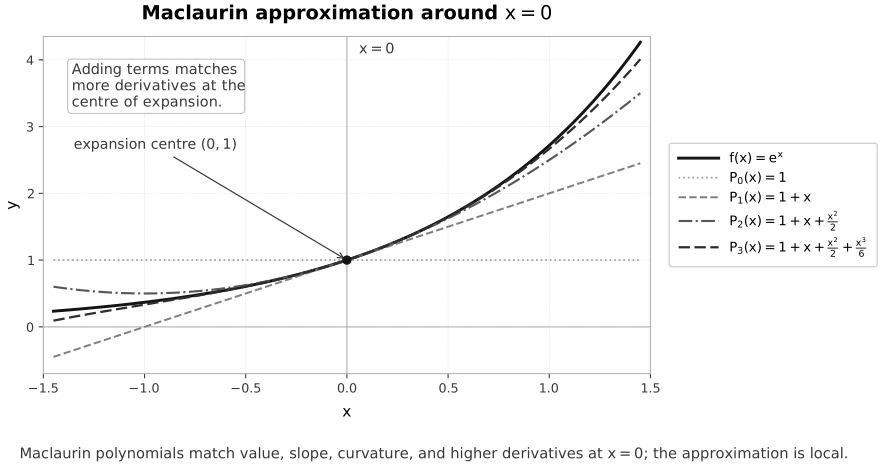 Caption: A Maclaurin polynomial uses derivative information at . Higher-degree truncations match more derivatives there and can improve the local approximation, but accuracy at a particular nonzero must still be checked rather than assumed.
The Maclaurin Formula
Suppose
Substituting gives
Differentiating once gives
so
Repeating this process gives
Hence the Maclaurin series is
provided the resulting series converges to in the range being used.
What The Formula Means
The Maclaurin series builds a polynomial approximation from derivative information at the origin.
- fixes the value at the origin.
- fixes the tangent slope at the origin.
- fixes the local curvature.
- Higher derivatives refine the local shape.
The first few Maclaurin polynomials are
and
For small , higher powers such as are usually small. This is why a low-order Maclaurin polynomial can be accurate near but poor far away.
Existence And Convergence
It is not enough for a function to have many derivatives. A Maclaurin series is useful only when the series converges to the original function in the range considered.
At H2 level, the practical checks are:
- the needed derivatives at must exist
- the resulting power series must be used inside its validity range
- the approximation is usually most accurate near
- different standard expansions have different validity ranges
For example,
is valid for all real , but
is valid only when .
Standard Maclaurin Expansions
The following standard expansions are the working toolkit.
Exponential Function
This is valid for all real .
Replacing by gives
For , since ,
Sine Function
This is valid for all real , with measured in radians.
Replacing by gives
Cosine Function
This is valid for all real , with measured in radians.
Replacing by gives
Logarithmic Function
This is valid for
Replacing by gives
with validity determined by
Binomial Series
For rational ,
More generally,
If is a non-negative integer, the series terminates and becomes the ordinary binomial theorem.
If is not a non-negative integer, the series is infinite and is valid for
Validity Ranges
A common exam error is to expand correctly but state the wrong validity range.
The reliable question is:
What expression replaced the standard variable?
For example,
If , then
and the validity condition is
so
For
use in . The validity condition is
Solving gives
The endpoint direction changes because the coefficient of is negative.
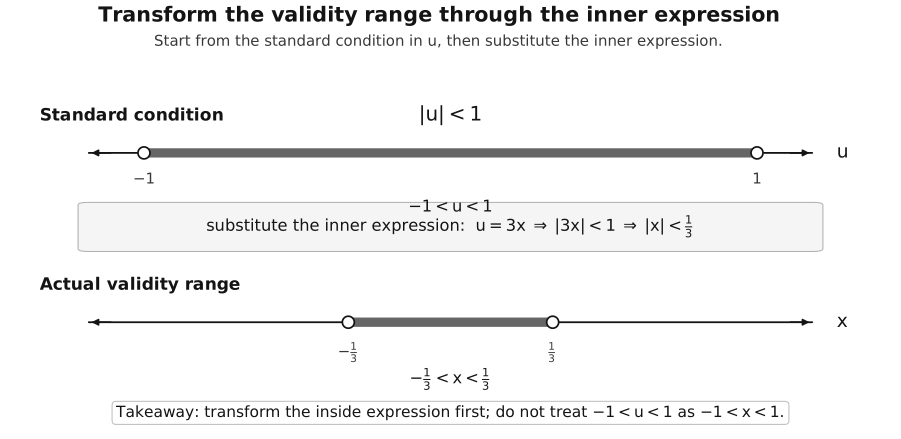 Caption: Validity ranges must be transformed from the standard variable into the actual variable used in the question.
Ascending And Descending Powers
For expressions such as , the factorisation determines the form and validity range.
Ascending Powers Of
For and , factor out the constant term only where the chosen real branch is represented consistently:
Then use the binomial series on
The validity condition is
so
The binomial interval must also be intersected with the original real domain. For a non-integer rational power, choose a real factorisation that preserves the required branch; a positive constant factor is the usual first-learner route.
This gives a series in ascending powers of :
Descending Powers Of
Support/enrichment. This form is useful for large- reasoning, but the real domain and branch of the original function must be preserved.
For and , factor out the -term only where the real powers involved are defined consistently:
The binomial-series condition is
so
This gives a series in powers of , but the condition must be intersected with the real domain and branch of the original expression. It is not automatically valid on both sides of the number line for a non-integer rational power.
For example,
on the usual real square-root branch requires as well as . Hence this descending expansion is valid for
not for .
Use ascending powers when values near are relevant. Use descending powers when is large and the expression is naturally controlled by powers of .
Manipulating Series
Most exam questions require adapting standard expansions rather than deriving every series from first principles.
Substitution
To expand , replace by :
To expand :
Sums And Differences
Expand each part to the required order, then combine like powers.
For example,
Now
and
Therefore
The validity range is the intersection of the two ranges:
Products
When multiplying series, keep only the terms needed up to the required order.
For example, expand up to and including the term in .
Use
and
Then
Keeping terms up to ,
The important discipline is not to over-expand blindly. Keep enough terms, but only enough terms.
Partial Fractions
For rational functions, partial fractions often make expansion easier.
For example,
can be decomposed into simple fractions of the form
Equating numerators gives
so and . Hence
Now
and
Therefore, up to ,
with the intersected validity range
Each part can then be expanded using a binomial or geometric series. The final validity range is the intersection of the validity ranges of all parts used.
Deriving Series By Differentiation
If a power series for is known, then a power series for can often be obtained by differentiating term by term within the interval of validity.
For example,
Differentiating both sides gives
Thus
This agrees with the direct expansion
Deriving Series By Integration
Term-by-term integration can also create a new series. Start from the geometric expansion
Integrate from to so that the constant is fixed automatically:
Thus
Term-by-term integration preserves the open interval of convergence used in the derivation. An endpoint such as must be checked separately; it should not be included merely because the antiderivative exists there.
At , the resulting alternating harmonic series converges, so the familiar final validity range is
At , is undefined and the series is excluded.
Deriving Series By Implicit Differentiation
Sometimes direct differentiation becomes messy. An implicit relation can make the repeated derivatives at easier to obtain.
For example, let
Then
Differentiating gives
so
At ,
Further differentiation gives higher derivatives at . Substituting into the Maclaurin formula gives
Implicit differentiation is useful when a function is defined through an equation involving , , trigonometric functions, or inverse trigonometric functions.
Approximations Using Maclaurin Series
To approximate a number using a Maclaurin series:
- Choose a suitable standard expansion.
- Rewrite the number as a function value near .
- Check the validity range.
- Substitute the chosen value of .
- Keep enough terms for the requested accuracy.
Example: Approximate
Use
Put :
To five decimal places,
This works well because is close to .
Example: Approximate
Write
Use
Put :
Accuracy And Number Of Terms
The accuracy of a truncated Maclaurin series depends mainly on:
- how far is from
- how many terms are kept
- whether the chosen lies in the validity range
For example,
is a good linear approximation only near , while
often gives a better approximation near , but a higher truncation order does not guarantee a smaller error at every fixed point.
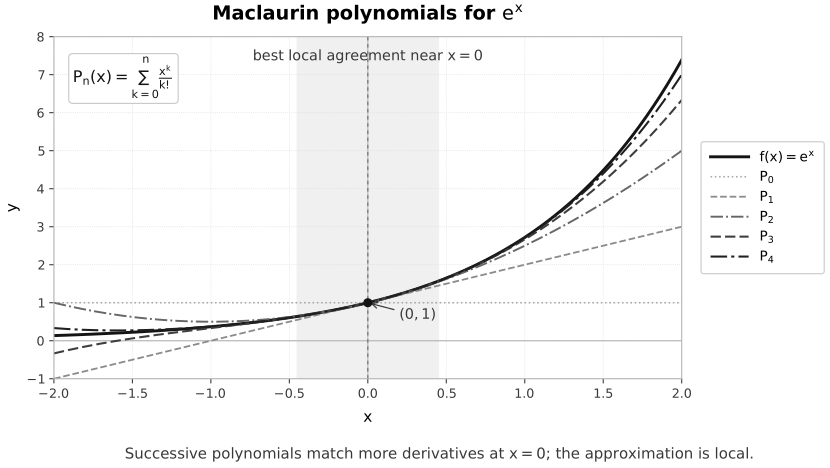 Caption: For , successive Maclaurin polynomials match more derivatives at and generally track the curve well over a larger nearby region. The figure illustrates local improvement; it is not a universal theorem that every added term reduces pointwise error everywhere.
Small-Angle Approximations
Small-angle approximations come directly from the Maclaurin expansions of trigonometric functions.
For small and measured in radians,
and
Thus
The simpler approximation
is sometimes enough, but is more accurate when terms up to are needed.
For example, if is small enough to neglect and higher powers, then
and
Worked Example: Deriving
Let
Then
and in general
At ,
Therefore
Worked Example: Deriving Up To
Let
Then
Since
we get
Differentiating again,
so
Differentiating once more gives
Therefore
Thus, for small ,
Worked Example: Expanding A Binomial Expression
Expand up to and including the term in .
Use
Here
Therefore
Simplifying,
The validity condition is
so
Worked Example: Expanding A Product
Find the expansion of up to and including the term in .
Use
and
Then
Collecting terms gives
The validity range comes from :
Worked Example: Coefficient Of
Find the coefficient of in
First factor out :
The general term is
Since
and
the coefficient of is
or
The validity condition is
so
Enrichment: Taylor Expansion Around
The Maclaurin series is a special case of Taylor series.
A Maclaurin series expands a function around
A Taylor series around expands the function around
The Taylor series of about is
If , this becomes the Maclaurin series.
So:
This is enrichment because the current H2 core emphasis is Maclaurin series, but the wider idea helps explain why the centre of expansion matters.
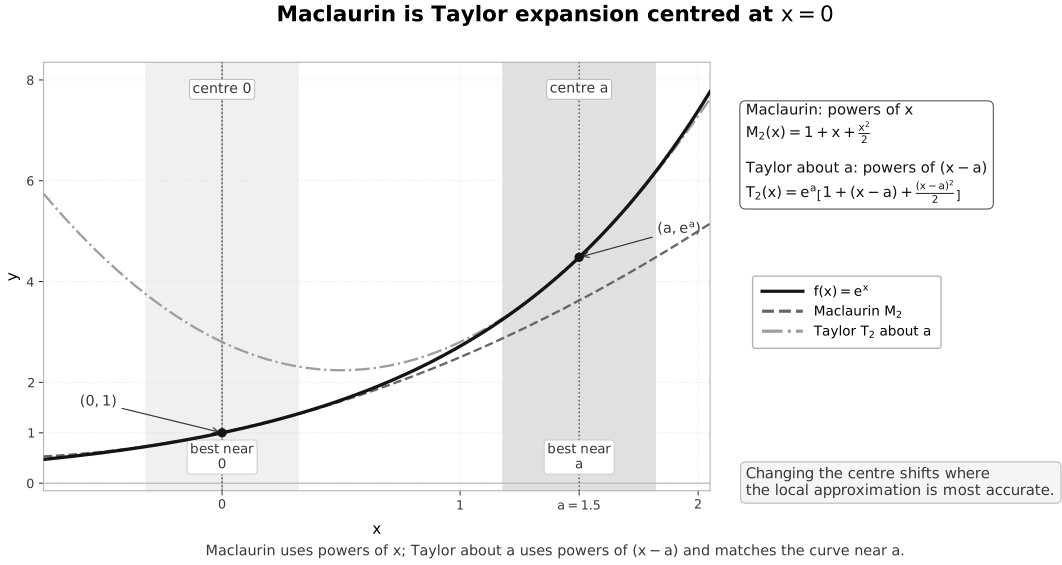 Caption: Maclaurin expansion is centred at ; Taylor expansion shifts the local centre to .
Common Mistakes
- Forgetting to state the validity range.
- Using degrees instead of radians in trigonometric expansions.
- Assuming every Maclaurin series is valid for all real .
- Keeping too few terms before multiplying series.
- Support/enrichment: choosing an invalid real branch when forming a descending-power expansion.
- Mishandling endpoint inequalities for .
- Treating the formula as memorised decoration rather than derivative information at .
- Forgetting that a truncated series is an approximation, not usually an exact equality.
Problem-Solving Checklist
- Identify whether the target resembles , , , , or .
- Rewrite or factor the expression into a standard form.
- For core questions, form the required ascending-power expansion. Support/enrichment: use powers of only when a descending expansion is explicitly required, checking the real branch.
- Substitute carefully into the standard expansion.
- Keep enough terms for the requested order.
- Simplify coefficients and combine like powers.
- State the validity range.
- For approximations, check that the chosen value lies within the validity range.
- For small-angle approximations, check that angles are in radians.
- For non-standard functions, consider using the derivative formula or implicit differentiation.
Summary Table
| Function | Maclaurin expansion | Validity |
|---|---|---|
| all real | ||
| all real , radians | ||
| all real , radians | ||
| $ |
Practice Questions
Basic Fluency
- Expand up to and including the term in .
- Expand up to and including the term in .
- Expand up to and including the term in .
- Expand up to and including the term in , and state the validity range.
- Expand up to and including the term in , and state the validity range.
Exam-Style Practice
- Expand in ascending powers of up to and including the term in .
- Expand up to and including the term in .
- Expand up to and including the term in .
- Use partial fractions to expand
in ascending powers of up to and including the term in , and state the validity range.
Enrichment Practice
- Use implicit differentiation to find the Maclaurin expansion of up to and including the term in .
- Find the Taylor expansion of about up to and including the term in .
- Use a suitable series to approximate correct to five decimal places.