Sampling Methods
Scope Label
Core 9758. This branch covers population, sample, sampling frame, random sampling, and the main H2 sampling methods: simple random, systematic, stratified, and quota sampling.
Overview: Why Sampling Method Matters
Before estimation can be trusted, the sample itself must make sense.
Suppose a group of students wants to estimate the mean number of hours JC students in Singapore spend watching videos each day. Asking only their close friends is easy, but the result may say more about their friendship group than about JC students in general. Asking students from several schools using a planned selection method is harder, but the result is more trustworthy.
This branch is the practical front end of Sampling and Estimation. It explains how a sample may be selected and why some methods support statistical inference better than others.
The key distinction is:
- a sample is a subset of the population
- in this H2 context, a random sample gives every population member the same chance of selection
- a sampling method affects whether conclusions drawn from the sample can be trusted
Big picture. A poor sampling method can produce biased data even when the sample size is large. Sampling design controls the quality of the evidence before any calculation begins.
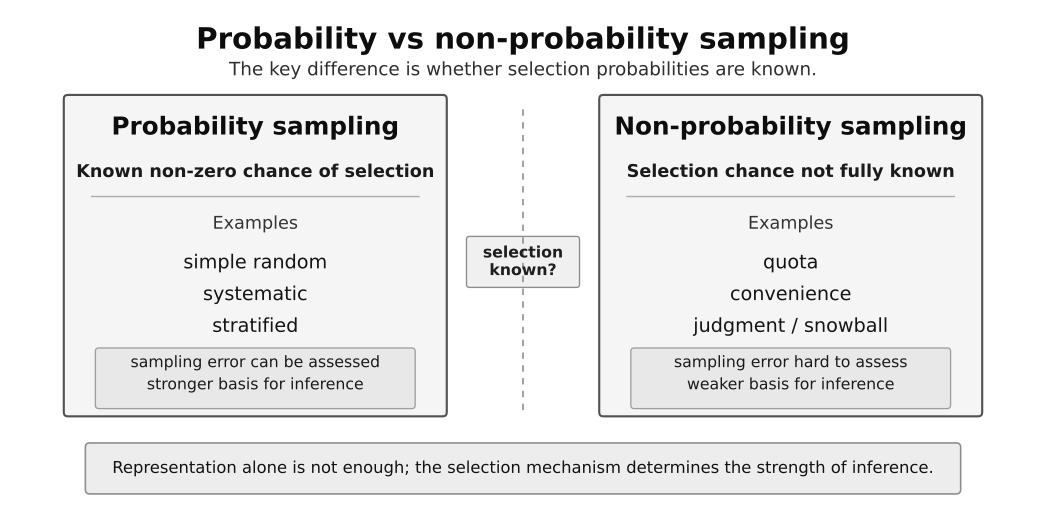 How to read this figure. Probability sampling gives population members known non-zero inclusion chances; non-probability methods do not. This supports stronger inference, but a probability sample still has random sampling variability and can suffer from frame undercoverage or non-response.
The Core Question: Can This Sample Represent the Population?
A sampling question is usually not asking only, “How do we choose some people?” It is asking whether the chosen sample can reasonably represent the population of interest.
When reading a sampling question, ask four questions first:
- Who is the population?
- What is the sampling frame?
- Is the selection random?
- Could the method introduce bias?
These questions are more important than memorising fixed advantages and disadvantages. The same sampling method can be suitable in one context and unsuitable in another.
For example, simple random sampling may work well for choosing students from a school register, but may be impractical for surveying all shoppers who visit a mall during a weekend, because there may be no complete list of such shoppers.
Population, Sample, and Sampling Frame
A population is the full group of interest.
A sample is the smaller group actually observed.
A sampling frame is the list or structure from which the sample is drawn.
The target population is the full group about which conclusions are intended. The accessible population is the part that the available frame can actually reach. If these differ, frame undercoverage can bias the result even when selection from the frame is random.
For example, if a survey wants to study all JC students in Singapore:
- the population is all JC students in Singapore
- a sample may be 500 selected JC students
- a sampling frame may be a complete list of JC students, school registers, or another usable list from which students can be selected
A sampling frame should be as complete and up to date as possible. If the sampling frame misses part of the population, then some members have no chance of being selected, even if the selection from the list itself is random.
In exam questions, identifying the sampling frame is often the first real test of whether the proposed method is even possible.
For example:
- To sample students from a school, the school register may be a suitable sampling frame.
- To sample households in a housing estate, a complete list of household addresses may be needed.
- To sample shoppers entering a mall, a complete sampling frame may not exist.
A method that requires a complete sampling frame may therefore be theoretically good but practically impossible in a given context.
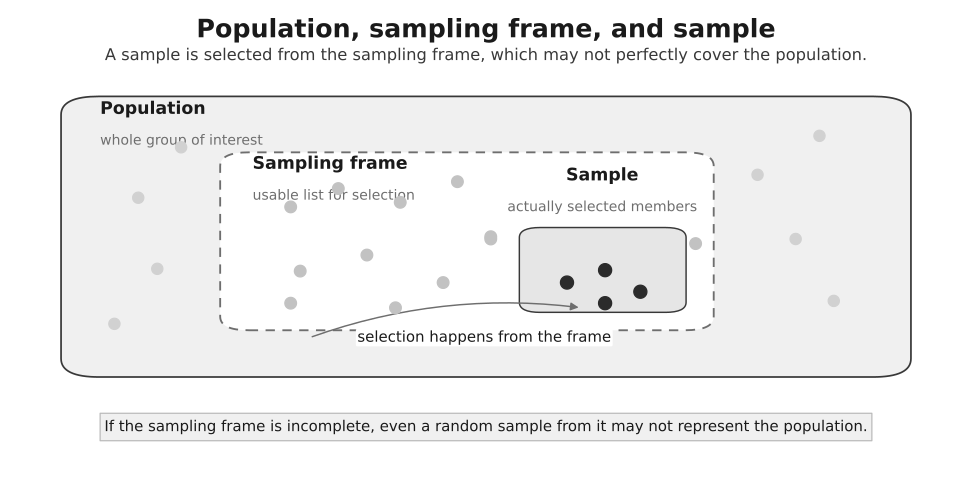 How to read this figure. Selection occurs from the sampling frame, not directly from an abstract target population. If the frame omits part of the target population, those members cannot enter the sample and increasing does not repair that undercoverage.
Sample versus Random Sample
A sample is simply a subset of the population.
A random sample is a sample selected by a random mechanism, so that the selection is not controlled by convenience, personal preference, or hidden bias.
For example, a group of 30 students chosen from one class may be a sample of students, but it is not necessarily a random sample of all JC students in Singapore.
This distinction matters because later statistical inference usually assumes that the sample has been selected in a defensible random way.
A large sample is not automatically a good sample. A large but biased sample can still give misleading conclusions.
Three related terms must be kept separate:
- a random sample, in this H2 definition, gives every population member the same chance of selection;
- a probability sample more generally gives every member a known, non-zero inclusion chance, which need not be equal;
- an iid random sample in probability theory models as independent and identically distributed. This stronger model justifies the standard formulas for and .
A simple random sample of size adds a set-level condition: every possible subset of population members is equally likely to be selected. Systematic and stratified designs can be probability samples, but they do not automatically create iid observations from the overall population.
Sampling Variability and Three Sources of Bias
- Sampling error or variability is the random difference between a statistic and its target parameter across repeated probability samples. A larger usually reduces this fluctuation.
- Frame undercoverage or selection bias arises when the frame omits members or the mechanism systematically favours some members. Increasing from the same flawed process does not remove it.
- Non-response bias arises when selected members do not respond and responders differ systematically from non-responders in the variable being studied. Random selection alone does not prevent this bias.
Therefore, a large sample can be precise but still systematically misleading.
Probability and Non-Probability Sampling
Sampling methods are often grouped into two broad classes.
Probability sampling
In probability sampling, each member of the population has a known non-zero chance of being selected.
This matters because:
- sampling error can be meaningfully discussed
- inference to the population has a defensible statistical basis
- the selection process is protected from personal choice or convenience
The H2 probability sampling methods in this note are:
- simple random sampling
- systematic sampling
- stratified sampling
Non-probability sampling
In non-probability sampling, the selection is not fully random, and selection probabilities are not known or not well defined.
This matters because:
- bias is harder to control
- sampling error is harder or impossible to assess
- conclusions are usually less statistically reliable
The main H2 non-probability method in this note is:
- quota sampling
The difference is not just “random” versus “not random”. The deeper difference is whether the sampling mechanism supports principled inference about the population.
| Feature | Probability sampling | Non-probability sampling |
|---|---|---|
| Selection mechanism | Random | Not fully random |
| Selection probability | Known and non-zero | Unknown or not well defined |
| Sampling error | Can be meaningfully discussed | Hard or impossible to assess |
| Inference strength | Stronger | Weaker |
| H2 examples | Simple random, systematic, stratified | Quota |
This is why the branch belongs beside Sampling and Estimation rather than before it only as vocabulary. Sampling design controls how trustworthy later estimation can be.
Simple Random Sampling
In simple random sampling, every member of the population has an equal chance of selection, and every sample of a given size is equally likely.
It is often the benchmark method against which other sampling methods are compared.
How to carry it out
To select a simple random sample of size from a population of size :
- Obtain a complete and updated sampling frame.
- Label each member of the population from to .
- Use a random number generator, calculator, or random number table to select distinct labels.
- Select the corresponding members.
Do not merely say “choose randomly”. A clear answer should explain how randomness is introduced.
Example: Simple Random Sampling
Suppose a school wants to select 40 students from a population of 800 students.
A clear description would be:
- Obtain the school register containing all 800 students.
- Label the students from to .
- Use a random number generator to select 40 distinct numbers between and .
- Choose the students whose labels match those numbers.
When it works well
Simple random sampling works well when:
- the population is manageable
- a complete sampling frame is available
- no important subgroup needs special protection
- the aim is to use a clean and fair random procedure
Strengths
- It is conceptually simple.
- It gives every member an equal chance of selection.
- It has minimal built-in selection bias.
- It provides a good foundation for statistical inference.
Limitations
- It requires a complete and updated sampling frame.
- It can be impractical for a very large or hard-to-reach population.
- By chance, it may under-represent small but important subgroups.
For example, if a school has a small number of international students, a simple random sample may accidentally include none of them. If their views are important to the study, stratified sampling may be more suitable.
Common exam phrasing
A good exam answer usually includes:
- the sampling frame
- the labelling process
- the random selection method
- the final selection of corresponding members
Systematic Sampling
In systematic sampling, members are selected at regular intervals from an ordered list after a random start.
If the population size is and the required sample size is , the sampling interval is usually
The value of is normally assumed to be an integer in standard H2 examples.
How to carry it out
To select a systematic sample of size from a population of size :
- Arrange the population in an ordered list.
- Calculate the sampling interval .
- Randomly select one member from the first members.
- Select every th member after that until the sample size is reached.
Example: Systematic Sampling
Suppose 8 households are to be selected from 120 households.
Then
If the random start is the 7th household, then the selected households are
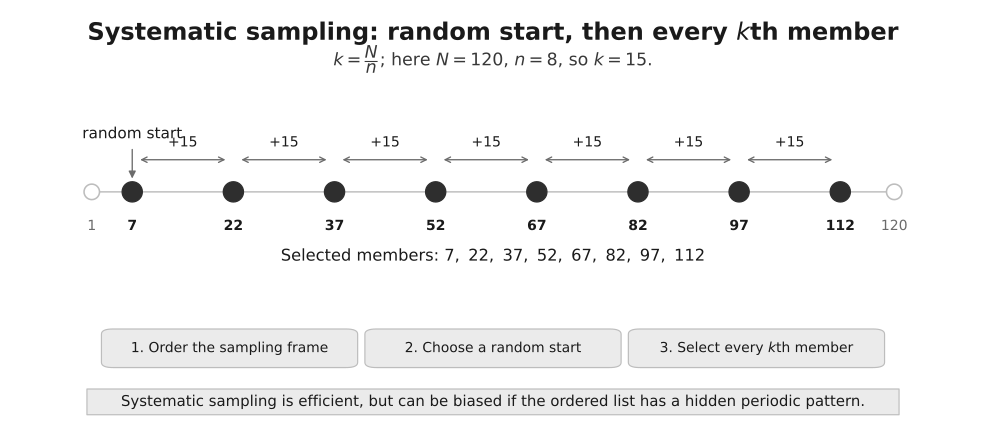 How to read this figure. A genuinely random start makes systematic sampling a probability design; subsequent selections are determined every positions. A periodic pattern aligned with can still distort the sample.
When it works well
Systematic sampling works well when:
- there is a complete and ordered sampling frame
- the method needs to be efficient
- the list does not contain a hidden pattern related to the variable being studied
It is often easier to carry out than simple random sampling because only the first member is chosen randomly; the rest follow a fixed interval.
Strengths
- It is relatively easy to conduct.
- It spreads the sample evenly across the ordered list.
- It can be more convenient than generating many separate random numbers.
Limitations
- It requires a complete and updated sampling frame.
- It depends on the ordering of the list.
- It can be biased if the list has a periodic pattern.
Periodicity trap
Systematic sampling can fail when the ordered list has a repeated pattern that matches the interval .
For example, suppose a survey records MRT station usage every 7th day. If the first selected day is a Sunday, then every selected day may also be a Sunday. The sample would then describe Sunday usage rather than typical weekly usage.
So systematic sampling is not automatically “almost random”. Its quality depends strongly on whether the ordering introduces unintended bias.
Stratified Sampling
In stratified sampling, the population is divided into non-overlapping groups called strata, and a random sample is taken from each stratum.
The key idea is deliberate representation.
Stratified sampling is useful when the population contains meaningful subgroups, and those subgroups may differ in ways relevant to the study.
How to carry it out
To select a stratified sample:
- Divide the population into non-overlapping strata.
- Ensure every member of the population belongs to exactly one stratum.
- Decide how many members should be selected from each stratum.
- Randomly select the required number of members from each stratum, usually using simple random sampling within each stratum.
The strata must be:
- non-overlapping: no member belongs to more than one stratum
- exhaustive: every member belongs to a stratum
Proportionate allocation
In proportionate stratified sampling, the number selected from each stratum follows the population proportions.
If the population has size , the required sample size is , and a stratum has size , then the number selected from that stratum is
Example: Proportionate Stratified Sampling
Suppose a school has 400 students, with 120 in Year 1 and 280 in Year 2. A sample of 50 students is needed.
A proportionate stratified sample would select
students from Year 1, and
students from Year 2.
Within each year group, the students should then be selected randomly.
If proportional allocations are non-integers, calculate all raw allocations before rounding. Then assign integer counts together—commonly by giving remaining places to the largest fractional remainders—so that the final stratum counts still sum to the required .
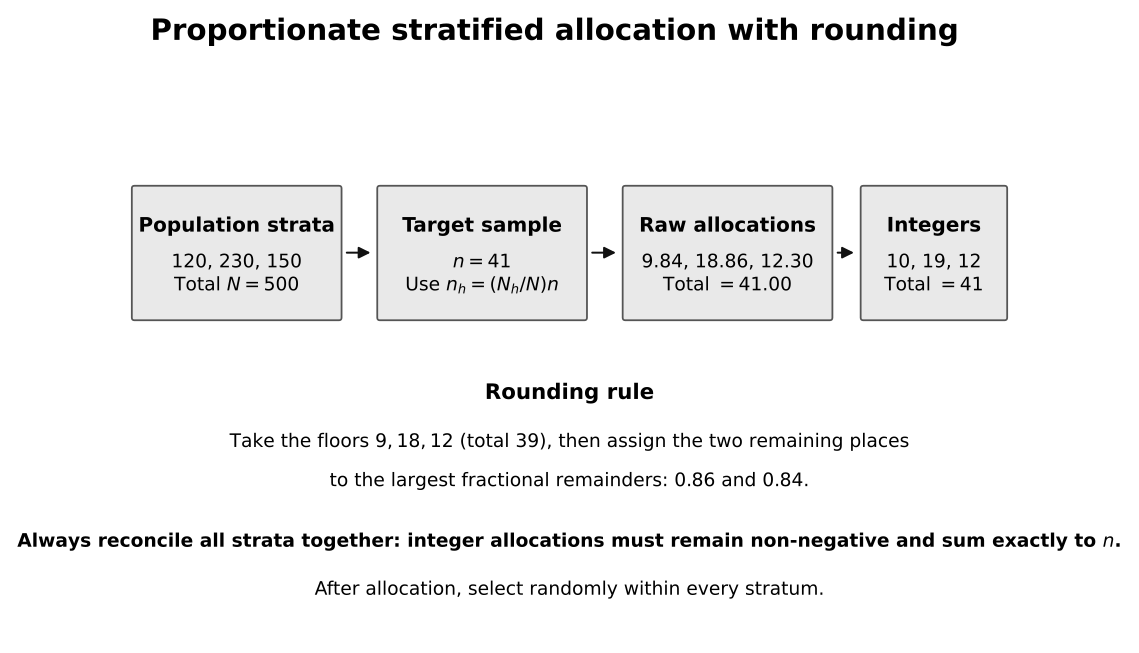
How to read this figure. Compute for every stratum before rounding. Reconcile the integer allocations as one set so the total remains exactly , then select randomly within each stratum.
When it works well
Stratified sampling works well when:
- important subgroups exist
- those subgroups may have different responses
- subgroup representation matters
- a complete sampling frame and subgroup information are available
For example, if passengers in first class, business class, and economy class may have different opinions about airline service, stratifying by class type is more appropriate than taking a simple random sample that might under-represent first-class passengers.
Strengths
- It gives good coverage of the population.
- It protects important subgroups from being missed by chance.
- It allows further analysis within specific strata if needed.
- It can produce a more representative sample than simple random sampling when subgroup differences matter.
Limitations
- It requires a complete and updated sampling frame.
- It requires prior knowledge of the population structure.
- It can be time-consuming to identify strata and calculate sample sizes.
- It may be difficult to choose appropriate strata.
So stratified sampling is not just about dividing people into groups. It is about using subgroup structure deliberately to improve representativeness.
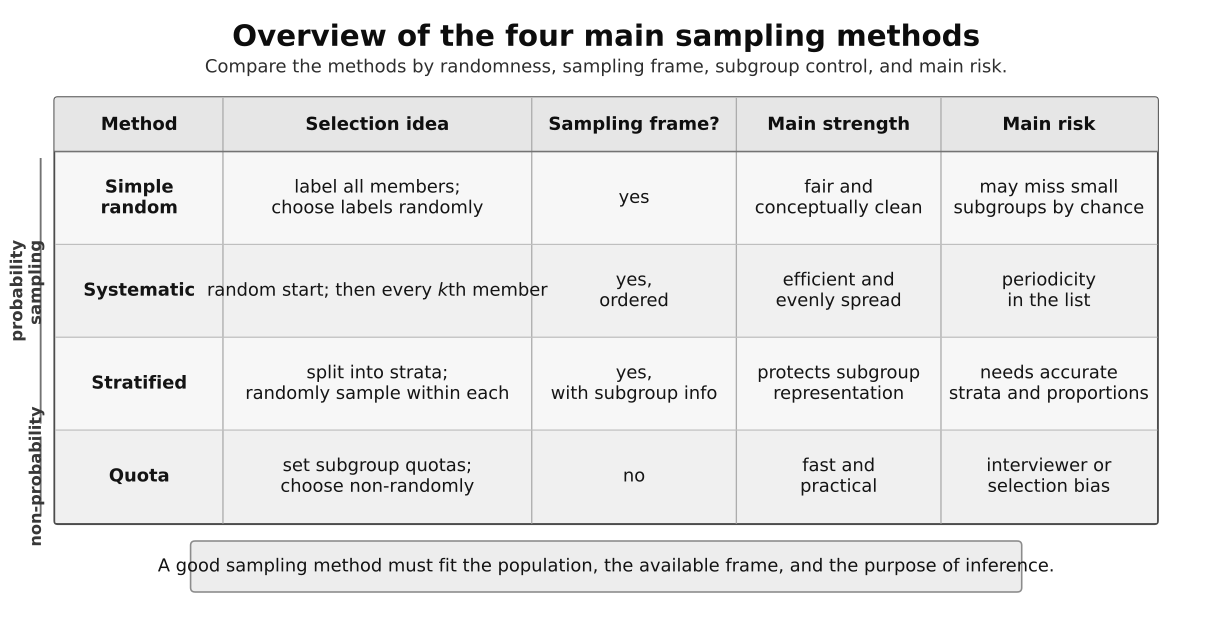 How to read this figure. Simple random, systematic, and stratified sampling are probability designs when carried out correctly; quota sampling is not. Compare frame needs, randomisation, subgroup protection, and context-specific risks rather than ranking methods universally.
Quota Sampling
In quota sampling, the population is divided into subgroups, and a fixed number of members is selected from each subgroup.
It may look similar to stratified sampling because both methods use subgroups. The important difference is that quota sampling does not require random selection within the subgroups.
The comparison is:
- stratified sampling: subgroup structure plus random selection
- quota sampling: subgroup structure without random selection
How to carry it out
To carry out quota sampling:
- Divide the population into non-overlapping subgroups.
- Decide the quota, or required number, for each subgroup.
- Select members from each subgroup until the quotas are filled.
The final step is usually not random. The interviewer may choose people who are nearby, willing to respond, or easy to approach.
Example: Quota Sampling
A surveyor at a shopping mall is asked to interview 20 shoppers, with quotas based on age group:
| Age group | Quota |
|---|---|
| Below 20 | 4 |
| 20–35 | 6 |
| 36–50 | 6 |
| Above 50 | 4 |
The surveyor may then approach shoppers until each quota is filled.
This is practical because there may be no complete list of all shoppers visiting the mall. However, the surveyor may unintentionally choose people who are more approachable, less busy, or more willing to answer. This creates possible selection bias.
When it works well
Quota sampling may be used when:
- a sampling frame is unavailable
- speed and low cost matter
- the aim is a quick survey rather than rigorous statistical inference
- subgroup quotas are still useful for practical coverage
Strengths
- It is fast.
- It is relatively low cost.
- It does not require a complete sampling frame.
- It can ensure that some broad subgroup quotas are filled.
Limitations
- It is non-random.
- It is vulnerable to interviewer bias.
- It is harder or impossible to assess sampling error.
- It has weaker inferential strength than probability sampling.
That difference is a common exam trap:
- “looks representative” is not the same as “supports probability-based inference”
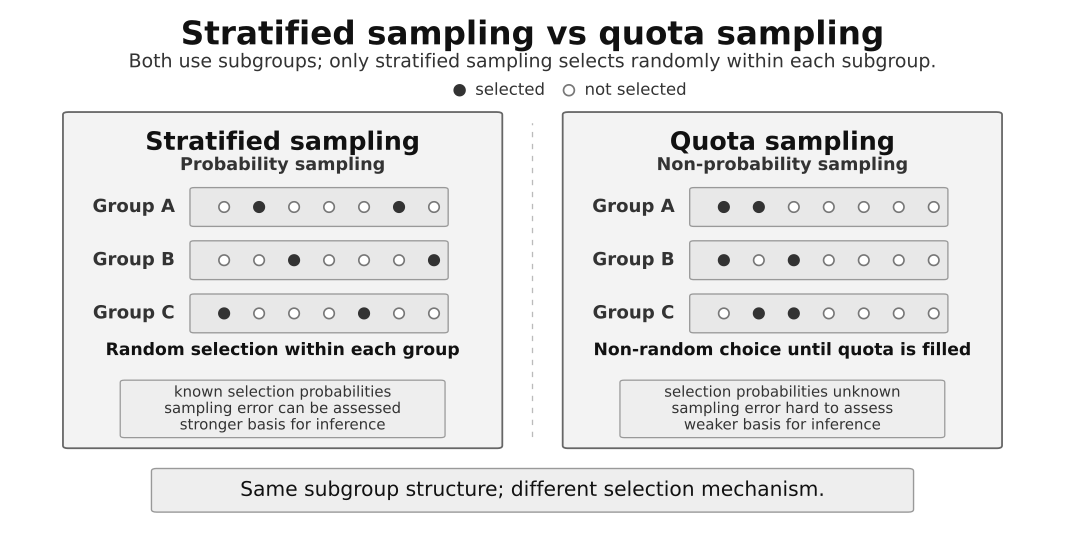 How to read this figure. Both methods set subgroup totals, but stratified sampling then selects randomly within every stratum. Quota sampling allows non-random selection within each quota, so filling the quotas does not by itself remove interviewer or selection bias.
Comparing the Four Main Methods
The four H2 sampling methods differ in randomness, need for a sampling frame, representativeness, and practicality.
| Method | Needs sampling frame? | Random? | Main strength | Main weakness |
|---|---|---|---|---|
| Simple random | Yes | Yes | Fair and conceptually clean | May not represent subgroups well by chance |
| Systematic | Yes | Yes: random start, then deterministic interval | Efficient and evenly spread | Can be biased by periodicity |
| Stratified | Yes | Yes, within strata | Ensures subgroup representation | Requires population information |
| Quota | No | No | Fast and practical | Selection bias; sampling error hard to assess |
A useful comparison is:
- simple random sampling protects fairness at the individual level
- systematic sampling protects spread across an ordered list
- stratified sampling protects subgroup representation
- quota sampling protects practical subgroup counts, but not random selection
How to Choose a Sampling Method
A sensible choice depends on the context, not on a fixed ranking of methods.
Ask:
-
Is a complete sampling frame available?
- If yes, probability sampling may be possible.
- If no, quota sampling may be practical, but inference is weaker.
-
Are important subgroups likely to differ?
- If yes, stratified sampling is often strong.
- If no, simple random or systematic sampling may be enough.
-
Is the population arranged in a usable ordered list?
- If yes, systematic sampling may be efficient.
- But check whether the ordering has a hidden pattern.
-
Is speed more important than statistical rigour?
- If yes, quota sampling may be acceptable in practical surveys.
- But its limitations must be stated clearly.
So the real question is not “which method is best in general?” but “which method fits the population, the available information, and the purpose of the study?”
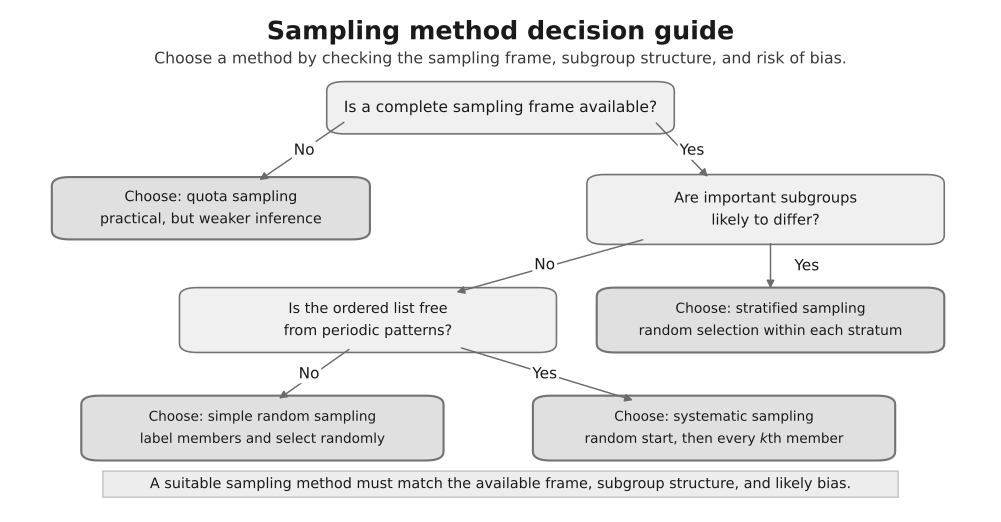 How to read this figure. The questions identify methods worth considering; they do not determine a unique best answer. No complete frame may make quota sampling practical, but inference is weaker and the context must still justify it.
Quick comparison mindset
When comparing methods, ask:
- Is randomness genuinely present?
- Is a full sampling frame needed?
- Are important subgroups being protected?
- Could the method hide a systematic bias?
- Is the method practical in the given context?
Core Examples
Core Example 1: Choosing a Suitable Method
A school wants to survey 200 students about canteen food. The school has students from Year 1 and Year 2, and the two groups may have different timetables and eating habits.
A suitable method is stratified sampling.
Reason:
- the population can be divided into meaningful strata: Year 1 and Year 2
- the school register provides a sampling frame
- students from each year can be selected randomly
- both year groups can be represented proportionately
A clear procedure would be:
- Obtain the school register of all students.
- Divide the students into Year 1 and Year 2 strata.
- Calculate the number to select from each year in proportion to the year-group sizes.
- Use simple random sampling within each year group.
Core Example 2: Describing Systematic Sampling
A college has 700 graduating students. A sample of 140 students is needed.
The sampling interval is
A clear description is:
- Arrange the list of all 700 graduating students in a fixed order.
- Randomly choose one student from the first 5 students.
- Select every 5th student after that until 140 students are chosen.
A possible limitation is that if the ordering has a pattern related to the survey question, the sample may be biased.
Core Example 3: Why Quota Sampling Is Not Stratified Sampling
A surveyor at a supermarket is asked to interview 30 shoppers, with fixed quotas for different age groups.
This is quota sampling, not stratified sampling, if the surveyor chooses people freely within each age group.
The method uses subgroups, but the selection within each subgroup is not random. The surveyor may choose shoppers who look friendly or are less busy. This makes the sample potentially biased.
To improve the method, one could use stratified sampling if a complete list of shoppers were available. In practice, such a list is usually unavailable, which is why quota sampling may be used despite its weaker statistical basis.
Common Exam Question Types
| Question type | What the examiner is looking for |
|---|---|
| “Identify the population” | State the full group of interest |
| “Identify the sample” | State the selected subgroup actually observed |
| “State the sampling frame” | Name the actual list or structure used for selection |
| “Describe how to obtain the sample” | Give clear procedural steps, not vague phrases |
| “Explain one advantage” | Link the method to the context |
| “Explain one disadvantage” | Identify bias, practicality, missing frame, or periodicity |
| “Suggest an improvement” | Make the method more random, representative, or practical |
A strong answer should be contextual. For example, do not simply write “simple random sampling is unbiased”. Instead, explain why random selection from the given sampling frame reduces selection bias in that situation.
How Sampling Methods Connect to Estimation
This branch supports Sampling and Estimation. Estimation uses sample information to infer population information, but the inference is only as trustworthy as the sample design allows.
The conceptual chain is:
- Define the population.
- Choose a suitable sampling method.
- Obtain a sample.
- Compute sample statistics.
- Use those statistics to estimate population parameters.
If the sampling method is biased, later calculations may look precise but still lead to unreliable conclusions.
Common Pitfalls
- Confusing a sample with a random sample.
- Assuming a sample is unbiased just because it is large.
- Forgetting that a sampling frame is required for many probability sampling methods.
- Saying “choose randomly” without explaining how the random selection is carried out.
- Treating quota sampling as the same as stratified sampling.
- Forgetting that quota sampling is non-random even when quotas are carefully chosen.
- Forgetting that systematic sampling can be distorted by periodicity in the ordered list.
- Giving generic advantages and disadvantages without linking them to the context.
- Assuming one method is always best, instead of judging suitability from the situation.
Revision Checklist
- Can you explain the difference between population, sample, and sampling frame?
- Can you distinguish a sample from a random sample?
- Can you distinguish probability sampling from non-probability sampling?
- Can you describe how simple random sampling is carried out?
- Can you describe how systematic sampling is carried out, including the interval ?
- Can you explain why systematic sampling may fail when there is periodicity?
- Can you describe how stratified sampling is carried out, including proportionate allocation?
- Can you explain why stratified sampling and quota sampling are not the same?
- Can you compare the strengths and limitations of the four main methods in context?
- Can you choose a suitable sampling method for a given real-life situation and justify your choice?