Special Arrangements and Restrictions
Scope Label
Core 9758. This note covers the exam-heavy counting cases where a direct use of , , or is not enough.
Use it after Counting Principles, Permutations, and Combinations.
Why Special Arrangements Need Extra Care
Many harder counting questions fail for one of two reasons:
- the same outcome is counted more than once
- a restriction is handled too late
The safest approach is:
- identify the basic objects
- identify whether any objects are identical
- identify the restriction
- choose a structure that naturally includes the restriction
- count only after the structure is clear
Arrangements with Identical Objects
If all objects are distinct, objects can be arranged in ways.
If some objects are identical, swapping identical objects does not create a new visible arrangement. Therefore, we divide by the number of invisible swaps.
If there are objects with identical groups of sizes , the number of distinct arrangements is
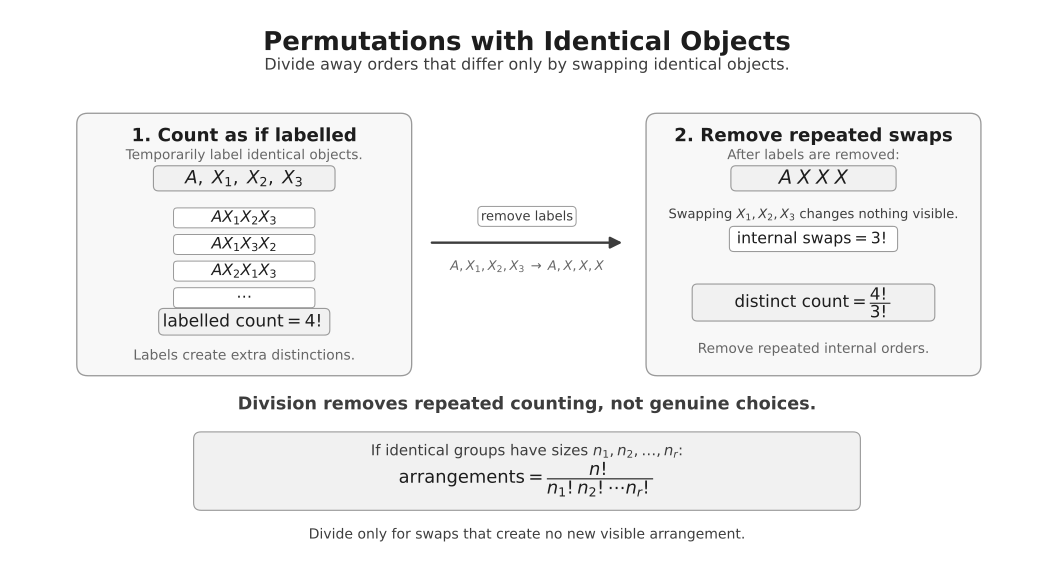
How to read this figure. Temporary labels expose the overcount. Removing labels turns every internal reorderings of an identical group into the same visible arrangement, so only those invisible swaps are divided out.
Example: MAMMA
The word MAMMA has 5 letters:
- 3 M’s
- 2 A’s
The number of distinct arrangements is
The denominator is not arbitrary. It removes the invisible swaps of the M’s and the invisible swaps of the A’s.
When a restriction changes the remaining multiplicities
For arrangements of SEASIDE that begin with a vowel, do not multiply “number of vowel types” by one common multinomial count. The word has two E’s but only one A and one I, so the remaining multiplicities depend on the first letter.
- first letter E:
- first letter A:
- first letter I:
The cases are disjoint and exhaustive, so the required number is .
The general lesson is more important than this word:
If an early restricted choice changes the number of indistinguishable copies remaining, fix that choice by cases before applying the identical-object formula.
Fixed Positions and Endpoints
Fill compulsory positions or endpoints first. Then count the remaining positions using the objects and multiplicities that are actually left. If different admissible choices for a fixed position leave different multiplicities, split those choices into disjoint cases before counting, as in the SEASIDE example.
Restrictions: Main Strategies
Restriction problems should be solved by choosing a counting structure. Do not first count everything and then try random corrections unless the complement method is clearly appropriate.
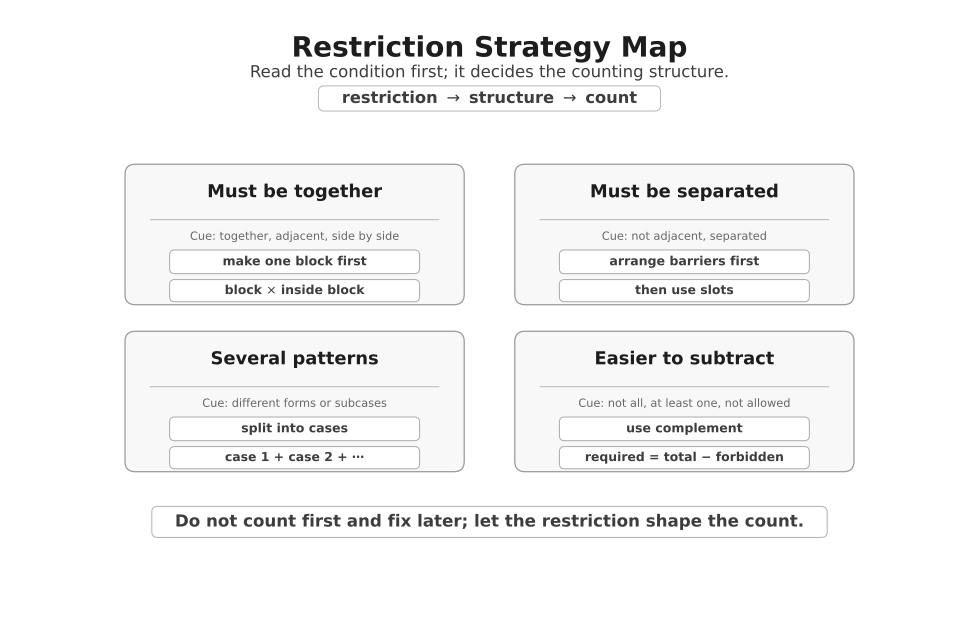
How to read this figure. These are strategy prompts rather than one-to-one rules. Choose the route that builds the condition naturally, state why its cases do not overlap, and use another route as a check when practical.
Grouping: Objects Must Be Together
If several objects must be together, treat them as a single block first.
Example
Arrange 4 boys and 3 girls in a row if the 3 girls must be together.
Treat the girls as one block:
There are 5 units to arrange:
Inside the girls’ block, the girls can be arranged in
ways.
Therefore, the total number is
The block handles the “together” condition. The internal factorial handles the order within the block.
Slotting: Objects Must Be Separated
If objects must not be adjacent, arrange the other objects first, then place the restricted objects in available gaps.
Example
Arrange 5 boys and 3 girls in a row if no two girls are adjacent.
First arrange the boys:
This creates 6 slots:
Choose 3 of the 6 slots for the girls and arrange the girls:
So the total number is
This method works because each selected slot can contain at most one girl.
In general, arranging distinct barrier objects in a row creates gaps. Placing distinct restricted objects with no two adjacent contributes , and is possible only when . The six row slots above include both end slots.
Alternating Two Types
If every object of two types must alternate in a row, the group sizes must differ by at most one.
- If the sizes are equal, either type may start, giving two type-patterns.
- If the sizes differ by one, the larger type must occupy both ends, giving one type-pattern.
- If the sizes differ by more than one, complete alternation is impossible.
After choosing the type-pattern, arrange the distinct objects within their allocated positions. For example, 4 distinct boys and 3 distinct girls in strict alternation must follow
so the number of arrangements is .
Cases
Use cases when the problem naturally splits into non-overlapping possibilities.
The cases must be:
- mutually exclusive: no outcome appears in two cases
- exhaustive: all valid outcomes are covered
Example
Choose 3 students from 5 boys and 4 girls with at least 2 boys.
Split into cases:
- exactly 2 boys and 1 girl
- exactly 3 boys
So the count is
Complement Method
Use complement when counting the unwanted outcomes is easier than counting the wanted outcomes directly.
The structure is:
Example
From 8 students, choose a committee of 4 with at least one girl. Suppose there are 5 boys and 3 girls.
Total committees:
Unwanted committees with no girls:
Therefore, the number of valid committees is
Circular Permutations
In a row, positions are distinguishable. In an unnumbered circle, rotations are usually equivalent.
For distinct objects around an unnumbered circle, with rotations regarded as equivalent, the number of arrangements is
Reason: fix one object to remove rotational freedom, then arrange the remaining objects.
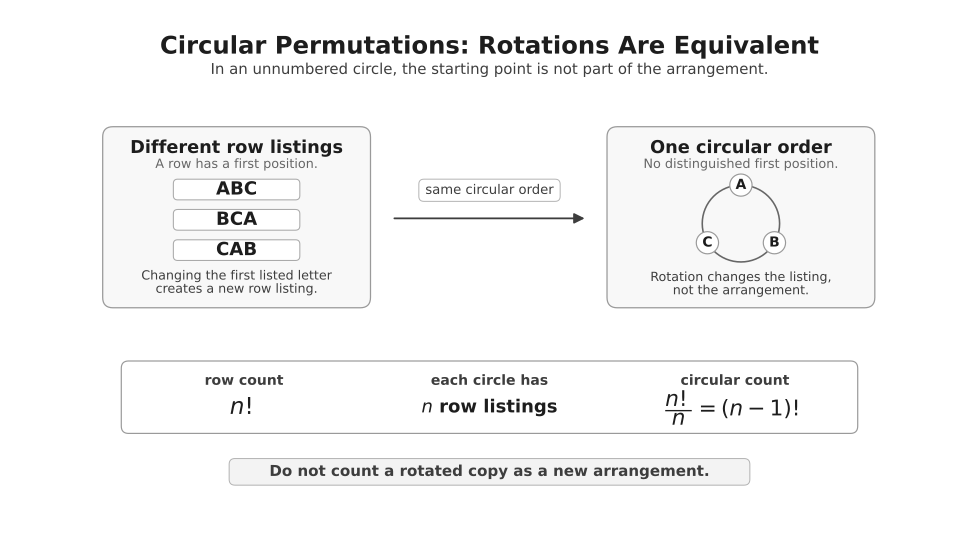
How to read this figure. For distinct objects in unnumbered seats, the row listings obtained by rotating the same neighbour-order represent one circular arrangement. Reflections remain distinct unless the question says otherwise.
Numbered versus unnumbered circular seats
If the seats are numbered, the positions are distinguishable. Then arranging people in numbered seats gives
ways.
If the seats are unnumbered around a round table, rotations are equivalent. Then the count is
Reflections
In most H2 seating questions, clockwise and anticlockwise orders are different unless the question explicitly says arrangements that are mirror images are the same.
Do not divide by unless the problem says reflections are equivalent.
Circular Restrictions
Circular restriction problems often combine the circular idea with grouping or slotting.
Objects together in a circle
If 3 friends must sit together among 7 people around an unnumbered round table:
- treat the 3 friends as one block
- arrange the block plus the other 4 people around a circle
- arrange the 3 friends inside the block
There are 5 circular units, so
Objects separated in a circle
If no two of a certain group may sit together, first arrange the unrestricted group around the circle, then place the restricted group into gaps.
Suppose 5 distinct adults and 3 distinct children sit around an unnumbered round table with no two children adjacent.
First arrange the adults around the circle:
This fixed adult arrangement creates 5 circular gaps, one after each adult. Relative to the fixed adult neighbour-order, these gaps are distinguishable. Choose and order 3 of them for the children:
Hence the total is
There are 5 circular gaps, not the 6 gaps that five objects would create in a row. This is why row slotting must not be transferred blindly to a circle.
In general, circularly arranged barrier objects create gaps, so placing restricted objects with at most one per gap requires .
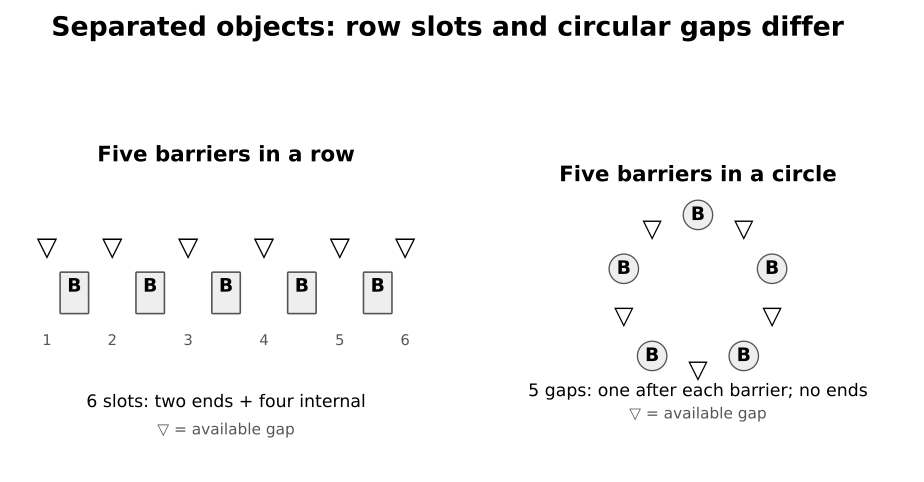
How to read this figure. A row has two end gaps; a circle has no ends. Once the unrestricted circular arrangement is fixed, its gaps can receive separated restricted objects, at most one per gap.
Mixed Counting Problems
Many exam questions mix several ideas. A useful workflow is:
- translate the wording into a precise outcome
- decide whether order matters
- decide whether objects are distinct or identical
- decide whether the arrangement is linear or circular
- identify restrictions
- decide whether grouping, slotting, cases, or complement is most natural
- write the count in stages before evaluating
Worked Core Examples
Example 1: Identical objects with restrictions
How many arrangements of BANANA begin and end with A?
BANANA has 6 letters: A, A, A, N, N, B.
Fix A at both ends:
The middle four positions contain A, N, N, B.
So the number of arrangements is
Example 2: Not all together
Arrange 5 distinct people in a row if 3 specified people are not all together.
Use complement:
Total:
All together: treat the 3 specified people as a block. Then there are 3 units to arrange, and the block has internal arrangements:
So the answer is
This is not the same as “all separated”.
Example 3: Committee with restrictions
From 6 boys and 5 girls, choose a committee of 4 with at least 2 girls.
Use cases:
The cases correspond to exactly 2 girls, exactly 3 girls, and exactly 4 girls.
Common Pitfalls
- Treating “not all together” as “all separated”.
- Forgetting to arrange objects inside a grouped block.
- Creating slots before arranging the unrestricted objects.
- Forgetting to check whether there are enough slots.
- Dividing by for circular reflections when the question does not make reflections equivalent.
- Using row formulas directly in circular arrangements.
- Splitting into cases that overlap.
- Using complement but subtracting the wrong unwanted set.