Polynomial and Rational Inequalities
Scope Label
Core 9758: rational inequalities in which the numerator and denominator are linear or quadratic expressions, together with the sign, restriction, graph, and interval logic needed to solve them. Quadratic inequalities provide essential preparation. Standalone inequalities involving higher-degree polynomials are retained below as Enrichment / transfer practice, not as a stated core requirement.
Role in the Topic
This branch expands the inequality methods in Equations and Inequalities.
The main idea is that an inequality asks where an expression is positive, negative, above another expression, or below another expression. The answer is usually an interval or a union of intervals.
For polynomial and rational inequalities, the most reliable method is sign analysis.
Formulating Inequalities
Some questions do not give the inequality directly. They describe a condition in words, and you must translate it first.
Common language includes:
- “at least” means
- “more than” means
- “not more than” means
- “between” means a double inequality, but the context must state whether the endpoints are included
For example, if a quantity
must lie between and , then the mathematical statement is
The solving method only begins after this translation is correct.
Why Roots Split the Number Line
For a polynomial expression, the sign can only change when the expression passes through zero.
For a rational expression, the sign can change when:
- the numerator is zero
- the denominator is zero
These values split the number line into intervals. On each interval, the sign of each factor stays fixed.
This is why sign charts work: they replace infinitely many possible -values with a finite set of intervals to test.
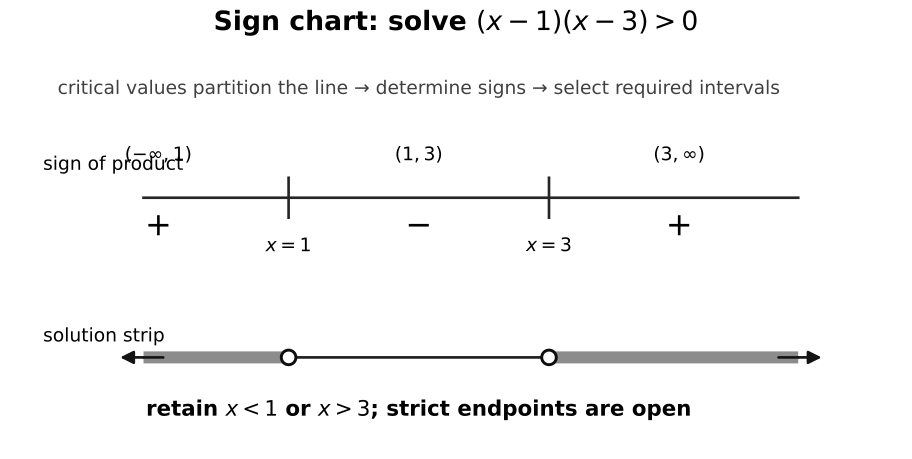 Figure reading. First place every zero and undefined value on the number line. These critical values partition the domain into connected intervals on which every continuous factor keeps the same sign. One test input therefore determines the sign throughout each interval. The final inequality symbol tells you which intervals to retain; endpoint inclusion is decided separately.
This argument depends on continuity within each interval. A polynomial factor cannot change sign without becoming zero. A rational expression can also change sign at a denominator zero, because the expression is not continuous—or even defined—there.
Quadratic Inequalities
To solve
first solve the related equation:
Using the quadratic formula,
Since the coefficient of is positive, the parabola opens upward. Therefore the quadratic is negative between its two roots:
So
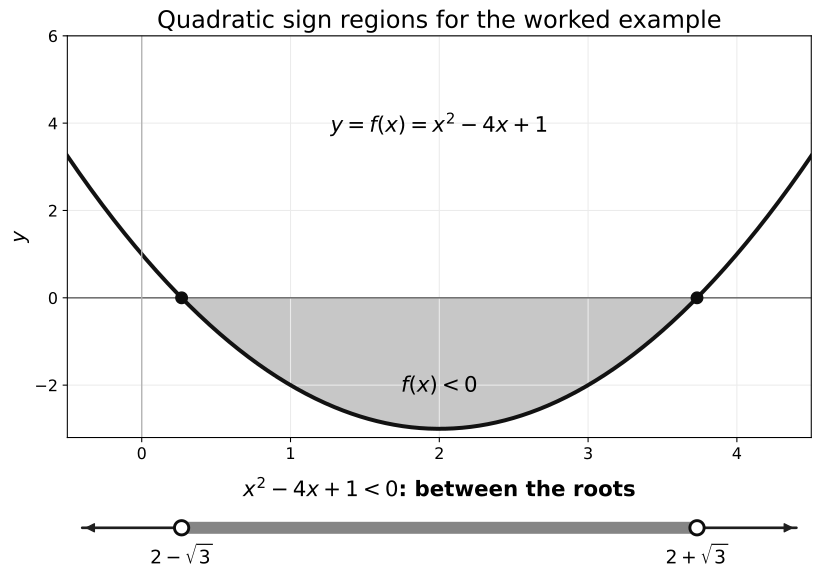 Figure reading. The roots are boundary values where the quadratic equals zero. Because the parabola opens upward, it lies below the -axis between the roots and above it outside them. Strict inequalities exclude the roots; inequalities allowing equality include them.
Enrichment: Higher-Degree Polynomial Inequalities
Scope
This section develops the same sign-chart reasoning beyond the stated linear/quadratic core. It is useful transfer practice, but should not displace revision of prescribed rational and modulus inequalities.
For higher-degree polynomial inequalities:
- bring everything to one side
- factorise if possible
- identify critical values
- use a sign chart or self-sketch
- keep intervals with the required sign
- include endpoints only if equality is allowed
For example, solve
The critical values are
They split the number line into
Testing signs gives:
Since the inequality asks for , keep the negative intervals and include the zeros:
The equality sign matters: zeros of the polynomial are included because the expression is allowed to equal zero.
Factor Multiplicity and Sign Changes
The sign does not necessarily alternate at every repeated root. Near a factor :
- if is odd, the factor changes sign as passes through ;
- if is even, the factor is non-negative on both sides and the sign does not change.
For example,
At the odd-multiplicity factor changes sign. At the squared factor becomes zero but does not change sign. A graph crosses the -axis at the first root and touches it at the second.
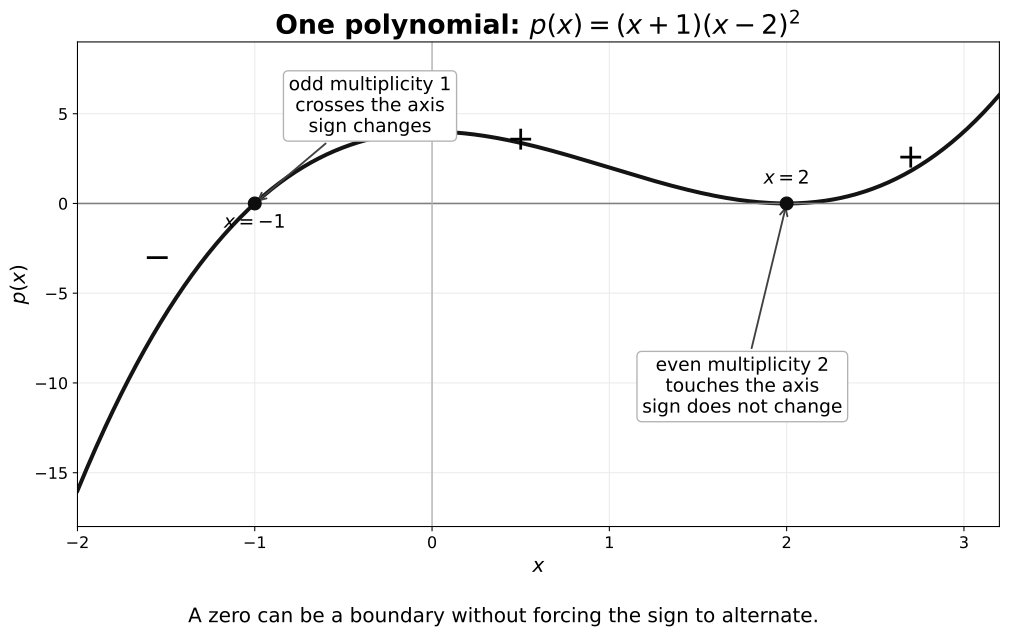 Figure reading. Both marked values are roots, but their local behaviour differs. At an odd-multiplicity root the curve crosses the axis and the sign changes. At an even-multiplicity root it touches the axis and turns back, so the signs on the two sides agree. Endpoint inclusion still depends on whether equality is allowed.
Rational Inequalities
For a rational expression
the denominator must not be zero:
This restriction must be stated before solving and remembered in the final answer.
Core example
Solve
First,
so
The critical values are:
- numerator zero:
- denominator zero:
These split the number line into
The sign pattern is
Since the inequality is , keep the positive intervals and include the numerator zero:
The point is not included because the expression is undefined there.
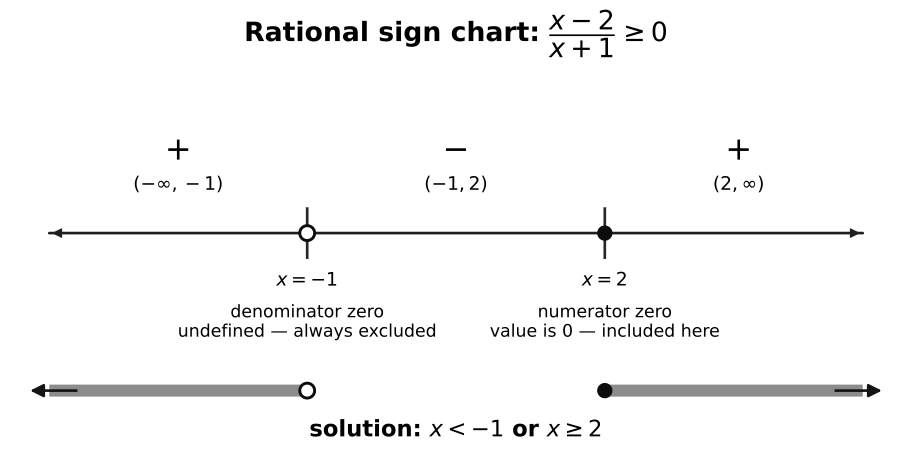 Figure reading. Both numerator and denominator zeros split the sign chart, but their endpoint roles differ. A numerator zero makes the fraction equal to zero and may be included when equality is allowed. A denominator zero makes the original expression undefined and is always excluded, even if algebraic cancellation later hides it.
Cancellation does not restore a missing domain point
Consider
For it simplifies to , but the original expression is still undefined at . The simplified graph is the line with a hole at . Any inequality involving the original fraction must therefore keep excluded.
Why Cross-Multiplication Is Dangerous
The move
is invalid because may be positive or negative.
If , multiplying preserves the inequality sign.
If , multiplying reverses the inequality sign.
Since the sign of changes at , careless cross-multiplication loses information.
The safer workflow is:
- move all terms to one side
- combine into a single fraction
- state denominator restrictions
- identify numerator and denominator zeros
- use a sign chart
When Multiplying by a Square Is Safe
Sometimes the denominator can be removed by multiplying by a square such as
It is zero when
So the restriction
must still be written.
The square removes the sign problem; it does not remove the domain restriction.
More precisely, after first recording , the square is strictly positive on the admissible domain. Multiplication then preserves the inequality direction and is reversible there. Saying only that the square is non-negative is not enough, because multiplication by zero would not preserve equivalence.
Rational Comparisons and Graphical Checking
Some inequalities are most naturally treated as comparisons between two expressions.
Solve
The restriction is
Move everything to one side:
Combine into one fraction:
Since
we solve
The critical values are
Here, is excluded because it makes the denominator zero. The values and may be included because they make the numerator zero and the inequality allows equality.
Testing intervals gives
Graphically, the same solution is where the graph of
lies on or above the graph of
This graphical view is useful for checking the interval structure, especially near the vertical asymptote . The algebraic sign chart is still needed for exact endpoints and the excluded value.
Double Inequalities
For
split the statement into two inequalities:
and
Solve both carefully, keeping the restriction
For the left inequality,
so
For the right inequality,
so
The original double inequality requires both conditions, so intersect the two sets:
The forbidden value has remained excluded throughout.
A clear final line should show this intersection explicitly. If the two component solution sets are and , then the answer is
not their union.
Substitution Inside Inequalities
Some problems reuse an earlier inequality result after replacing with another expression such as .
For example, if an earlier step gives
and later
then
Since is positive and increasing,
This kind of problem tests whether you understand the range and monotonic behaviour of the substitution, not only the original sign chart.
Two checks are required after a substitution :
- admissibility: retain only -values in the range of (for , require );
- back-substitution: solve in the retained intervals, taking account of whether is increasing or decreasing.
Exact Algebra Versus Calculator Support
Graphical methods are useful when:
- a polynomial is not easily factorised
- a rational comparison is easier to interpret as one graph above another
- you need to check the shape or approximate roots
However, calculator roots may be decimal approximations. If the question expects exact values, use algebraic methods such as factorisation, the quadratic formula, or exact sign charts wherever possible.
Common Pitfalls
- Forgetting to state denominator restrictions.
- Including a denominator zero in the final answer.
- Cross-multiplying without knowing the sign of the denominator.
- Multiplying by a square but forgetting the excluded zero of the square.
- Treating a graphing-calculator decimal as exact.
- Using “and” when the final answer should be a union of intervals.
- Using “or” when two inequalities in a double inequality must both hold.
- Assuming the sign alternates at a repeated root without checking its multiplicity.
- Cancelling a common factor and then accidentally including a value excluded from the original domain.
Revision Checklist
- Can I explain why roots and undefined points split the number line?
- Can I solve core quadratic/rational sign problems and apply the same reasoning to labelled higher-degree enrichment?
- Can I distinguish numerator zeros from denominator zeros?
- Can I justify endpoint inclusion or exclusion?
- Can I solve rational inequalities without unsafe cross-multiplication?
- Can I handle double inequalities by intersection?
- Can I predict whether the sign changes at a root from its multiplicity?
- Can I retain original domain restrictions after cancellation?
- Can I use graphical calculator results appropriately without losing exactness?