Modulus Inequalities and Set Logic
Scope Label
Core 9758. This note covers modulus inequalities through distance interpretation, case splitting, safe algebraic manipulation, graph support, and set logic.
Role in the Topic
This branch expands the modulus and set-logic material in Equations and Inequalities.
Modulus inequalities are conceptually important because they can be read in two ways:
- as distance statements on a number line
- as piecewise algebraic statements that require case splitting
Good solutions usually combine both views.
Meaning of Modulus
For a real number ,
So a modulus expression is not a single algebraic expression everywhere. It changes form depending on the sign of the expression inside.
For example,
changes form when
so at
Hence
The point is the boundary between the two cases.
The two cases must cover the entire domain without overlap except, at most, at a deliberately assigned boundary. That is why one case uses and the other uses .
Distance Interpretation
The expression
means the distance between and on the number line.
So
means is less than units away from .
Thus
so
This distance interpretation is often the fastest method for simple modulus inequalities.
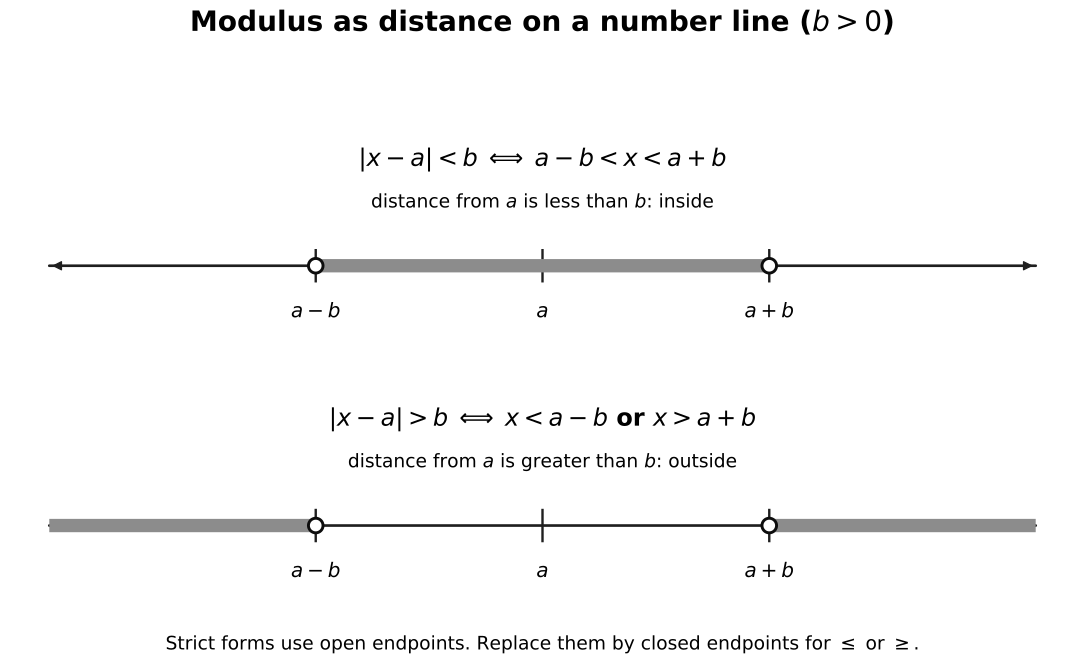 Figure reading. The centre is and the two boundary points and are exactly distance from it. Therefore selects the points strictly inside the boundaries, while selects the two outside rays. Replace open endpoints by closed endpoints for or ; these templates require for the strict forms.
Standard Forms
For ,
For ,
For ,
For ,
The memory aid is:
- modulus less than a positive number means inside an interval
- modulus greater than a positive number means outside an interval
What if the right-hand side is zero or negative?
Because for every real , check the right-hand side before applying a memorised template:
- has no solution;
- is equivalent to ;
- is equivalent to ;
- is true for every value in the domain;
- if , then and have no solution, while and are true throughout the domain.
These edge cases explain why the usual strict “inside” and “outside” templates state .
Case Splitting
Use case splitting when the modulus expression is compared with another expression that also depends on .
Solve
The modulus changes form at
Case 1:
Here,
So
Solving gives
But this answer must be combined with the case condition:
Therefore Case 1 gives
Case 2:
Here,
So
Solving gives
Together with the case condition , Case 2 gives
Combining the Cases
Since either case may apply, take the union:
So
The key discipline is:
- solve inside each case
- intersect with the case condition
- then union the case results
In set notation, if are the case domains and are the algebraic solutions obtained inside them, the final set is
This formula prevents a common error: accepting a result from a case in a region where that case formula was invalid.
Graphical Interpretation
The same problem can be read graphically as comparing
with
The solution to
is the set of -values where the line lies above the modulus graph.
Graphical reasoning is useful for seeing the interval structure, but exact algebra is still needed when exact endpoints are required.
The two intersection points are the boundary candidates. Since the inequality is strict, the intersections themselves are excluded. Between them, the line is above the V-shaped modulus graph, giving .
When Squaring Is Safe
Squaring can remove a modulus, but it must be used carefully.
For real and , the useful equivalence is
The condition is essential. Without it, squaring can turn an impossible original inequality into a true squared inequality.
For example, if
then before squaring we need
Otherwise the left side might be negative while the modulus is always non-negative, making the original inequality impossible.
Careless squaring can introduce invalid solutions. A safe approach is usually:
- check non-negativity conditions
- square only when equivalence is justified
- verify the final answers in the original inequality
For non-strict comparisons, formulate the corresponding equivalence separately and keep track of the zero case; do not replace by mechanically without checking the sign condition.
Worked safe-squaring example
Solve
The right-hand side must first be positive:
Within this region, both sides are non-negative and squaring is equivalent:
Using difference of squares,
so
Intersecting with the required condition leaves . A check in the original inequality confirms that works, while the boundary gives equality and is excluded.
Set Logic: “And” Versus “Or”
Inequality solutions depend heavily on set logic.
The word and means intersection:
The word or means union:
In modulus casework, each case usually uses and internally:
Different cases are then combined with or because any one valid case can satisfy the original inequality.
Common Pitfalls
- Forgetting the case condition after removing the modulus.
- Combining case results by intersection instead of union.
- Using distance formulas when the modulus expression is not in a simple distance form.
- Squaring both sides when one side may be negative.
- Trusting a graph for exact endpoints without algebraic confirmation.
- Writing endpoints incorrectly when the inequality is strict.
- Applying an inside/outside template when the right-hand side is zero or negative.
Revision Checklist
- Can I explain as distance from ?
- Can I convert and into interval or outside-interval statements?
- Can I split a modulus expression into cases using the sign of the inside expression?
- Can I intersect each case result with its case condition?
- Can I combine cases using union?
- Can I explain why careless squaring may create false solutions?
- Can I handle the and cases without using an invalid template?