Equations and Systems
Scope Label
Core 9758. This note covers equation meaning, formulation, graphical interpretation, and systems of linear equations. Matrix-inverse solution methods are not treated as the core route.
Role in the Topic
This branch expands the equation half of Equations and Inequalities.
The central idea is that an equation is a condition. Solving an equation means finding all values that make the condition true. Solving a system means finding values that satisfy several conditions at the same time.
This is why equations can be read in three linked ways:
- algebraically, as statements to manipulate
- graphically, as roots or intersections
- contextually, as constraints translated from a situation
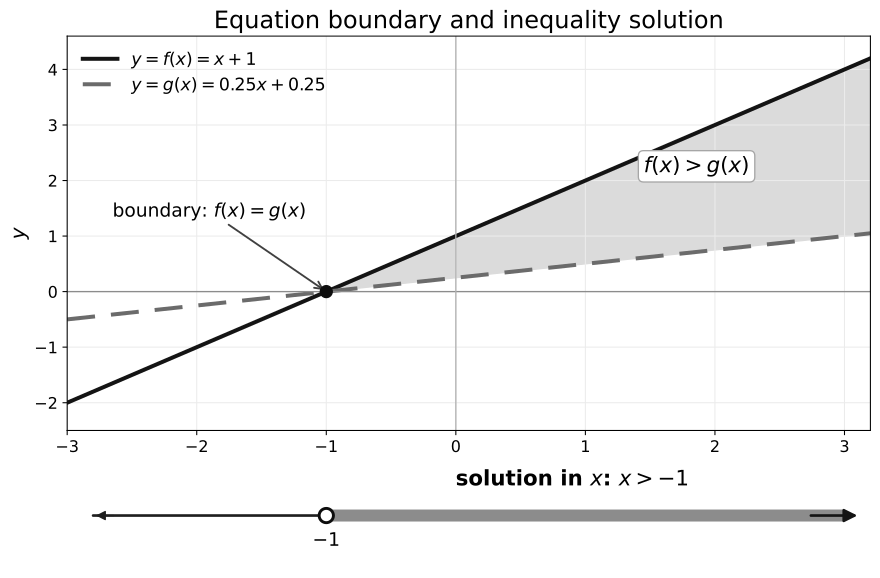 Figure reading. The two graphs are equal only at their intersection, so solving means reading the intersection’s horizontal coordinate. For , compare the vertical heights at the same : keep every horizontal coordinate where the graph of is higher. The shaded band makes that comparison visible, but the solution is the corresponding interval on the -axis, not the shaded area itself.
Expression, Equation, and Solution
An expression such as
has a value when is chosen.
An equation such as
is a statement that may be true or false.
An identity, such as
is true for every admissible . By contrast, an equation such as is true only for particular values. This distinction matters: solving an equation finds its truth set; proving an identity establishes equality throughout its domain.
Solving the equation means finding all values of for which the statement is true.
For example,
so
has solutions
Graphically, these are the -coordinates where
meets the -axis.
Equivalent Steps and Lost Information
A sound solution uses transformations that preserve exactly the same solution set. For example,
Each arrow is reversible. Some familiar operations are not automatically reversible:
- squaring can introduce extraneous roots because allows or ;
- multiplying by an expression that may be zero can introduce extraneous candidates;
- dividing by an expression can lose a valid solution if that expression may be zero;
- numerical graphing may reveal only roots inside the chosen viewing window.
When a step is not known to be equivalent, treat the resulting values as candidates and check them in the original equation.
Intersections as Equations
Many equations are more naturally read as intersections.
Solving
means finding the -coordinates where
meet.
This viewpoint matters when algebra is awkward. A graphing calculator can help estimate intersections, but if the question asks for exact answers, the graphical result should be treated as support rather than final proof.
Systems of Equations
A system of equations is a collection of equations that must all hold at once.
For example,
The solution must satisfy both equations.
Adding the two equations gives
so
Substituting into gives
Hence
Graphically, this is the intersection of the two lines.
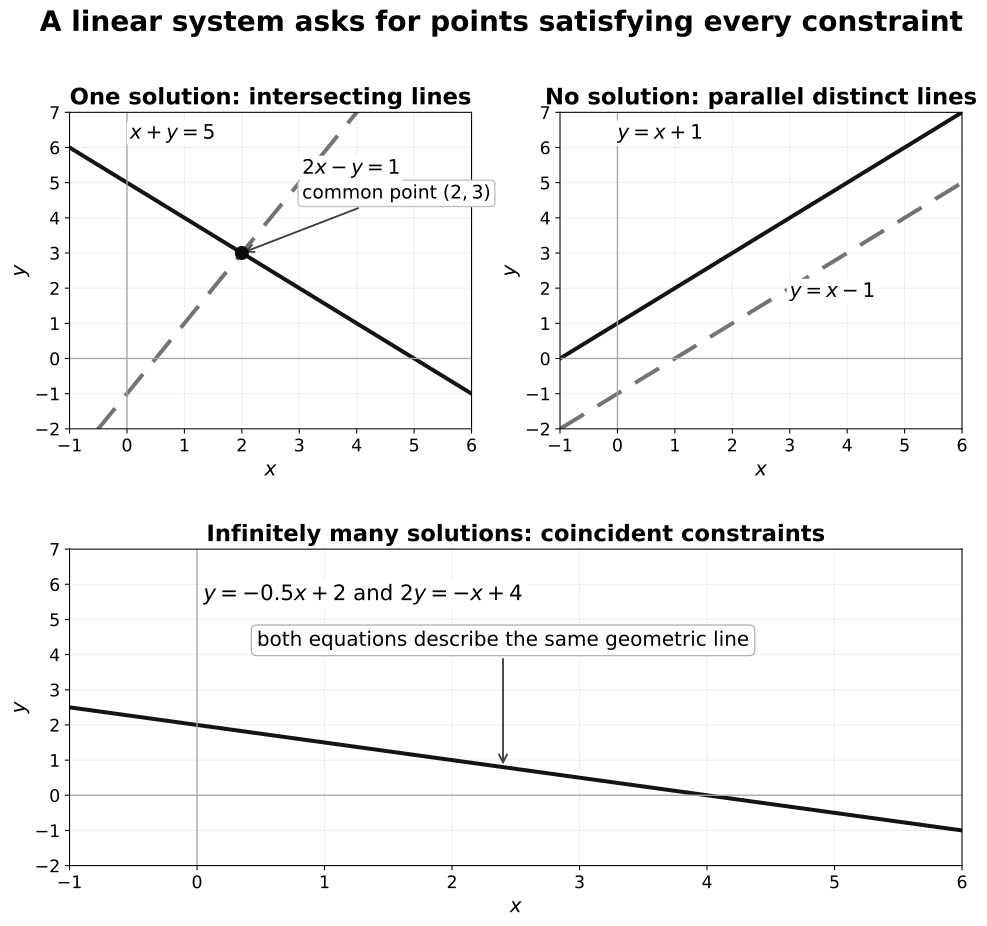 Figure reading. Each line is the complete set of ordered pairs satisfying one equation. Intersecting lines have one common point and hence one solution. Distinct parallel lines have no common point and hence no solution. Coincident lines describe the same constraint and have infinitely many common points. Substitution into every original equation checks which situation the algebra represents.
Three possible outcomes for two linear equations
For a pair of linear equations in and , elimination does not always end with a single ordered pair:
- a statement such as followed by a determined gives a unique solution;
- a contradiction such as means the constraints are inconsistent, so there is no solution;
- an identity such as means one equation is dependent on the other, so there are infinitely many solutions along the common line.
This is the algebraic form of the three geometries described in the figure.
Three or More Unknowns
The same idea extends to systems with more variables. For example,
This kind of system shows that the central task is not only solving but also managing several constraints at once.
In current H2 scope, the clean emphasis is:
- formulate the equations correctly
- use elimination, substitution, or graphing-calculator simultaneous-equation support when appropriate
- check the solution in every original equation
- avoid treating inverse-matrix methods as core examinable technique
For this system, the solution is
You should still check:
and
The check is not cosmetic. It confirms that the ordered triple satisfies all three constraints.
Device-independent solver workflow
For a calculator or software simultaneous-equation solver:
- write every equation in a consistent variable order, such as ;
- enter one coefficient row per equation, including zero coefficients for missing terms;
- interpret the output rather than assuming a unique solution exists;
- substitute the reported values into every original equation;
- report exact values when available, or round only to the accuracy requested.
An error in variable order changes the system being solved. A singular-system message may indicate dependent or inconsistent constraints, so return to the equations and classify the outcome.
Formulating Equations from Context
In word problems, the difficult step is often forming the equations.
A reliable workflow is:
- define each unknown, including its unit and physical meaning;
- identify independent constraints rather than rewriting the same information twice;
- translate each statement into an equation and keep units consistent;
- solve the system by an appropriate method;
- substitute into every original equation;
- reject values that violate contextual conditions such as positivity, integrality, or a stated range;
- answer in words with units.
For example, suppose a solid is made of three cylindrical sections with heights . If the problem gives total volume, total curved surface area, and a relationship between one height and the total height, then each condition becomes one equation in .
The algebra is only useful after the modelling step is correct. A wrong equation from the context will produce a wrong answer even if the simultaneous-equation solver is used perfectly.
H2 modelling example: determine polynomial coefficients
Forward application to differentiation
This example uses the later result that a stationary point satisfies . If differentiation has not yet been studied, read the equation-formulation idea now and revisit the calculation with Differentiation.
Let
Suppose , , , and the curve has a stationary point when . Since
the four conditions give
Solving gives
so
Check the four original conditions, not only the coefficient equations. In particular,
This example shows how point, value, and gradient information become simultaneous linear constraints on unknown coefficients.
Algebraic Versus Graphical Methods
Use algebra when:
- exact values are required
- factorisation or elimination is manageable
- the structure of the equation is clear
Use graphical support when:
- intersections are easier to see graphically
- the equation is hard to factorise
- a numerical answer or estimate is acceptable
- you want to check the plausibility of an algebraic answer
Graphical solutions also depend on the viewing window and numerical resolution. Apparent tangency, nearly parallel lines, or intersections outside the window can mislead. Use the graph to understand or check the structure, then report exact values when the question requires them.
Approximate equation example
To solve
numerically, graph and locate its intersection with the -axis. A suitable window shows one root between and , and numerical solving gives
Thus, to three decimal places,
The graph or a sign check such as supplies evidence that the chosen window contains the root. Since for every real , the function is strictly increasing, so there cannot be another real root hidden outside the window.
The graphing calculator is a tool for exploration and checking. It does not replace exact reasoning when the question expects exact roots or exact parameter values.
Core Example: Formulate and Solve a System
Two numbers have sum . The larger number is more than the smaller number. Find the two numbers.
Let the smaller number be and the larger number be .
Then
and
Substituting into the first equation gives
So
Then
The answer is not just the pair ; it is also the interpretation that the smaller number is and the larger number is .
Common Pitfalls
- Solving each equation in a system separately instead of finding a common solution.
- Forgetting to check a solution in every original equation.
- Reporting calculator decimals when exact values are required.
- Forming equations from context without defining variables clearly.
- Treating a graphical intersection as proof of an exact answer without algebraic justification.
- Assuming every linear system has exactly one solution.
- Accepting algebraic values that violate units, positivity, or other contextual restrictions.
Revision Checklist
- Can I explain the difference between an expression and an equation?
- Can I interpret roots as -intercepts?
- Can I interpret as graph intersections?
- Can I solve a system and check the result in every equation?
- Can I distinguish unique, inconsistent, and dependent systems algebraically and graphically?
- Can I formulate equations from a contextual description?
- Can I decide when a graphing calculator answer is only an approximation?