T-Tests and Unknown Variance Enrichment
Scope Label
Enrichment / outside current confirmed Core 9758 path. This branch is retained for broader statistical understanding. The core revision path for this wiki is the -test for a single population mean with known population variance.
Why Unknown Variance Changes the Problem
This enrichment branch should not change the main revision route. Learn the core -test first. Then use this branch to understand why a different distribution appears when the population variance is not known.
In the core -test, the population standard deviation is known, so the test statistic is
If is unknown, it is common to replace it with the sample standard deviation :
But this replacement introduces extra uncertainty because is itself computed from the sample.
Choosing Between and
The broad decision logic is:
- if is known, use a -test;
- if is unknown and is large, a large-sample normal approximation may be used;
- if is unknown, is small, and the population is normal or assumed normal, a -test may be used;
- if is unknown, is small, and normality cannot be assumed, the usual small-sample mean test is not justified in this framework.
| Variance information | Sample size / population condition | Test idea |
|---|---|---|
| known | population normal, any | core -test |
| known | large | core large-sample -test |
| unknown | large | enrichment large-sample approximation using |
| unknown | small sample, normal population assumed | enrichment -test |
| unknown | small sample, no normality assumption | not justified in this framework |
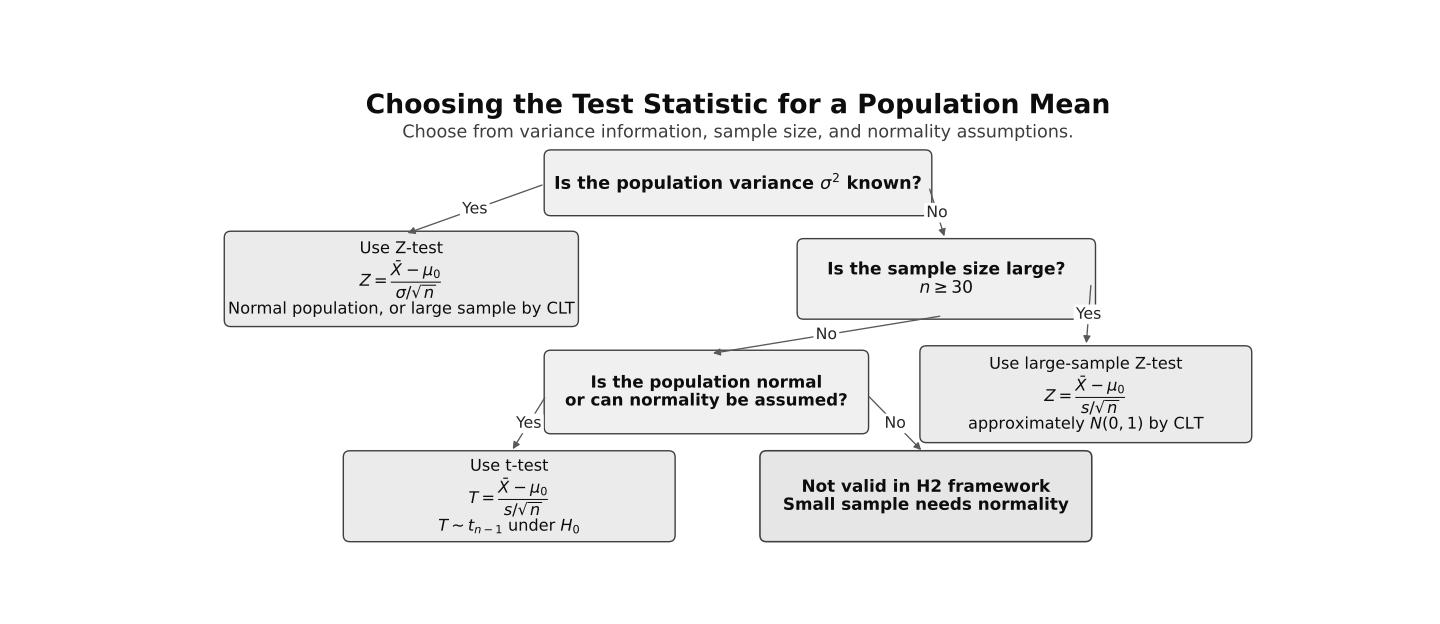 How to read this enrichment figure. Known leads to the core route. Replacing by sample introduces extra uncertainty; the small-sample normal-population route then uses a distribution.
The -Distribution
When is replaced by , the statistic has more uncertainty than a standard normal statistic.
For a random independent sample from a normal population, define as the sample standard deviation obtained from the unbiased sample variance
Then the statistic
follows a -distribution with degrees of freedom under .
The -distribution:
- is centred at ;
- is symmetric;
- has heavier tails than ;
- becomes closer to as the degrees of freedom increase.
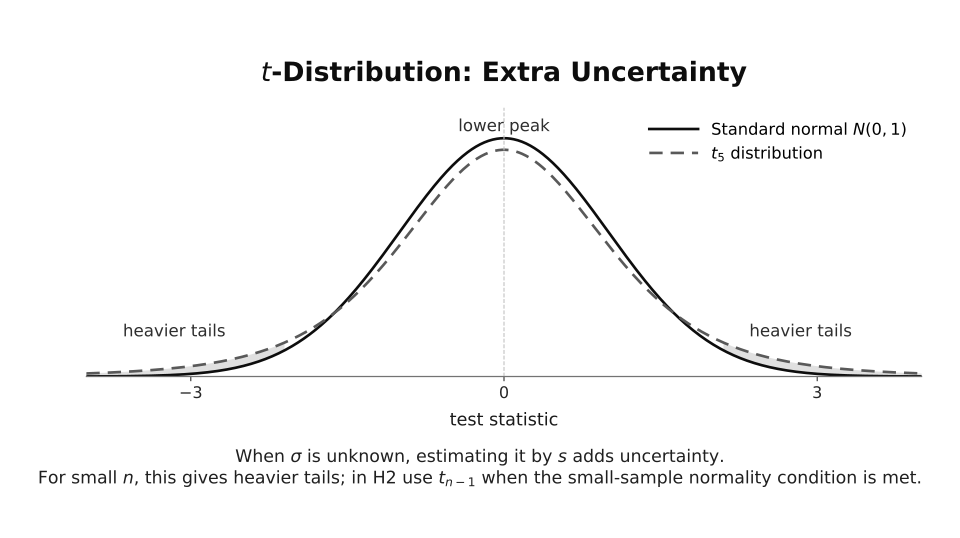 How to read this enrichment figure. Both curves are symmetric about zero, but the curve has lower centre and heavier tails. As degrees of freedom increase, it approaches the standard normal curve.
Enrichment Example: Small-Sample -Test
A sample of size is taken from a population assumed to be normal. The sample mean is and the sample standard deviation is .
Test at the level whether the population mean is greater than .
Let be the true population mean.
Since is unknown, is small, and normality is assumed, use
The observed statistic is
For an upper-tailed test with degrees of freedom, the critical value is approximately .
Since
do not reject .
Conclusion: there is insufficient evidence at the level that the population mean is greater than .
Enrichment: Large-Sample Unknown-Variance Test
When is large and is unknown, replacing by is often handled using a large-sample normal approximation:
This is not the same situation as the core known-variance -test. The approximation relies on large sample size.
Keep the distinction clear:
- known : standard core -test;
- unknown , small normal sample: -test enrichment;
- unknown , large sample: large-sample approximation enrichment.
Common Pitfalls
- Using a -test just because the sample size is small, without checking unknown variance and normality assumptions.
- Using the known- -test when is not given.
- Treating as if it were the true population standard deviation.
- Forgetting that the degrees of freedom are .
- Mixing this enrichment branch into the current core revision path.
Revision Checklist
- Can you explain why replacing by adds uncertainty?
- Can you state when a small-sample -test is appropriate?
- Can you identify the degrees of freedom?
- Can you explain why the -distribution has heavier tails?
- Can you keep this enrichment path separate from the core -test path?