Reverse Hypothesis Testing Questions
Scope Label
Core 9758 support. This branch handles reverse questions for the core -test path. The ideas are not a new test; they are the usual testing inequalities used backwards.
What Makes a Question “Reverse”
In a normal hypothesis-test question, you are given the sample result and asked for the decision.
In a reverse question, you may be given:
- the decision;
- a required significance level;
- a boundary condition;
- a phrase such as “find the range of values for which is not rejected”.
Then you work backwards.
The core idea is:
A decision about rejection is an inequality for the test statistic.
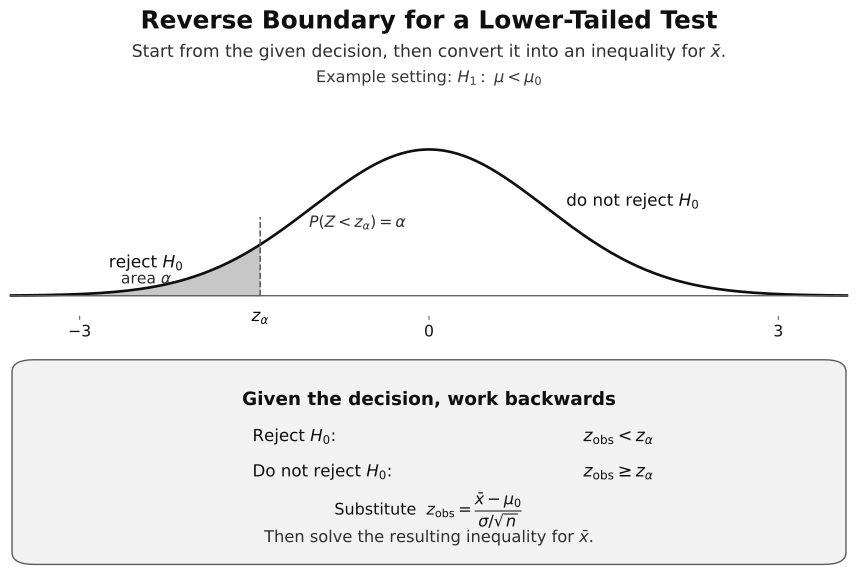 How to read this figure. Translate the stated decision into a test-statistic inequality before substituting for . The direction and number of boundaries come from .
Rejection and Non-Rejection Inequalities
For a lower-tailed test:
- reject if is in the left critical region;
- do not reject if is outside that region.
For an upper-tailed test:
- reject if is in the right critical region;
- do not reject if is outside that region.
For a two-tailed test:
- reject if is too far from in either direction;
- do not reject if lies between the two critical values.
Substituting the Test Statistic
For a -test of a population mean,
Once you know the inequality for , substitute this expression and solve for the unknown.
The unknown may be:
- ;
- a sample size;
- a claimed mean ;
- a boundary value in the question.
Worked Example 1: Range for Non-Rejection
A population has known standard deviation . A random sample of size is used to test
at the level.
Find the range of sample means for which is not rejected.
For a two-tailed test, the non-rejection region is approximately
Now
because .
So
Hence
For sample means in this interval, the test does not reject at the level.
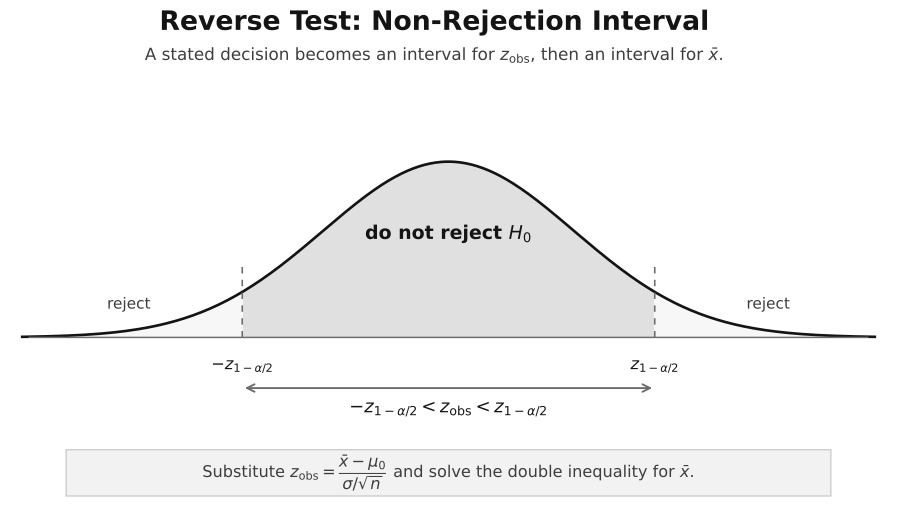 How to read this figure. Non-rejection lies between the two critical boundaries. Because the standard error is positive, substituting preserves the inequality directions.
Worked Example 2: Rejection Boundary
A lower-tailed test is carried out at the level:
The population standard deviation is and the sample size is . Find the boundary sample mean for rejection.
For a lower-tailed test,
Substitute
For the boundary,
Thus
With the convention, rejection occurs for approximately
The unrounded boundary is . If measurements are reported only to a specified resolution, apply that resolution after deriving the boundary.
Least Significance Level
If a question asks for the least significance level at which would be rejected, find the p-value.
Reason:
- rejection happens when p-value ;
- the smallest threshold that leads to rejection is therefore the observed p-value.
In practice, state the p-value with appropriate rounding and interpret it as the least significance level needed for rejection.
Worked Example 3: Unknown Means No Direct p-Value
A test is carried out at the level:
The population is assumed normally distributed with standard deviation , and a random sample of size is taken. It is given that is rejected. Find the rejection boundary for the sample mean.
Because is unknown, we cannot compute a p-value directly. Instead, use the rejection condition.
For a lower-tailed test,
Now
At the boundary,
So
Therefore, rejection occurs for approximately
The rejection boundary is about ; values on the rejection side of this boundary lead to rejection under the stated convention.
Common Pitfalls
- Starting with the sample mean instead of the decision condition.
- Using a rejection inequality when the question asks for non-rejection.
- Forgetting to reverse or preserve inequalities correctly when solving.
- Using one-tailed critical values in a two-tailed reverse question.
- Treating “least significance level” as a new formula instead of the p-value idea.
Revision Checklist
- Can you identify whether the question gives a decision and asks for a range?
- Can you write the critical or non-rejection inequality first?
- Can you substitute correctly?
- Can you explain why the least significance level is the p-value?