Paper 2 Section B Practice: Hypothesis Testing
Original practice material
These four scenarios total 41 marks. They are a topic-local practice pack, not a complete Paper 2 Section B.
Answers: Hypothesis Testing Answers.
Question 1: Lower-Tailed Test from Summary Information
A filling machine is set so that the mean amount of liquid in a bottle is ml. The population standard deviation is known to be ml. A supervisor suspects that the machine is underfilling bottles.
For a random sample of bottles, the total amount of liquid is ml.
(a) Calculate the sample mean. [1]
(b) State suitable hypotheses, defining any symbol you use. [2]
(c) Carry out the test at the significance level using a critical-value method. [5]
(d) State the conclusion in context. Explain why the conclusion does not imply that every bottle is underfilled. [2]
[Total: 10]
Question 2: Two-Tailed Test
A manufacturer claims that the mean lifetime of a battery is hours. The population standard deviation is known to be hours. A random sample of batteries has mean lifetime hours.
A quality-control engineer wishes to test whether the population mean lifetime has changed.
(a) Explain why a two-tailed test is appropriate. [1]
(b) State the hypotheses, defining any symbol you use. [2]
(c) Carry out the test at the significance level using critical values. [5]
(d) Find the p-value to 3 significant figures and verify that it is consistent with the decision in part (c). [2]
[Total: 10]
Question 3: Upper-Tailed Test with a Diagram
The established population mean score on a standardised diagnostic test is . After participating in a training programme, a random sample of students has mean score . The population standard deviation of scores is known to be .
A researcher tests whether the population mean score after the programme exceeds .
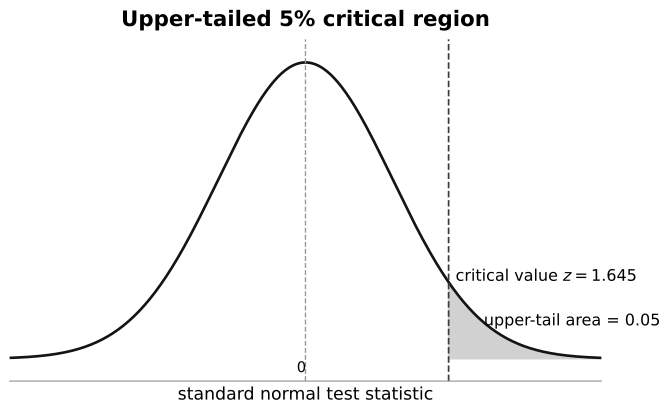
For a upper-tailed test, the critical region is shown below.
(a) State the null and alternative hypotheses, defining any symbol you use. [2]
(b) Calculate the observed test statistic. [2]
(c) Use the diagram and your answer to part (b) to make a decision and state the conclusion in context. [3]
(d) Explain the role of the known population standard deviation in this test. [2]
(e) State one condition about the sample or population model that is needed for the test to be valid. [1]
[Total: 10]
Question 4: Reverse Hypothesis-Test Boundary
The population mean waiting time at a service counter was previously seconds. A new queueing system is introduced. The population standard deviation is known to remain seconds. A lower-tailed -test is to be carried out using a random sample of waiting times.
The hypotheses are
(a) State the critical value for the standard normal test statistic at the significance level. [1]
(b) Find the largest sample mean, to 2 decimal places, for which would be rejected. [4]
(c) If the observed sample mean is seconds, state the decision of the test. [2]
(d) Explain why the boundary in part (b) changes if the sample size is increased while the significance level and population standard deviation remain unchanged. [4]
[Total: 11]