Graph Transformations
Scope Label
Core 9758 graphing support. Transformations of graphs are part of the functions-and-graphs strand. This note supports Graphing Techniques by giving a focused method for moving from a known graph to a transformed graph.
This note focuses mainly on transformations of graphs that can be written in the form
and related forms such as
Standard conics such as parabolas, ellipses, and hyperbolas are treated in the main graphing and conics notes, where their centres, axes, vertices, asymptotes, intersections, and restrictions are handled explicitly. The transformation ideas here are still useful when interpreting shifted or scaled standard forms, but this note does not replace the conics treatment.
The main aim is not to memorise isolated rules. The main aim is to know whether a change acts on:
- the output of the function, which moves or rescales -values
- the input of the function, which moves or rescales -values
This distinction explains most graph-transformation rules.
The Central Idea
Start with a known graph
A transformation changes how points on this graph are read.
If a point lies on , then
After a transformation, the corresponding point may become on the new graph.
The cleanest way to think is:
- output changes affect
- input changes affect
For example, if the new graph is
then every output is larger. The graph moves up.
If the new graph is
then the function is fed the input . To get the same old input , we need
so
The graph moves right by .
This is why horizontal transformations can feel reversed: the algebra is changing the input before the function acts.
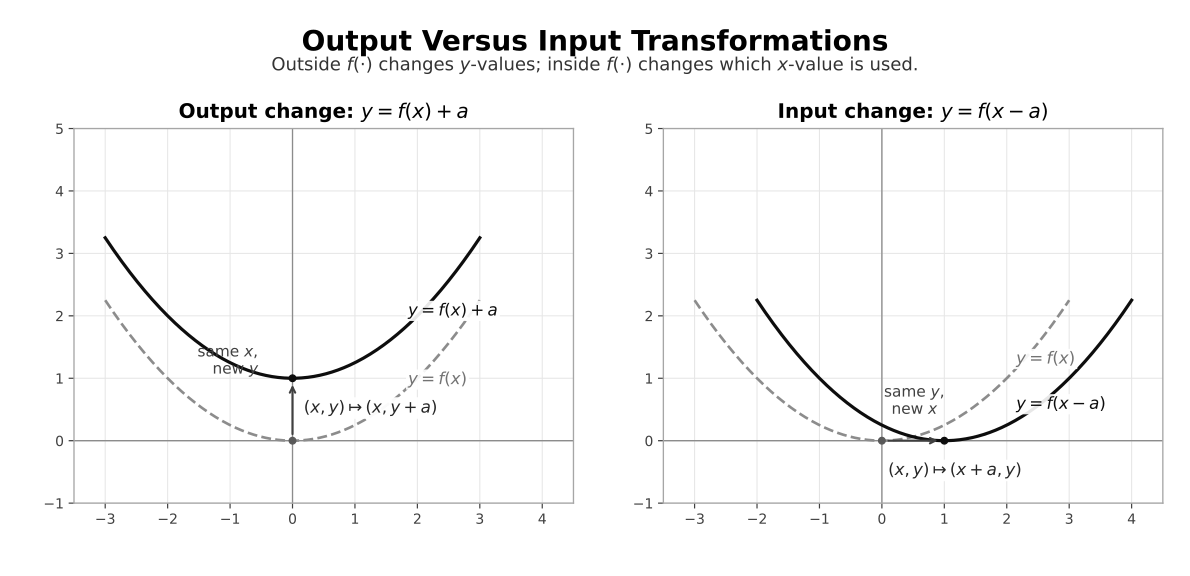 How to read this figure. An outside change acts on the output and therefore moves or rescales vertical coordinates directly. An inside change must first be solved for the old input, which explains the apparently reversed horizontal shift and the reciprocal horizontal scale factor.
Transformation as point mapping
A transformation can often be understood by asking:
If is an old point, where does it go on the new graph?
For example, suppose lies on .
For the transformed graph
we first match the old input:
Hence
Then transform the old output:
So the point mapping is
This is more reliable than trying to describe the graph using only words such as “shift” and “stretch”.
Output Transformations
Output transformations change the value of after the input has already been used.
They are usually easier to read because the visible change agrees with the sign or factor in the formula.
Vertical translation
The graph of
is obtained by translating the graph of vertically by units.
- if , move up by
- if , move down by
Point mapping:
The domain is unchanged. The range is shifted by .
For example, if has range , then has range
Vertical stretch
The graph of
is obtained by multiplying every -value by .
Point mapping:
If , the graph is stretched vertically. If , the graph is compressed vertically.
If , there is also a reflection in the -axis.
If , the expression collapses to the constant graph , so it is no longer a stretch of the graph in the usual sense.
For example,
means:
- multiply all -values by
- reflect in the -axis
Equivalently, each point becomes
Reflection in the x-axis
The graph of
is the reflection of in the -axis.
Point mapping:
The domain is unchanged. The range changes sign.
If the original range is
then the reflected range is
Output transformations and intercepts
Output transformations can change -intercepts because the new graph may cross the -axis at different places.
For example, if
then the -intercepts of are found by solving
not by simply moving the old -intercepts upward.
However, a vertical stretch by a non-zero factor preserves the old -intercepts. If
then
So the -intercepts remain at the same -values.
Input Transformations
Input transformations change the value of before the function rule is applied.
They require more care because the visible horizontal movement is determined by solving for the old input.
Horizontal translation
The graph of
is obtained by translating right by units.
Point mapping:
The graph of
is obtained by translating left by units.
Point mapping:
The reason is structural. To reproduce the old output using the new input , solve:
So
This is the safest way to avoid the common sign error.
Horizontal stretch
For , the graph of
is obtained by multiplying all -coordinates by .
Point mapping:
If , the graph has horizontal scale factor , so widths are divided by .
If , the graph is stretched horizontally by factor .
If , there is also a reflection in the -axis.
This can be understood by solving for the old input:
so
Again, the visible horizontal change is the reciprocal of the coefficient inside the function.
Reflection in the y-axis
The graph of
is the reflection of in the -axis.
Point mapping:
This is an input transformation because the negative sign is applied to before the function acts.
Input transformations and the domain
Input transformations affect which -values are allowed.
Suppose has domain
Then is defined only when
so the transformed graph has domain
For
we require
so
The safest method is not to guess the new domain from the picture. Instead, impose the original domain condition on the new input.
Summary Table
| New graph | Point mapping from | Description |
|---|---|---|
| vertical translation by | ||
| horizontal translation right by | ||
| vertical scale factor | ||
| , | horizontal scale factor , with reflection if | |
| reflection in the -axis | ||
| reflection in the -axis |
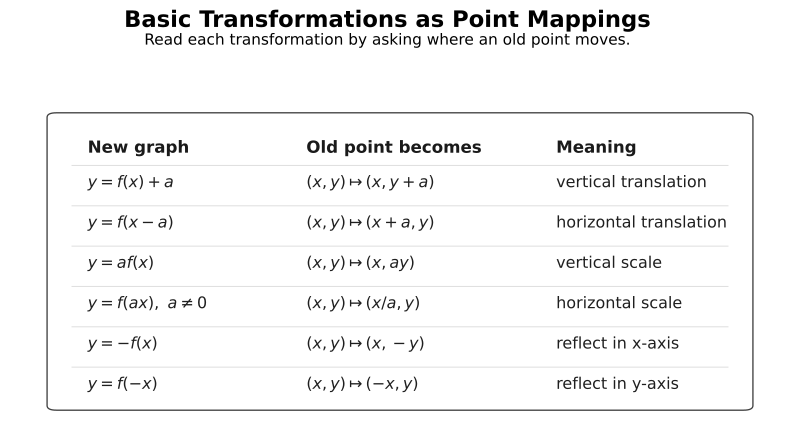 How to read this figure. Each row follows one old point to its new position. Reading transformations as coordinate mappings prevents the two most common errors: reversing a horizontal translation and forgetting that uses the reciprocal horizontal scale factor.
Modulus-Related Graphs
Modulus graphs require special care because the modulus symbol changes signs or inputs.
The three syllabus forms
and
and
do different things.
The graph of y = |f(x)|
For
the output is made non-negative.
So:
- parts of above or on the -axis stay where they are
- parts below the -axis are reflected in the -axis
This transformation acts on outputs.
Point meaning:
The domain is unchanged:
The -intercepts remain in the same positions. A simple crossing usually becomes a sharp corner, but a zero at which the original graph already touches the axis smoothly need not become sharp.
The range of is always non-negative:
However, the precise range still depends on the original graph. For example, if never reaches , then may have range such as rather than .
The graph of y = f(|x|)
For
the input is made non-negative before being used.
So:
- for , the graph is unchanged
- for , the graph mirrors the right-hand part across the -axis
This transformation acts on inputs.
The left-hand part of the original graph is ignored unless it is already the mirror of the right-hand part.
Its domain is
which need not be all real numbers.
This is a common source of mistakes. The graph of is not obtained by reflecting the negative part below the -axis. That is the behaviour of , not .
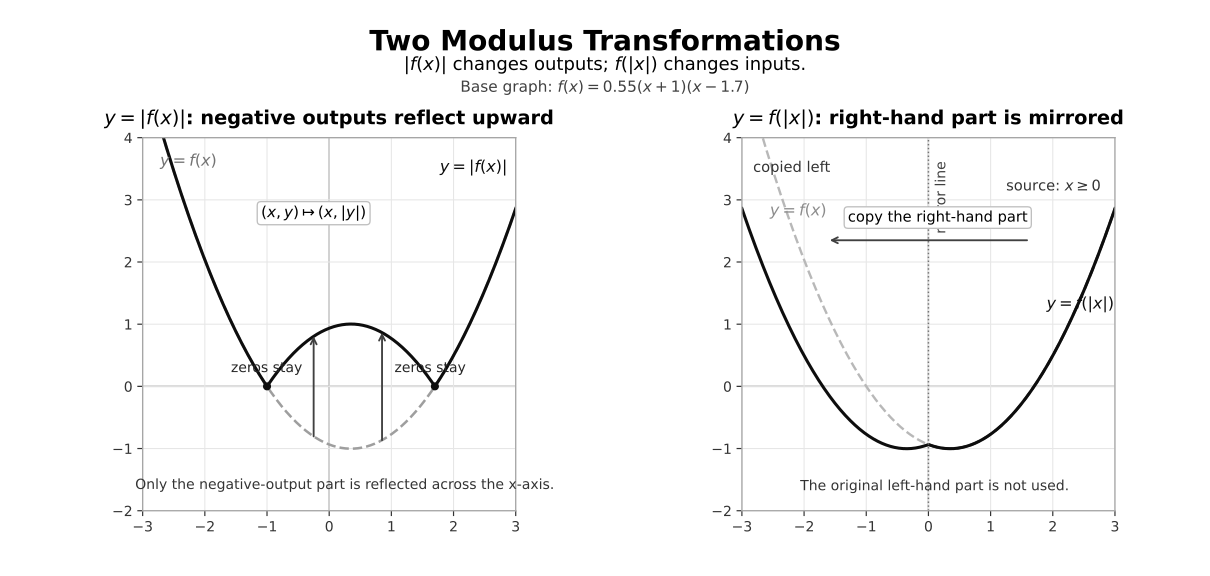 How to read this figure. The three modulus forms perform different selections. folds negative outputs upward; keeps the right-hand half and mirrors it left; first discards points with and then reflects the retained part across the -axis, generally producing a relation rather than a function.
The relation
The equation
has real points only where , because cannot be negative. At each allowed ,
Therefore:
- discard every part of below the -axis
- keep the part on or above the -axis
- reflect that retained part in the -axis
Unless the retained part lies entirely on the -axis, the result gives two -values for many inputs and is therefore a relation, not a function of .
For , the condition gives , and
The two rays meet at and are reflections in the -axis.
A concrete comparison
Let
Then
This graph is obtained from the line by reflecting the part below the -axis upward. The corner occurs at the original -intercept:
But
This graph keeps the right-hand part of and mirrors it across the -axis. The corner occurs at
So even for the simple base graph , the two modulus graphs are different:
whereas
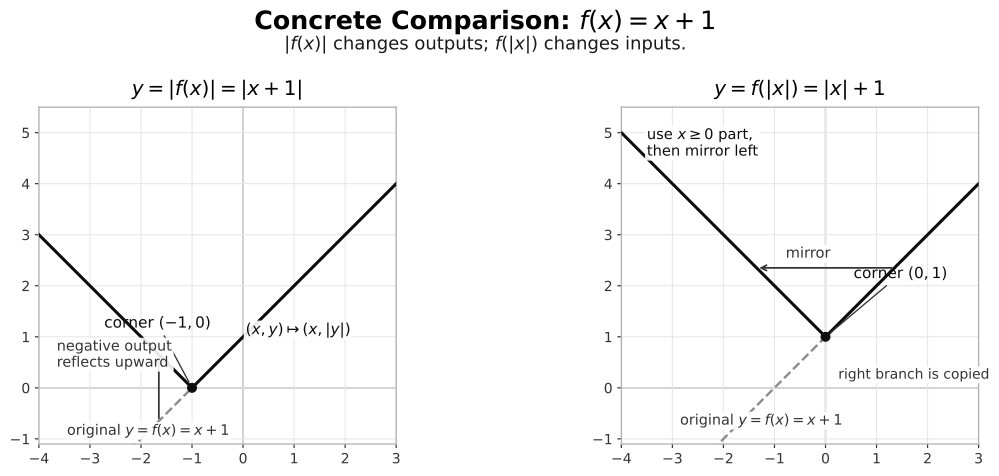 How to read this figure. For the same base line , folds at the old zero , while mirrors at the input boundary . The location of the corner reveals whether the modulus acts on output or input.
Combining Transformations
When several transformations appear together, do not rely on vague phrases such as “shift then stretch” without checking which expression is being transformed.
For example, compare
with
The first graph is easier:
- means shift right by
- multiplying by stretches vertically by factor
- adding shifts upward by
The second graph needs extra care because
The inside transformation is not simply “right by ”. It combines a horizontal scale with a horizontal translation.
A reliable method is to use point mapping.
Suppose lies on the original graph. For
we want
Solving gives
The output is
So the point mapping is
This method avoids arguing about which horizontal operation happened first.
More generally, for
with , solve
to get
The output becomes
So the point mapping is
This formula is useful, but it should not be used mechanically. The values of must be read from the exact transformed expression after any needed factorisation inside the function.
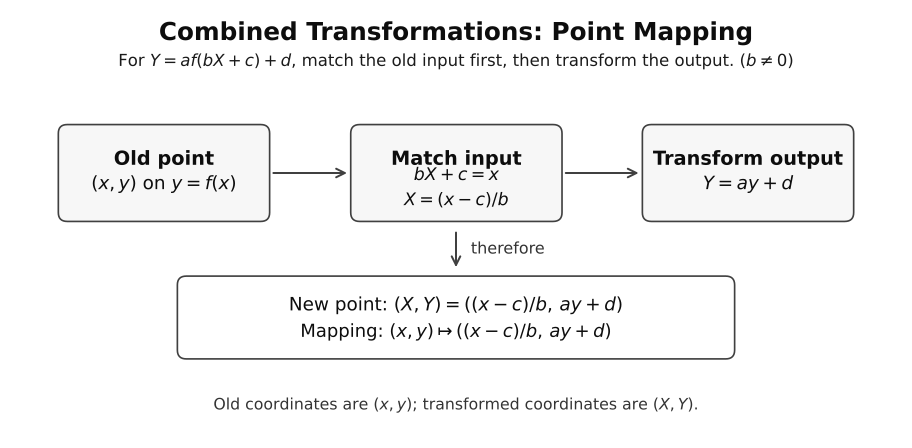 How to read this figure. For combined transformations, solving for the old input gives the safest point mapping.
Order versus point mapping
Students often ask whether the graph should be shifted first or stretched first.
For many exam questions, the safest answer is:
Use the point mapping. It automatically gives the final position.
For example, for
matching old input gives
so
This says every old -coordinate becomes
There is no need to argue verbally about whether the graph is first shifted or first compressed. The equation itself determines the final coordinate.
What Happens to Key Graph Features
Transformations should not be applied only to the visible curve. They also move the structural features that define the curve.
A complete transformed sketch should consider:
- points
- intercepts
- asymptotes
- endpoints
- holes or excluded points
- domain and range
- symmetry
This is why graph transformations belong naturally inside curve sketching. A sketch is incomplete if the curve is moved but its defining features are left behind.
Intercepts
Intercepts may move, disappear, or appear after transformation.
For example, a vertical translation may change where the graph crosses the -axis. A horizontal translation moves existing -intercepts horizontally, but a vertical stretch by a non-zero factor keeps the same -intercepts.
So intercepts should be checked from the transformed equation if exact values are required.
The safest rule is:
- transformed old intercepts are useful visual clues
- exact intercepts of the new graph should be checked using or
For example, if
then the -intercept is
provided is in the domain of .
But the -intercepts must satisfy
They are not generally obtained by simply shifting the old -intercepts upward, because points on the -axis stop being -intercepts after a vertical shift.
Asymptotes
Asymptotes transform with the graph.
If has vertical asymptote , then has vertical asymptote
If has horizontal asymptote , then has horizontal asymptote
The asymptote is not decoration. It is part of the graph’s limiting behaviour, so it must be transformed consistently.
For combined transformations, use the same point-mapping idea.
If an old vertical asymptote is
then solve the input equation
for , where is the new input fed into and .
If an old horizontal asymptote is
then transform the output:
An oblique asymptote transforms by the same substitution, not by moving two guessed points. If the old asymptote is
and the new curve is
where and ,
then its transformed asymptote is
Therefore its gradient is and its intercept is . This follows because the difference between the curve and the old asymptote tends to zero, and the same input/output mapping preserves that limiting comparison.
Domain and range
Input transformations affect the domain. Output transformations affect the range.
For example, if has domain
then has domain
If has range
then has range
The safest rule is:
- transform the domain using the input mapping
- transform the range using the output mapping
Modulus transformations should be checked separately because they may reflect, discard, or duplicate parts of the original graph.
Endpoints and holes
If the original graph has an endpoint, the endpoint is transformed like any other point.
For example, the graph of
has endpoint
For
use the old input condition
So
The output transformation is
Thus the endpoint becomes
The transformed domain becomes
and the transformed range becomes
Holes are treated in the same way. If the original graph has a hole at , then the transformed graph has a hole at the transformed point. The blank circle must be moved with the graph.
Symmetry
Transformations can preserve, move, or destroy symmetry.
For example, if is even, then it is symmetric about the -axis. The graph of
is symmetric about
not about the -axis.
If is odd, then it is symmetric about the origin. After a translation, the new graph may have rotational symmetry about a different point, or the simple odd-function test may no longer apply.
So symmetry should be checked from the transformed graph or transformed equation, not assumed from the original graph without adjustment.
Worked Examples
Example 1: Transforming a known point
Suppose lies on the graph of .
Find the corresponding point on
Let the new point be .
To use the old input , solve
So
The old output is , so
Thus the corresponding point is
Example 2: Transforming an asymptote
Suppose has horizontal asymptote
Find the horizontal asymptote of
The input change affects horizontal position, not horizontal asymptote height.
The output transformation is
So
Hence the transformed graph has horizontal asymptote
Example 3: Distinguishing two modulus graphs
Suppose has part of its graph below the -axis for .
For
that negative part is reflected upward.
For
the graph for is not obtained from the old left-hand part. Instead, it is the mirror image of the original right-hand part.
So the two graphs can be completely different even though both contain modulus signs.
Example 4: Transforming a complete set of graph features
Suppose the graph of has:
- -intercepts and
- -intercept
- vertical asymptote
- horizontal asymptote
- domain
- range
Let
We want to transform from the old graph to the new graph
Match the old input:
So
Transform the output:
Thus the point mapping is
The old -intercepts become
These are not -intercepts of the new graph; they are transformed points from the old -axis.
The old -intercept becomes
Again, this is not necessarily the new -intercept. It is the image of the old -intercept.
The vertical asymptote transforms by the input mapping:
So the new vertical asymptote is
The horizontal asymptote transforms by the output mapping:
So the new horizontal asymptote is
The domain becomes
and the range becomes
This example shows the key lesson: transforming the graph means transforming its structure, not only its visible curve.
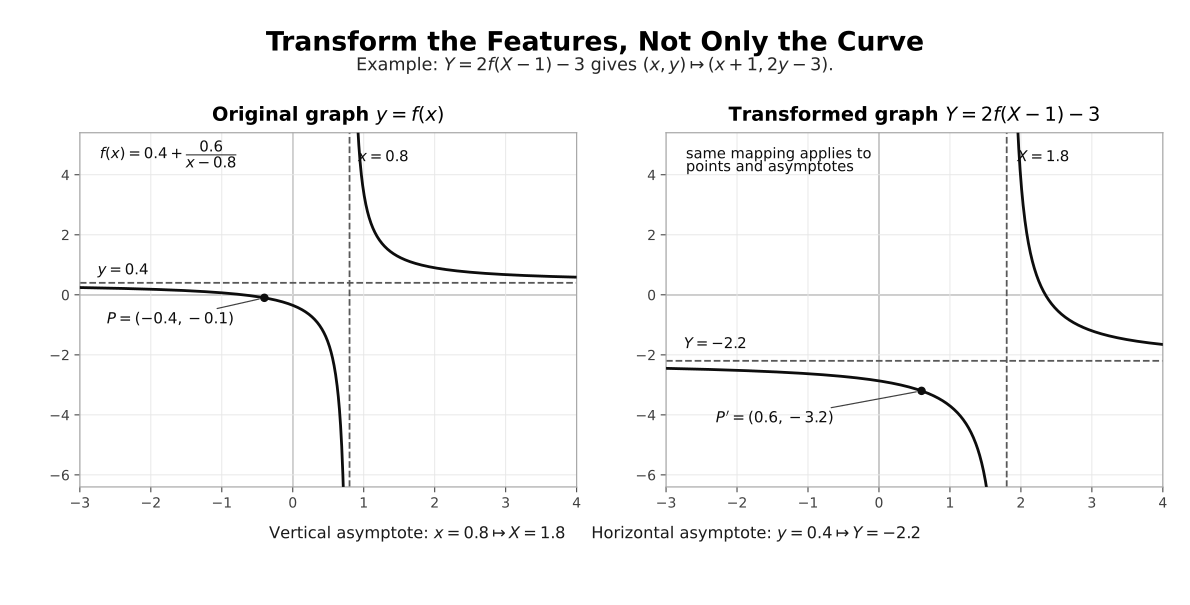 How to read this figure. A transformed sketch should move points, asymptotes, domain restrictions, range restrictions, and excluded features consistently.
Example 5: Transforming a restricted-domain graph
Consider the base graph
It has endpoint , domain , and range .
Now sketch
Let the old graph be . The new graph is
Match the old input:
so
Transform the output:
The endpoint becomes
The domain comes from
so
The old range transforms under
Since multiplying by a negative number reverses the inequality,
So the transformed graph starts at and extends to the right and downward.
A Practical Sketching Workflow
When transforming a graph, use this order.
- Identify the base graph. Decide what original graph you are transforming.
- Find the point mapping. Use old coordinates and new coordinates .
- Transform key points. Move labelled points, endpoints, holes, and useful intercepts.
- Transform asymptotes. Move vertical asymptotes using the input mapping and horizontal asymptotes using the output mapping.
- Update domain and range. Use input restrictions for domain and output mapping for range.
- Check new intercepts if required. Use and on the transformed equation.
- Check symmetry. Decide whether symmetry is preserved, shifted, or lost.
- Draw the final sketch. The curve and all labels must agree with the transformed features.
This workflow prevents a common error: drawing a plausible shifted curve but leaving the asymptotes, holes, or endpoints in the wrong places.
Common Pitfalls
1. Reversing horizontal shifts
A common error is to say that moves left by because of the minus sign.
This is wrong. Solve
Then
so the graph moves right by .
2. Treating f(ax) like af(x)
The expressions
and
act in different directions.
- changes the input, so it is a horizontal transformation.
- changes the output, so it is a vertical transformation.
3. Forgetting reciprocal horizontal scale
The graph of
is horizontally compressed by factor , not stretched by factor .
Point mapping:
If the coefficient of is negative, include the reflection as well. For example, maps
4. Mixing up |f(x)| and f(|x|)
The expression
makes outputs non-negative.
The expression
makes inputs non-negative.
Do not treat them as the same transformation.
The relation
is different again: keep only the portion where and reflect that retained portion in the -axis. It will generally fail the vertical-line test.
5. Transforming only the curve, not its features
When the curve moves, its asymptotes, intercepts, endpoints, holes, and domain restrictions move too.
A sketch is incomplete if the curve is transformed but the structural labels remain in their old positions.
6. Forgetting that transformed old intercepts may not be new intercepts
If an old -intercept is moved vertically, it will usually no longer lie on the new -axis.
So transformed old intercepts are useful points, but the new intercepts should be checked from the transformed equation when exact intercepts are required.
7. Treating modulus transformations as ordinary stretches or reflections
The transformations and are not ordinary one-to-one transformations of the whole graph.
For , negative outputs are folded upward.
For , the right-hand part is copied to the left.
This can change sharp corners, range, symmetry, and the number of intersections with a line.
Revision Checklist
Core transformation meaning
- Can I decide whether a transformation acts on input or output?
- Can I use point mapping to transform a point from ?
- Can I explain why shifts right by ?
- Can I explain why has horizontal scale factor when , with reflection if ?
Modulus graphs
- Can I sketch by reflecting negative outputs upward?
- Can I sketch by mirroring the right-hand part of the graph?
- Can I sketch by retaining only and reflecting that part in the -axis?
- Can I distinguish the two functions , from the relation ?
- Can I explain why and are usually different?
Combined transformations
- Can I use for after reading the expression correctly?
- Can I handle combined transformations by solving for the old input?
- Can I avoid relying only on ambiguous phrases such as “shift then stretch”?
Transformed graph features
- Can I transform domains, ranges, intercepts, endpoints, holes, and asymptotes consistently?
- Can I distinguish transformed old intercepts from actual intercepts of the new graph?
- Can I update a vertical asymptote using the input transformation?
- Can I update a horizontal asymptote using the output transformation?
- Can I decide whether symmetry is preserved, shifted, or lost?